By Kevin O'Marah | June 17, 2016
CSCO Outlook for 2027: Cloudy With a Chance of Moderate Growth
October 09 2026


By Kevin O'Marah | June 17, 2016
For two years now, I’ve been using a population projection from the United Nations to explore business and supply chain implications of the demographic turmoil and equilibration we’re experiencing. The chart below says three important things about the world of the 21st century:
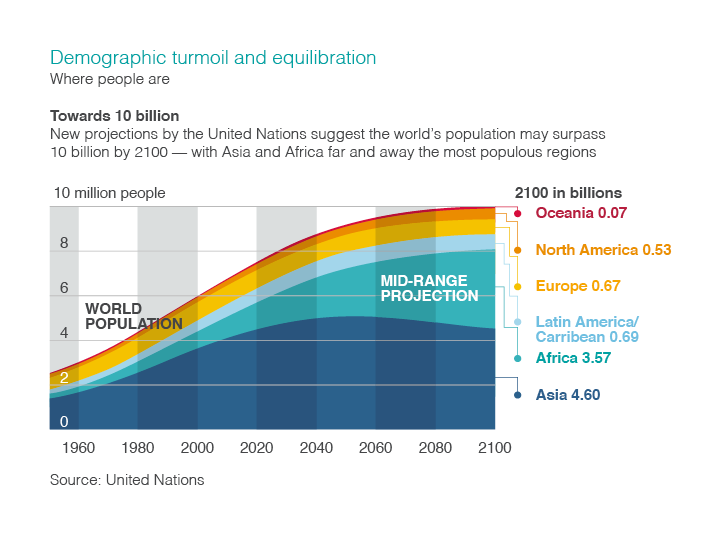
For an interactive database to examine these projections in far more detail, see the United Nations Population Division website.
Brexit, Trump, ISIS and the South China Sea
Meanwhile, news around the world bristles with tension. Traditional powers jostle with emerging powers for space at a geopolitical level, while individuals and families struggle to survive and thrive.
We see strikes in France as workers cling to fading ideas of Marxist glory. We see continued northerly migrations into the US and Europe as people flee conflict and seek economic opportunity. We see an expansive China pushing outward and a prideful Muslim world thrashing itself and its supposed enemies.
Everywhere, people are grasping for security in a time of change. Promises to turn back the clock beckon, with Trump and Brexit both offering a tantalisingly nostalgic pitch to the Anglo world and similarly strident calls from nationalists in many countries. At the same time, modern revolutionaries cry for a takedown of the status quo, from Bernie Sanders in the US to Brazilians in the streets of Rio.
It would be fair to think we’re going to tear ourselves apart, and yet I believe we can turn these same disruptive demographics into opportunity.
Finding the win-win
I’ve long argued that the world is on the threshold of a time of abundance. Last week’s column took a position in favour of universal basic income precisely because of the explosive role of technology and automation in global supply chains. It may take another 20 years, but we’ll be able to feed, clothe and care for everyone while at the same time eliminating many, if not most, existing jobs.
The transition looks difficult and short-term victims could overwhelm our sense of possibility, but the win-win lies in using these same demographic forces to our advantage. Surging new populations mean demand for a growth-starved western world, just as productive new technologies offer abundant supply to the hungry.
The key is developing a cooperative mind-set in place of our primeval urge to compete.
Supply chain people do this all the time by cooperating with suppliers or collaboratively planning with customers. In fact, an SCM World study carried out in 2013 found that collaborative trading partner relationships meant a 50% steeper learning curve for shared business processes. Similar research by John Henke in the auto industry proves superior performance improvements driven by collaborative relationships between OEMs and tier suppliers.
The hope lies in adopting this principle on a grander scale.
What can we do?
This column is written for supply chain people, so let’s stick with that.
First of all, we can resist short-term thinking by applying network modelling analytics to longer time horizons. Financial markets, and therefore CEOs, generally want payback on supply chain investments within two years. This is too short for some of the complex platforms that we are contemplating in food manufacturing, medicines and energy. Rigorous analysis might earn the right to build growth businesses in emerging markets that can weather the turmoil and deliver long-lasting profit streams.
Second, we can build diversity into our organisations. The push for gender diversity in supply chain is intense. One of the main reasons is that diverse groups make better decisions. Wouldn’t this also apply to global diversity?
Finally, we can demonstrate the power of collaboration. Combative procurement techniques are known to destroy value, and yet some are still forced by bosses to do just that. Proving the profitability of joint value creation could open some eyes while helping hit immediate business goals.
The century ahead looks tumultuous. Approaching it with hostility fans the flames of conflict. Looking for the win-win could ease the tension.
Beyond Supply Chain
Subscribe on LinkedIn to receive the biweekly Beyond Supply Chain newsletter.