Not every organization needs to be AI-first, yet every organization can learn from how AI-first companies invest.
- Gartner client? Log in for personalized search results.
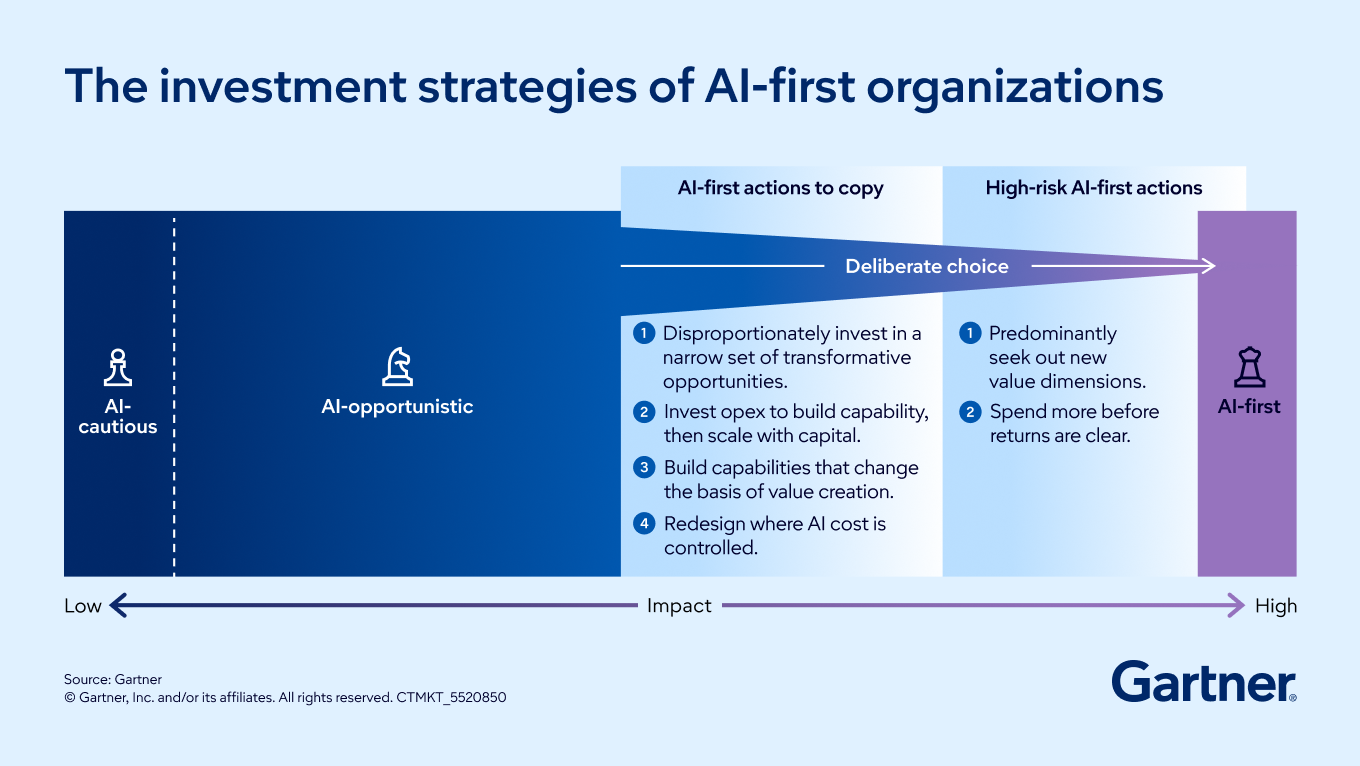
AI-first is a strategic choice, not an inevitable outcome
Only 19% of organizations report significant business value from AI investments, while 49% report little to no value. The organizations seeing the greatest returns are not necessarily deploying the most AI. They are making deliberate choices about where AI can create competitive advantage.
Gartner identifies three AI investment postures: AI-cautious, AI-opportunistic and AI-first. Organizations often move between AI-cautious and AI-opportunistic approaches as their confidence, capabilities and experience evolve. AI-first organizations, however, make an intentional choice to pursue larger investments and significant operating changes in search of future competitive advantage. Not every organization should become AI-first. But every organization should understand the investment principles that distinguish AI-first organizations from their peers.
“AI-first organizations’ intentional discipline allows them to make high-risk AI investments that may not be palatable to everyone,” notes Johanna Robinson, Practice Vice President and Chief of Research at Gartner.
You might also like this webinar: How to Identify, Fund and Measure High‑Value AI Use Cases
Four AI-first practices every organization can adopt
Organizations do not need to become fully AI-first to benefit from the lessons of AI-first companies. Here are four practices that every organization can adopt to pursue AI with greater discipline and position themselves for future value creation.
Concentrate investment on transformative opportunities
AI-first organizations invest narrowly rather than broadly. Rather than scattering resources across numerous low-risk productivity initiatives, they focus investment on a small number of strategically critical opportunities tied directly to competitive advantage.
These investments are designed to unlock new growth opportunities or fundamentally reshape the organization’s cost structure. Doubling down on what truly matters, these organizations elevate AI from a tool for incremental improvement to a force that drives structural advantage and long-term differentiation.
Build capability before scaling investment
AI-first organizations treat AI as a long-term capability investment rather than a source of immediate returns. They fund early efforts through operating budgets, giving teams time to build foundations and validate where value emerges before scaling.
Rather than making one-time funding decisions, they use staged investment models tied to demonstrated progress. Organizations generating high ROI from AI investments spend four times more, as a percentage of revenue, on data and context, governance and security, and people foundations than organizations that do not.
Invest in capabilities that compound value
AI-first organizations avoid funding disconnected use cases. Instead, they invest in reusable capabilities such as platforms, data architectures, orchestration layers and shared workflows that support future initiatives.
Each investment strengthens a common foundation that can be reused across the enterprise. By improving data availability, quality and integration early, they create conditions for AI value to scale and compound over time.
Design cost and performance from the start
AI-first organizations recognize that cost and performance are determined largely by design decisions made before deployment. Model selection, orchestration choices and execution patterns all influence both outcomes and spending.
This discipline is increasingly important because AI introduces persistent and often unpredictable costs. While model unit costs may decline, total task costs can rise as usage expands. AI-first organizations respond by making these trade-offs explicit, monitoring economics continuously and incorporating life cycle cost considerations into their business cases.
AI-first organizations FAQs
What is an AI-first organization?
According to Gartner, an AI-first organization deliberately chooses where AI can create competitive advantage and is willing to make the investment and operating changes required to pursue that opportunity. Becoming AI-first is a strategic choice rather than a natural outcome of AI adoption.
How is an AI-first organization different from other organizations using AI?
Gartner identifies three AI investment postures: AI-cautious, AI-opportunistic and AI-first. Organizations can drift into AI-cautious and AI-opportunistic approaches, but becoming AI-first requires an intentional decision to accept higher costs and significant organizational change in pursuit of future advantage.
What practices do AI-first organizations use to create value?
While AI-first organizations’ intentional discipline allows them to make very high-risk AI investments that may not be palatable to everyone, such as seeking out new value dimensions and spending more before returns are clear. There are four common AI-first practices all organizations can adopt: concentrating investment on transformative opportunities, building capability before scaling investment, investing in reusable capabilities that compound value, and designing cost and performance into systems from the outset. These practices help organizations pursue AI opportunities with greater discipline and long-term focus.
Attend a Conference
Join Gartner analysts and your peers to accelerate growth
Gather alongside your peers in National Harbor to gain insight on emerging trends, receive one-on-one guidance from a Gartner analyst and create a strategy to tackle your priorities head-on.
2 – 4 Jun 2027
Gartner Finance Symposium/Xpo™
National Harbor, MD

Drive stronger performance on your mission-critical priorities.