AI-first success demands more than models — it requires six bold shifts in how work gets done, how to build and scale, and how to govern for trust and value.
- Gartner client? Log in for personalized search results.
AI-First Transformation: What Every Chief Data and Analytics Officer Must Do
By Rita Sallam | June 10, 2026
AI-first transformation starts with data and analytics leadership
You can’t wait for AI success to “just happen.” Chief data and analytics officers (CDAOs) must lead the charge, moving beyond incremental adoption to reimagine business models and processes with AI at their core. Organizations that report successful AI initiatives share a common attribute; they invest up to four times more in foundational areas, such as data quality, governance, AI-ready people and change management, compared with those that experience poor outcomes from AI. This means going beyond adding models to building a foundation of high-quality, trusted and context-rich data accessible to both humans and AI agents.
You might also like this webinar: Data and Analytics 2030: The Vision for an AI‑Native Enterprise
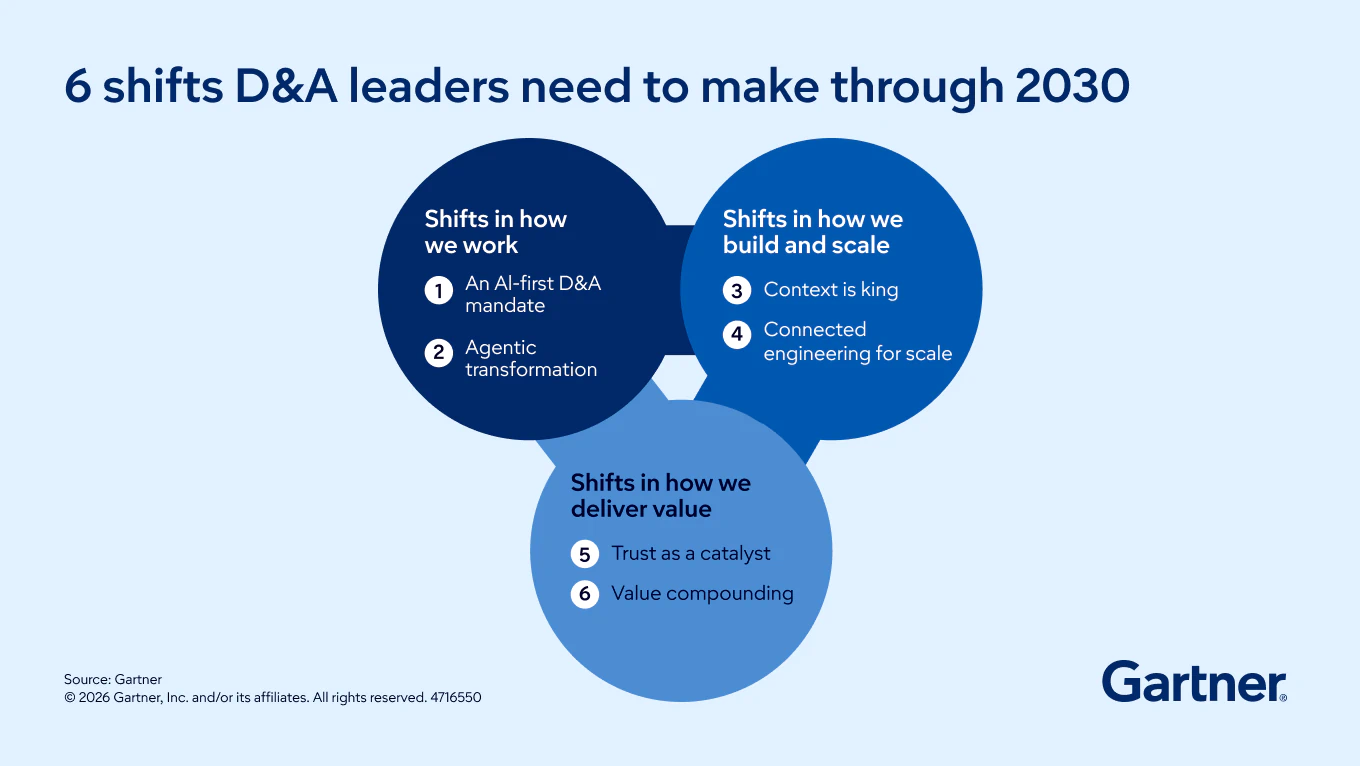
Six shifts to unlock AI-first value by 2030
AI-first isn’t a buzzword — it’s a mandate. Here’s how you get there:
Adopt an audacious AI-first mindset for D&A.
AI-first organizations embed AI into every business decision and process. This means shifting behaviors and work, not just technology, to use AI to transform. You need to position AI as a primary driver of innovation and competitive advantage and align efforts to match your organization’s AI ambition. Start by challenging legacy linear thinking and incentivizing teams to experiment with AI-driven solutions. The goal: Make AI innovation the default, not the afterthought.
Redesign for human-agent collaboration.
The most successful D&A organizations build agile, multidisciplinary smaller teams. Gartner analysts call them “questionneers” — broad-skilled technology-and-business-expert humans who work alongside AI specialist agents. This approach amplifies human ingenuity, focuses on outcomes and leverages the complementary strengths of people and machines. You’ll see faster problem-solving and more creative solutions.
Establish context as critical infrastructure.
Context isn’t optional. Semantics, metadata and knowledge graphs are essential infrastructure that enable AI agents to reason, adapt and deliver trusted intelligence. Think of using context as infrastructure to give AI agents context awareness of your business that enhances both human and machine decision making.
Scale connected engineering practices.
Siloed data and ad hoc AI projects are not enough. Instead, integrate data, AI, software and context engineering to deliver composable, reusable and autonomous data and AI products that drive agility and innovation.
Build trust as the foundation for innovation.
Governance models must ensure AI outcomes are trustworthy and aligned with your values and regulatory requirements. Embed controls directly into workflows and make transparency and continuous monitoring a core principle.
Go beyond ROI to value compounding.
Shift from a traditional focus on ROI to creating a “value flywheel” where efficiency gains from high-impact investments are intentionally reinvested into growth and innovation. The currency of success changes from “time saved” to “time transformed into money.”
Action steps for CDAOs to drive AI-first success
Overhaul governance to embed automated, adaptive and transparent controls for compliance, privacy and bias.
Shift from traditional ROI metrics to a “value flywheel” that reinvests efficiency gains into further innovation.
Invest in new metrics, adaptive governance and continuous learning to keep pace with AI’s evolution.
What’s next in AI-first transformation?
Planning and implementing changes to data and analytics practices and operations is just one critical step in the CDAO’s mandate to evolve the AI-ready data and analytics architecture.
The other steps in this imperative include:
Assess gaps in AI-readiness and develop strategies to close those gaps.
Build the business case to secure funding for investments in AI-ready data and analytics.
Define and demonstrate the value of AI readiness for data, governance and people.
Evaluate technologies, platforms and architectures needed to support specific AI-ready data requirements.
Evolve data management practices to scale AI-ready data.
Government leaders are exploring many of the same AI opportunities, but within a distinct environment of public accountability, regulation and mission outcomes. Discover how public sector executives are turning AI investments into measurable value while managing risk and building stakeholder trust.
AI-first FAQs for chief data officers
What does “AI-first” mean for my data strategy?
AI-first means making AI the default lens for every data and analytics decision. This requires high-quality, trusted and context-rich data accessible to both humans and AI agents. It’s not just about more models — it’s about rethinking your entire approach to data, governance and value creation.
How do I measure success in an AI-first organization?
Move beyond traditional ROI by focusing on a “value flywheel,” where efficiency gains are reinvested into innovation and growth. Success is measured by compounding business value, not just cost savings or time saved.
What’s the biggest risk if I delay AI-first transformation?
Organizations that wait to adopt AI-first strategies risk losing competitive advantage, missing out on innovation and struggling to meet regulatory demands. Early action positions you to thrive as AI reshapes your industry.
What should I do next to make data and analytics AI-first by 2030?
As AI rapidly reshapes data and analytics, leaders must treat AI as a strategic driver, shifting behavior and how people work and make decisions, not just technology, and using AI to transform. This imperative marks the starting point of a broader journey CDAOs must make to shift how the D&A team works, scales and creates value.
Attend a Conference
Accelerate growth with Gartner conferences
Gain exclusive insights on the latest trends, receive one-on-one guidance from a Gartner analyst, network with a community of your peers and leave ready to tackle your mission-critical priorities.

Drive stronger performance on your mission-critical priorities.