Organizations face AI-related exposure under a wide range of existing legal, regulatory and industry requirements, not just emerging AI legislation.
- Gartner client? Log in for personalized search results.
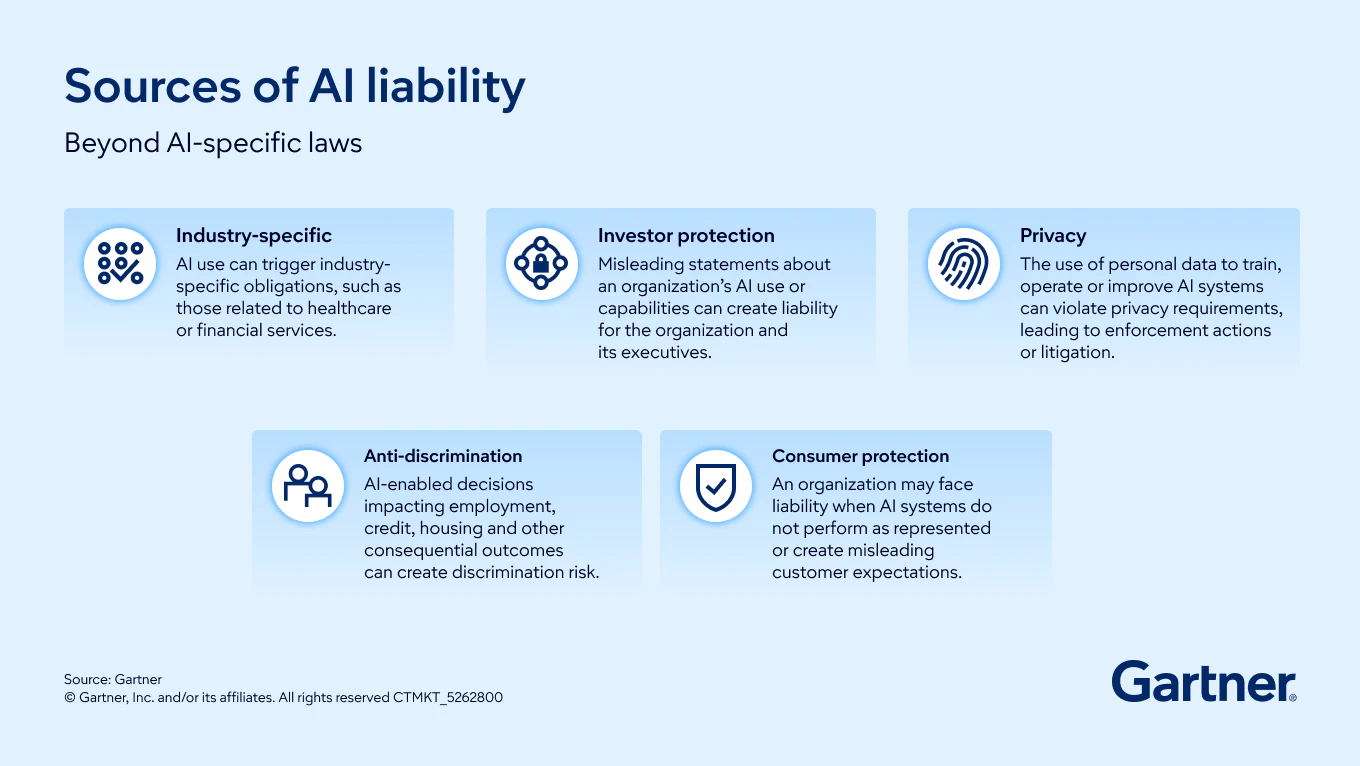
AI liability extends beyond AI-specific regulations
AI governance programs are often narrowly focused on emerging regulations, such as the EU AI Act. While compliance with AI-specific laws remains critical, it represents only part of the risk landscape. Organizations face growing exposure under long-standing legal and regulatory frameworks that were not written for AI but are increasingly being applied to AI-enabled decisions, practices and outcomes.
For CIOs, that means AI governance cannot focus solely on checking AI-specific regulatory boxes. It must also address how AI systems intersect with privacy, consumer protection, discrimination, investor protection and industry-specific requirements. As agentic AI becomes more autonomous, managing these risks will become even more critical. Gartner Senior Director Analyst Var Shankar explains, “Though legal departments generally own AI liability, CIOs play a key role in reducing liability through system architecture, governance mechanisms and technical controls.”
You might also like this webinar: How Ready Is Your Organization for Agentic AI and AI Agents?
How CIOs can reduce AI liability
CIOs must work closely with legal, compliance and risk teams to reduce AI liability across the enterprise. Clear accountability, evidence of responsible AI use, strong vendor controls and adoption of an agent governance framework can help reduce AI liability, regardless of legal jurisdiction.
AI liability has many sources
Though AI-specific laws around the globe are important to monitor as they shape global AI governance discussions, they are not the only source of litigation risk.
Recent enforcement actions and litigation show that regulators and courts increasingly rely on existing industry-specific laws and legal frameworks, including those for investor protection, privacy, antidiscrimination and consumer protection, to AI use.
Sources of liability include:
- Industry-specific: Healthcare and financial services regulators are applying existing sector laws to AI-enabled decision-making processes.
- Investor protection: AI washing has emerged as a growing source of legal exposure. AI-related securities class actions reached a record 16 filings in 2025.
- Privacy: Existing privacy regulations have already produced some of the largest AI-related penalties.
- Antidiscrimination: Courts are increasingly applying longstanding antidiscrimination laws to AI-enabled hiring and employment decisions.
- Consumer protection: Organizations can face liability when AI products or services are marketed with inaccurate claims regarding performance or business outcomes.
Key steps to reduce AI liability now
CIOs can take practical steps to reduce exposure:
- Assign clear roles for AI governance and compliance across the C-suite. No single function can address all sources of AI liability, so CIOs should take the lead in outlining responsibilities for themselves, while helping to define roles for general counsel, compliance and risk leaders.
- Document evidence of risk reduction for every AI system. Track system components, risk analyses, impact assessments, bias tests and human involvement to show auditors that controls are in place.
- Strengthen vendor contracts with AI guardrails. Though most AI is bought rather than built, buying organizations own most of the deployment risk. Negotiate testing, audit rights, indemnification and liability allocation with vendors. Require vendors to support validation, monitoring and incident investigations.
- Adopt an agent governance framework. As AI agents become more autonomous, multidisciplinary oversight is essential. Align governance with emerging regulatory guidance to keep agentic systems within legal and organizational boundaries.
Stay ahead of evolving AI regulations
The compliance landscape will only become more complex as additional provisions of the EU AI Act and new AI regulations take effect around the world. CIOs who account for both AI-specific requirements and broader legal obligations will be better positioned to reduce risk and build trust. Regulatory approaches continue to vary by jurisdiction, with governments adopting different requirements based on AI use cases, risk levels and organizational responsibilities. As a result, organizations must monitor developments across multiple markets and adapt governance programs as obligations evolve. Proactive governance, clear documentation and strong vendor controls are essential for staying ahead of emerging compliance, enforcement and litigation risks.
AI liability FAQs
What is AI liability?
AI liability refers to an organization’s legal, regulatory and financial exposure arising from the development, deployment or use of AI systems. Liability can originate from AI-specific regulations such as the EU AI Act, as well as existing legal frameworks including privacy, consumer protection, antidiscrimination, investor protection and industry-specific laws.
How can CIOs reduce AI liability?
CIOs can reduce AI liability by establishing clear governance responsibilities, creating evidence of risk reduction for AI systems, incorporating AI guardrails into vendor contracts and adopting governance frameworks for agentic AI. These measures help demonstrate responsible AI use and support compliance across multiple legal regimes.
Why is AI liability not limited to the EU AI Act and other AI-specific laws?
AI liability extends beyond the EU AI Act and other AI-specific laws because regulators and courts increasingly apply established legal frameworks to AI-related activities. For example, recent enforcement actions and litigation have involved existing privacy laws, antidiscrimination laws, consumer protection requirements, investor protection regulations and industry-specific compliance obligations.
Attend a Conference
Accelerate growth with Gartner conferences
Gain exclusive insights on the latest trends, receive one-on-one guidance from a Gartner analyst, network with a community of your peers and leave ready to tackle your mission-critical priorities.

Drive stronger performance on your mission-critical priorities.