Employees gain confidence with AI when they apply it to real finance work.
- Gartner client? Log in for personalized search results.
AI training isn’t changing how work gets done
Your finance employees have been trained on AI tools, but adoption is still lagging. Many employees remain uncertain about how AI fits into their day-to-day work, while others hesitate because they fear misuse or failure, lack hands-on support or struggle to see AI’s relevance to their responsibilities.
“Employee reluctance to adopt AI is often due to their uncertainty about how to apply new tools and data, fear of misuse or failure, a lack of hands-on support and low perceived relevance to their daily work,” says Hilary Richards, Vice President Analyst at Gartner.
You might also like this webinar: AI at Work: Why AI Efforts Stall — And How to Fix Them
AI capability is a work design challenge
“The fastest way to fall behind is to treat AI skills as a training gap instead of a work design problem,” says Richards. Employees build AI capability more effectively when AI becomes part of the work itself.
Employees need to see where AI fits
Finance employees often struggle to connect AI capabilities to the responsibilities, decisions and workflows that occupy most of their day. This lack of perceived relevance is one of the barriers slowing AI adoption. While training may increase awareness of AI, employees often leave with little clarity on how to apply it to their work.
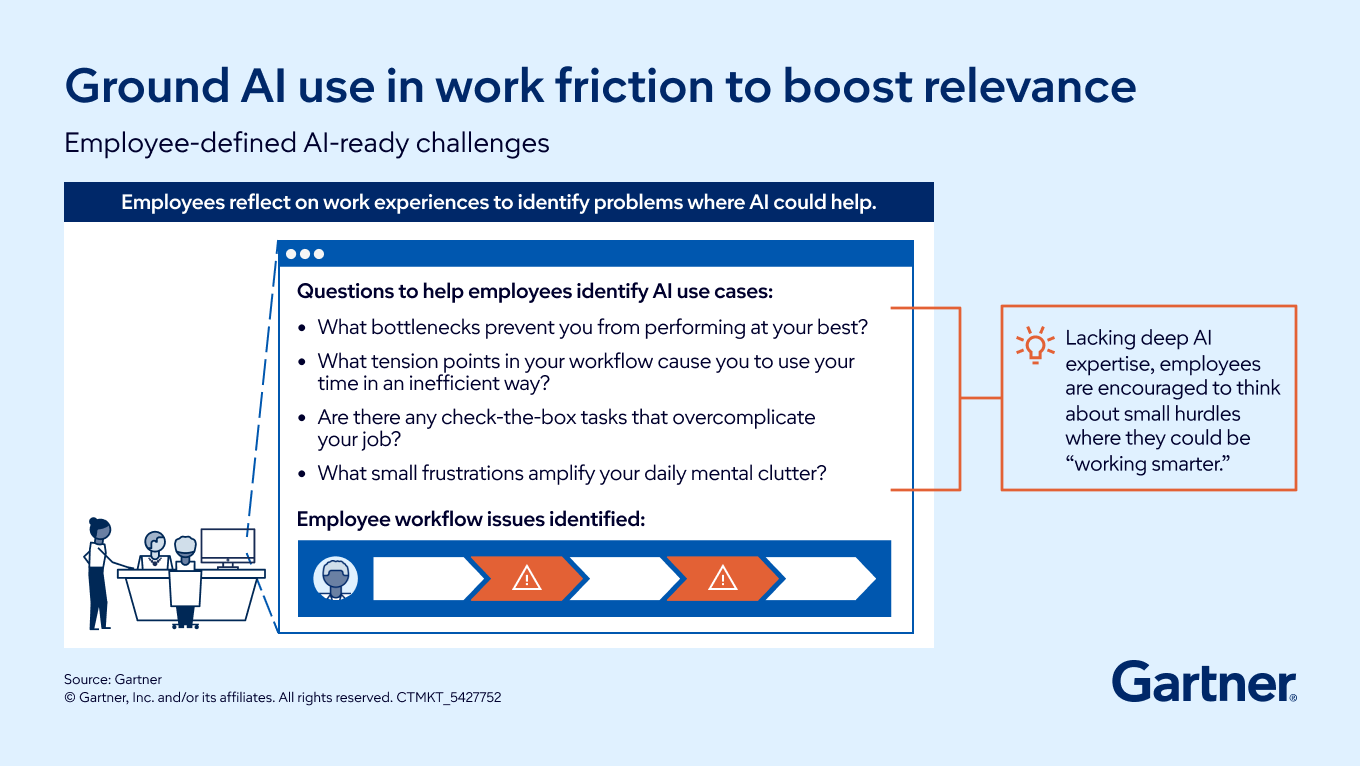
To combat this, Gartner recommends CFOs anchor AI learning in workflow friction. Repetitive tasks, process bottlenecks and manual handoffs give employees practical opportunities to apply AI to problems they already need to solve. Learning becomes more relevant when it’s tied directly to work.
Real work builds capability
People do not build AI skills by studying AI in isolation or attending training programs. Effective AI upskilling occurs when employees apply new capabilities to everyday finance activities. They also develop AI capability more quickly when they learn by solving their own problems through supported experimentation. Practical experience helps employees understand how AI performs, where it can accelerate work and where human judgment remains essential.
Work design determines whether adoption scales
Organizations can redesign roles so AI performs an initial pass while finance employees review outputs, challenge assumptions, investigate exceptions and explain what the numbers mean. When AI becomes part of everyday work rather than a separate activity, capability develops more naturally. Employees learn where AI adds value, where it breaks down and when human judgment needs to step in.
AI adoption FAQs
Why isn’t AI training leading to AI adoption?
Employees often struggle to apply AI after training because they are uncertain how to use it, fear misuse or failure, lack hands-on support or do not see its relevance to their daily responsibilities. Gartner also finds that AI skills decay without practical application in real workflows.
How can finance organizations improve AI adoption?
Gartner recommends embedding AI learning into finance work, anchoring learning in workflow friction and helping employees solve real business problems through supported experimentation.
Why does work design matter for AI adoption?
Employees develop AI capability more effectively when AI is integrated into their day-to-day responsibilities. Redesigning work so employees regularly use AI helps capability develop naturally through application.
Attend a Conference
Join Gartner analysts and your peers to accelerate growth
Gather alongside your peers in National Harbor to gain insight on emerging trends, receive one-on-one guidance from a Gartner analyst and create a strategy to tackle your priorities head-on.
2 – 4 Jun 2027
Gartner Finance Symposium/Xpo™
National Harbor, MD

Drive stronger performance on your mission-critical priorities.