Token waste is the new digital debt. Websites that are overloaded with visual excess for humans will limit growth for tech CEOs.
- Gartner client? Log in for personalized search results.
AI is becoming the first evaluator of technology providers
The 2026 Gartner Technology Buying Behavior Survey finds that 89% of B2B buyers now leverage AI in the buying process. As enterprise AI agents increasingly support early-stage research and vendor discovery, website token efficiency has become a business issue, not just a technical one.
Gartner Director Analyst Erin Gordon explains, “Websites have traditionally been optimized for human visitors, prioritizing brand aesthetics and visual hierarchy. But that design paradigm translates to a financial burden for AI: Every unnecessary image, script and formatting tag carries a metadata tax that drives up retrieval costs.” While major search engines and LLMs can often filter out this noise, many private enterprise research agents operate within strict token budgets. When those limits are reached, agents may truncate content, skip pages or misinterpret information. As a result, critical differentiators can be overlooked before potential buyers ever engage with a sales team.
How token efficiency drives revenue and visibility while lowering costs
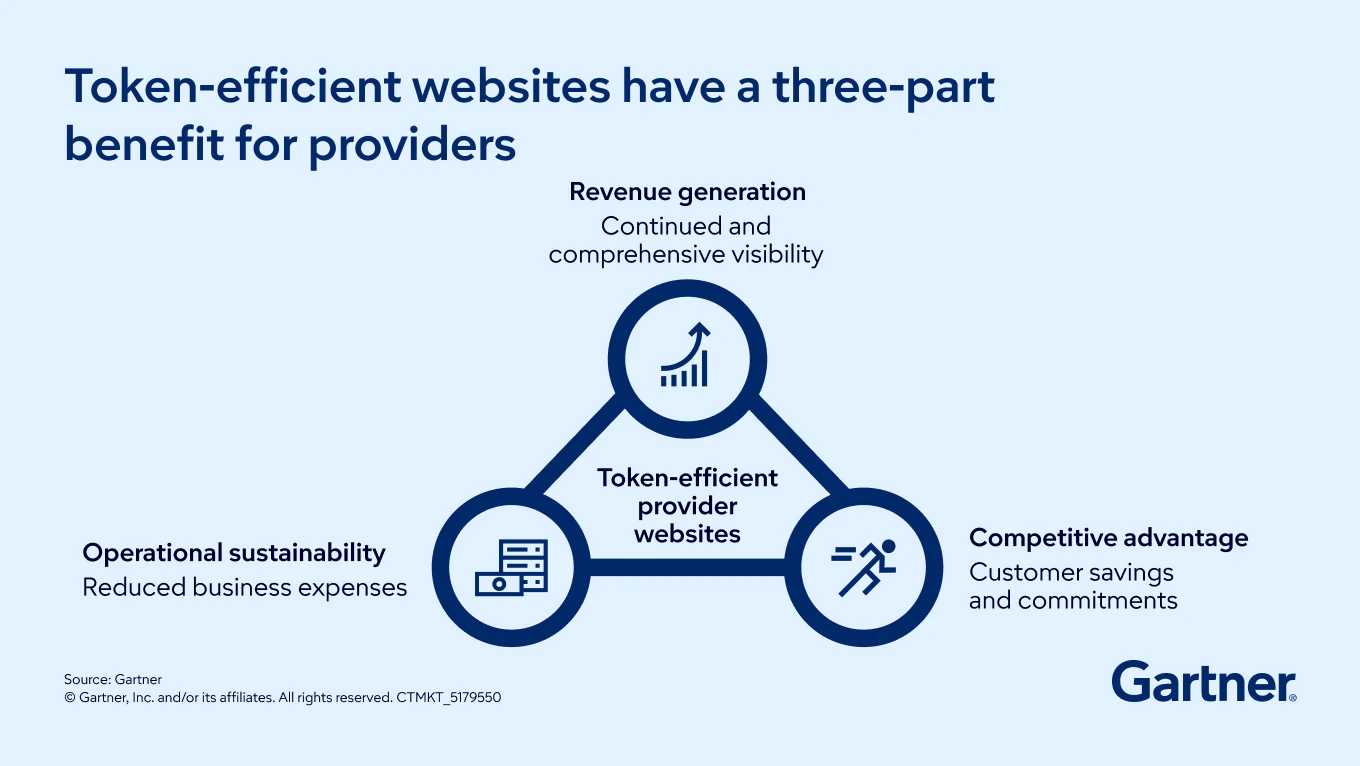
In the context of go-to-market messaging, token efficiency is emerging as a key driver of revenue generation, operational sustainability and competitive advantage. Tech CEOs who ignore it risk losing visibility during AI-mediated discovery, while those who optimize for it can improve buyer access to their most important content.
Revenue generation depends on AI visibility
As AI becomes a primary research tool, website content effectively becomes commercial infrastructure. Enterprise AI agents often rely on sitemaps and operate within fixed token budgets. If a page is overly complex or contains excessive visual and formatting overhead, agents may partially ingest the content or omit it entirely.
The consequences are significant. Buyers do not see an error message when this happens. Instead, they receive summaries that can exclude key product capabilities, proof points, competitive differentiators or the solution entirely. Providers may be removed from consideration before reaching a shortlist.
Gartner predicts that through 2027, tech CEOs who ignore token efficiency across their digital properties will miss 30% of their potential shortlists. Maintaining a high token-to-fact ratio helps ensure product information, pricing signals and differentiators remain visible and retrievable across AI platforms.
Operational sustainability reduces expenses
Token efficiency lowers costs across both website operations and content production.
For provider websites, leaner digital experiences can deliver benefits such as:
Lower infrastructure and bandwidth costs through smaller page payloads
Faster page performance that improves engagement and conversion
Greater scalability because each AI request consumes fewer tokens
Reduced content generation and maintenance overhead for AI-assisted workflows
The benefits extend beyond website delivery. Content creation remains the top AI use case for marketing teams in organizations with annual revenue between $10 to $100 million. Reducing unnecessary content complexity can lower token consumption throughout the content life cycle, cutting production effort.
Competitive advantage comes from customer savings and commitments
Token efficiency can also become a customer-facing value proposition. By reducing the resources required for AI systems to process their content, providers lower customers’ inference costs across the buying journey. This positions the organization as a more efficient and cost-conscious partner.
The opportunity extends beyond economics. Lean, machine-readable websites align with growing interest in Green AI initiatives and Scope 3 emissions goals. Organizations that demonstrate efficient digital operations can reinforce their sustainability credentials while signaling operational discipline and responsible resource consumption to the market.
Similar to ESG commitments in the early 2020s, token efficiency may become a brand factor buyers and evaluators increasingly incorporate into decision-making criteria. The business impact comes not from the efficiency itself, but from how it influences visibility, consideration and partner selection.
Adopt a bimodal web strategy to survive website token economics
Improving token efficiency does not require eliminating rich digital experiences. Instead, tech CEOs should adopt a bimodal web strategy that balances AI optimization with human engagement.
- Early-stage buying content should prioritize token efficiency: Product overviews, competitive comparisons and differentiation summaries should be streamlined for AI ingestion with strong signal density and minimal unnecessary overhead.
- Later-stage content should continue to support deeper human engagement: Case studies, implementation resources, ROI tools, interactive demos and pricing content can retain visual richness and interactive functionality for buyers who are actively and directly evaluating suppliers.
The goal is not to choose between machines and humans. The most effective websites support both. Organizations should also avoid creating separate AI-only website versions or relying on llms.txt files as a primary strategy. Maintaining parallel content experiences introduces versioning risks and messaging inconsistencies that can result in visibility challenges. Instead, focus on building a single, well-structured experience that supports both AI retrieval and human engagement on a page-by-page basis.
Token efficiency FAQs
What is token efficiency?
Token efficiency is the practice of maximizing useful information while minimizing the tokens required for AI systems to process content. For websites, this means reducing unnecessary visual, structural and formatting overhead so AI agents can retrieve and understand important information more effectively.
Why is token efficiency important for B2B technology providers?
Token efficiency helps ensure AI systems can accurately retrieve product information, differentiators and proof points during buyer research. Gartner predicts that through 2027, tech CEOs who ignore token efficiency across their digital properties will miss 30% of their potential shortlists, making visibility in AI-mediated discovery a direct business concern.
How can organizations improve token efficiency without hurting user experience?
Organizations should adopt a bimodal web strategy. Early-stage discovery content should prioritize signal density and machine readability, while later-stage buying content can preserve rich visuals, interactive experiences and detailed engagement tools. This approach supports both AI-driven discovery and human decision making.
Attend a Conference
Accelerate growth with Gartner conferences
Gain exclusive insights on the latest trends, receive one-on-one guidance from a Gartner analyst, network with a community of your peers and leave ready to tackle your mission-critical priorities.

Drive stronger performance on your mission-critical priorities.