Malaysian CIOs face more favorable conditions than many of their peers when it comes to establishing themselves as digital leaders, according to Gartner Inc.’s 2016 CIO Survey.
While the survey found that global IT budgets are fairly static compared to 2015, with an average growth of just over two percent, Malaysia shows an average change in total IT budgets of eight percent. Furthermore, compared to their global peers, Malaysian CIOs have more control over their enterprise's IT investments and can leverage this to strengthen their position as digital influencers.
Gartner’s 2016 CIO Agenda survey asked 2,944 CIOs worldwide about their top digital business opportunities, threats and strategies, with responses from 103 CIOs in Southeast Asia including 43 from Malaysia. Data from the 2016 survey shows that globally, the average CIO is expecting digital revenues to grow from 16 to 37 percent in the next five years. In the Southeast Asia region, CIOs expect to see digital revenues grow from 15 to 38 percent in the same period, indicating that they are poised to make the most of digital business opportunities.
“Malaysian CIOs are seeing their IT budgets increase, they are leading in digital initiatives and innovation, and there is a growing recognition from Malaysian businesses of the importance of digitalization for competitive advantage,” said Bard Papegaaij, research director at Gartner.
“This doesn’t mean CIOs in Malaysia can just wait for things to go their way. They face a looming skills shortage, they need to keep working on growing their influence and power and they must take the lead in shaping the best possible circumstances for their enterprises to thrive as digital businesses.”
Spending Priorities
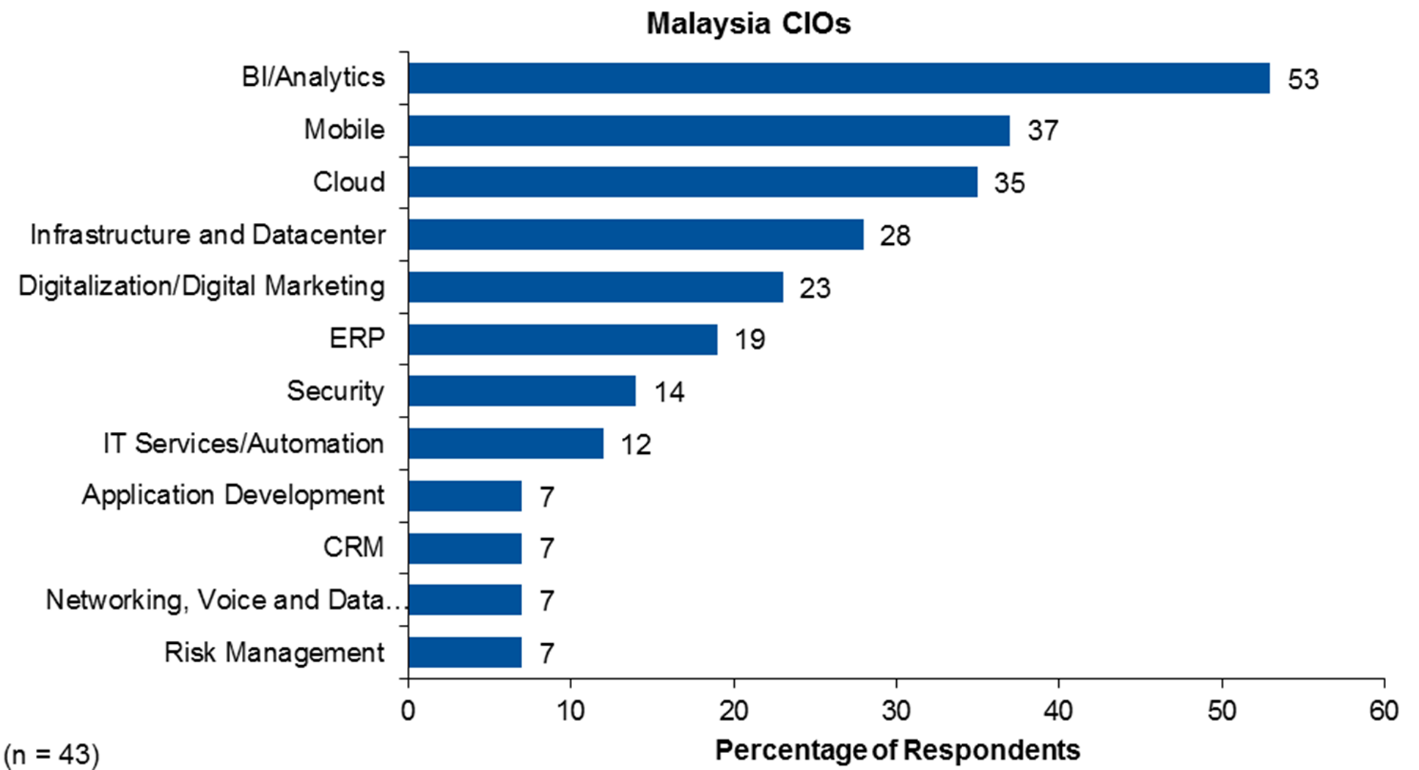
The survey revealed the top areas of new technology spending in Malaysia to be on BI/analytics, mobile and cloud (see Figure 1). With 35 percent cloud spending compared to a global percentage of 25 percent, it seems that Malaysian CIOs are leading the way in freeing up budgets and creating the flexibility for a more digital focus by reducing their investment in internal infrastructure and data centers.
“The need to innovate is driving penetration and deepening of the bimodal construct, where two separate, coherent modes of IT delivery are managed – one focused on stability and the other on agility,” said Poh-Ling Lee, vice president and executive partner at Gartner. “With a larger increase of IT spending under their control than most of their global peers, Malaysian CIOs have more room to invest in setting up and developing bimodal capabilities. By using the extra room in their IT budgets this way, they can help their organizations reap the benefits of digitalization sooner than the competition.”