By Kevin O'Marah | March 14, 2013
CSCO Outlook for 2027: Cloudy With a Chance of Moderate Growth
October 09 2026


By Kevin O'Marah | March 14, 2013
Four of the world’s 20 largest nations by population are in Africa. All are bigger than France, the UK, Italy or South Korea. Their respective annual GDP growth rates over the past decade are 7.5%, 8.9%, 4.6% and 6.2%. Can you name them?
The Dark Continent has for all of my working life been looked upon as a virtual non-starter from a business perspective, relegated during most strategic planning discussions to the end of the PowerPoint deck as a footnote buried in “Rest of World”. Recently, however, SCM World community members as diverse as consumer packaged goods, mobile devices, heavy cranes and petroleum have come looking for ways to learn more and faster about this suddenly critical part of the global market.
The problems in Africa still loom large for many. Corruption, political instability, poor infrastructure and tricky cross-border trade restrictions are especially challenging from a supply chain perspective. Change however is underway with democracy steadily gaining ground and the rule of law relatively stable for more than half of the continent.
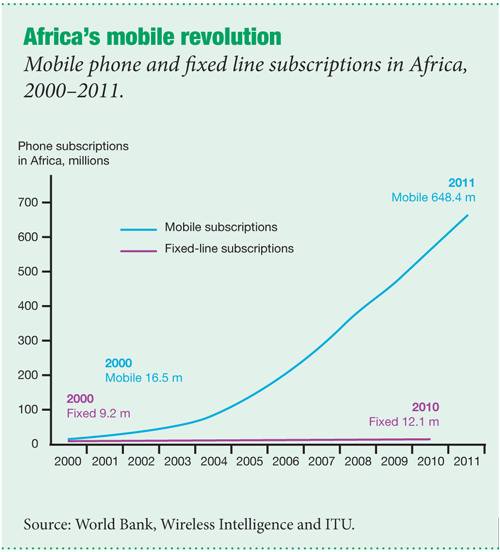
Not only is governance crystallising but so too is transparency with an exploding communications infrastructure provided mostly via mobile phones and internet connectivity (see chart). A billion new consumers, most of whom lack almost everything we in the north now take for granted, can suddenly see and buy from the same catalogues that we do. Now, if we can just build the production and distribution networks to deliver it all…
The Financial Times this week featured an article about General Electric’s plans to double sales in sub Saharan Africa. The article quotes CEO Jeff Immelt telling shareholders that the company expects to build billion dollar businesses in Nigeria, South Africa, Mozambique and Angola. The phase that GE (as well as Konecranes, Chevron, and Cisco Systems to name a few) is joining here is all about building the foundation for growth in terms of power, transportation, communication and more. This phase could last for 20 years during which time jobs, technology and capital investment should flow steadily southward, raising incomes across the region.
Following this infrastructure phase will be a consumption phase. The four biggest countries in Africa have per capita incomes of $2,500, $1,000, $6,200, and $300 respectively (have you guessed them yet?). As these numbers grow it is safe to assume that almost all the money will be spent on consumer products. This means food, personal care, apparel, consumer electronics, furniture, vehicles and of course healthcare should all experience the kind of steady growth enjoyed in the US and Europe between 1950 and 2000. Where we in the north are saturated, Africa is hungry.
Supply networks capable of initially delivering large volumes of low-priced but high-quality product will earn secure business beachheads for their brands. These beachheads will then have the potential to flourish with the same kind of assortment variation that our brethren in marketing and product development live for. Global scale in sourcing and manufacturing is a strong start, but sustainable growth will depend on local innovation and therefore a supply chain architecture that is just as demand driven in Nairobi as it must be in London.
Here, however, is the rub. The same FT edition which cited GE’s growth plans for Africa led with a front page story and big colour photo of Nigeria’s Central Bank governor Lamido Sanusi criticising China’s approach to economic engagement with the continent. The essence of Sanusi’s complaint is simply that China is repeating many of the sins of colonial Europe. By coming to Africa in search of oil, minerals and other natural resources China, in Sanusi’s view, is exploiting the land at the expense of its people. “China takes our primary goods and sells us manufactured ones… the essence of colonialism,” he said.
The missing ingredient is respect. Europe then and China now care little, if at all, for the people of Africa. Both exemplify a supply push mentality, looking exclusively for ways to drive down input costs to make more money for the home country. Real opportunity lies in taking a demand-driven approach to Africa. What does the busy mother in Luanda want from a shampoo? What does an ambitious young man in Lagos crave in his first car? How should coffee be served to a shop full of teens in Dakar? These billion consumers bring new ideas to the market that will enrich the whole world. Respect them as consumers and thrive. Bypass them and risk repeating the mistakes of our past.
The four countries by the way are Nigeria, Ethiopia, Egypt, and the Democratic Republic of the Congo.
Beyond Supply Chain
Subscribe on LinkedIn to receive the biweekly Beyond Supply Chain newsletter.