By Kevin O'Marah | October 02, 2015
Navigating the Supply Chain AI Fog
September 18 2026


By Kevin O'Marah | October 02, 2015
Amazon just announced an initiative to leverage the nascent “gig economy” as part of its ongoing mission to deliver everything to everyone at all times. Amazon Flex, which promises to pay people $18-25 per hour to use their own cars and smartphones to deliver parcels, is the latest – and probably biggest – lurch towards “Uberisation” in supply chain that we’ve seen to date. It is also a smart way to co-opt the young.
Amazon’s effort extends a trend exemplified by the likes of Instacart to employ app-enabled private contractors for last-mile delivery service to customers’ homes. Instacart pays its shoppers $10 per hour and presumes that tips will bring the effective rate closer to $15-20 per hour. Instacart’s grocery retail partners include Costco, Whole Foods Market and, most recently, Target.
Operationally the system has challenges. The actual shopping is typically done by a 20-30-year-old who rarely starts with any sense of how to be efficient. They use smartphone navigation to find their drop-off locations and support from the company is limited. Mistakes happen. Despite these hurdles, Instacart is growing fast.
Retailers like it because they need not dedicate inventory, space or staff to have a solid footing in e-commerce. Customers like it because of the convenience and reasonable cost-value trade-off. Most important, however, the shoppers like it because the work fits their schedules and lifestyle.
Amazon Flex looks even better to prospective “contractors”. The pay is higher (a key fact since the reliability of tips for Instacart shoppers is poor). The supply chain back end is likely tighter, which means complexity at the shelf of Whole Foods, for instance, need not hinder the shopper’s workflow. In addition, errors and substitutes, which are a fact of life for Instacart’s grocery deliveries, may be less problematic for Amazon Flex.
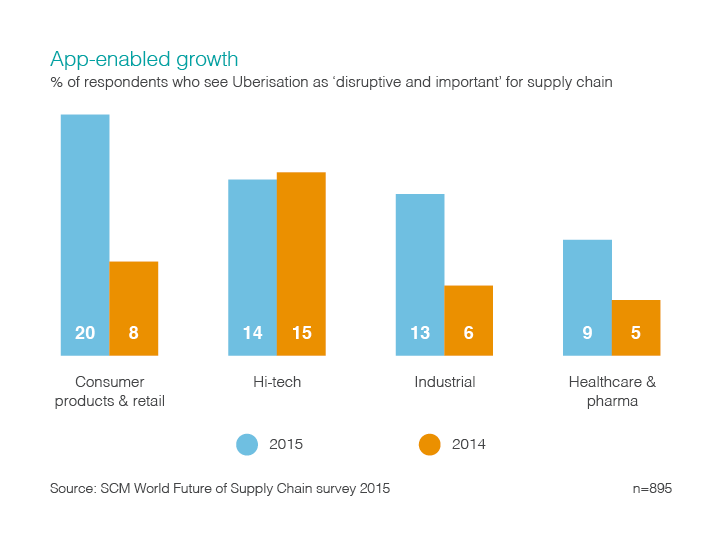
Uberisation is compelling. In our recent Future of Supply Chain survey the percentage of respondents who said Uberisation is “disruptive and important” doubled between 2014 and 2015. We have seen and chronicled a rise in Uber-like services for trucking and entertained plenty of questions about Uber as applied to factories, warehouses and more. From an asset utilisation standpoint the economics are irresistible.
More important, however, may be the excellent fit of this emerging business model to the social norms now ascendant with millennials coming of age. Great hand-wringing persists among supply chain professionals about how to engage, recruit, motivate and retain young people. Companies that excel at this, like Under Armour, specifically design career paths and recruiting messages to match the profiles of this group.
Millennials’ apparent comfort with technology, quick team formation and innovative approaches to problem solving could easily offset their supposed impatience to get ahead and shorter time horizons. For supply chain strategists, the opening here looks enticing: scale fast, tap new ideas from the outside and yet keep fixed costs very low.

The most popular emerging supply chain tactic in use today is network optimisation. Almost two-thirds of respondents to our Future of Supply Chain survey plan to use it with at least some automated technology support in the next 18 months. I wonder how many are experimenting with Uberisation elements in these models.
The life challenges of a 25-year-old today include massive fixed costs for housing, healthcare and education. Many are still living at home, and under Obamacare are covered by their parents’ healthcare until they are 26. If they have education loans to pay off, the need for cash is urgent. Doesn’t it seem likely that this wave of talent, all of whom are exceedingly smartphone literate and probably patching together an unreliable budget, will continue to swarm the gig economy?
Amazon Flex will certainly face problems, including quality control and reliability, as well as uncertainty about the legal legitimacy of the Uber workforce model. It is also more of a nice-to-have feature than a necessity for Amazon’s long-term strategy.
But for an ambitious kid with his parents’ SUV and an Android phone this looks like a perfect fit.
Beyond Supply Chain
Subscribe on LinkedIn to receive the biweekly Beyond Supply Chain newsletter.