By Kevin O'Marah | October 30, 2015
Navigating the Supply Chain AI Fog
September 18 2026


By Kevin O'Marah | October 30, 2015
This week, Apple yet again announced amazing growth, profitability and cash-flow figures for its most recent quarter. Public perception of the company centres on innovation, and the iconic images featured in its marketing suggest freedom, independence and personal expression. Its defining public statement may be the famous Super Bowl spot from 1984 in which freedom routs sameness with an explosion of new ideas.
Bracing stuff, and yet Apple is great precisely because of its ability to harness standardisation as a basis for massive leverage while simultaneously offering a compelling degree of customisation to the consumer. Standardisation and agility are not mutually exclusive. In fact, it appears that standardisation used wisely enhances agility.
This saying, long attributed to the father of industrial standardisation, Henry Ford, sums up the central problem of supply chain design. By standardising every element of the product and process, Ford was able to deliver quality products, in huge volumes and at unimaginably low prices. The sacrifice in terms of agility to offer different colours, features or models was sound because of the pay-off in both profits and consumer satisfaction.
Dial forward 50 years and variation became the winning formula as GM overtook Ford mid-century using an intentionally agile supply chain, spinning out new designs annually with an explosion of options. Agility had trumped standardisation.
In more recent times, the auto industry has learned to use platforming strategies to reap some of the benefits of standardisation while still offering variety with an increasingly agile final assembly process. On top of that, auto makers from Tesla to Ford are enhancing their agility with a digital supply chain that echoes the customisation experience offered by the iPhone.
Supply chain strategists are beginning to see that they can have the best of both worlds with operations based on process standardisation without constraining agility. Our Future of Supply Chain survey of more than 1,000 practitioners last month saw near unanimous agreement that “process standardisation is essential in enabling a high-performing supply chain organisation”. And yet, nearly 40% rejected the idea that “process standardisation constrains agility”.
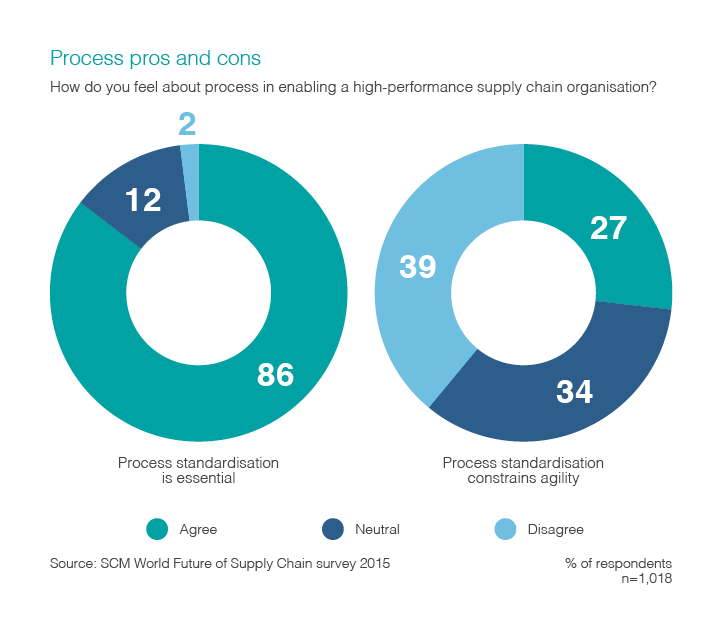
The paradox of agility is demonstrated neatly by Apple. The 48 million iPhones it sold this quarter are all essentially identical coming off the production line, and yet no two look or work exactly the same once the galaxy of accessories, apps and personal configurations have been applied. Product customisation happens post-sale and at the consumer’s command. This gives the impression of agility while componentry, production processes and logistics support all harvest the scale and quality benefits of standardisation.
A big part of the reason this works is the arrival of digital supply chain, which “ships” product electronically in the form of software, content or enabling information like recipes, formulae and codes. All very cool, but it is all dependent on standardisation of things like operating systems, plug sockets and equipment calibration.
For the wider supply chain world the analogy holds. Collaboration between retailers and suppliers in the fast-moving consumer goods world is a great principle, but without data synchronisation standards any push for more agility begets either chaos or gridlock. In engineered industrial products, agility matters in field service, but without standardised parts, diagnostic procedures and tools mistakes are made, money is lost and no one wins.
Today’s supply chain is being built on a hybrid of material technology and information technology. This means that process standards in sourcing, manufacturing and logistics ensure not only quality and cost control, but also compatibility and traceability. Smart products know what they are and what the customer in any given situation needs. This is true for a Burberry coat, a Honeywell thermostat or a BMW car.
The path forward depends on finding where standards-based leverage can combine with customer-centric agility to create an operational edge. Doing so creates a supply chain platform reminiscent of what auto makers or software firms exploit with their products.
Consider the iPhone versus the BlackBerry. Both were built on operating system platforms, but that’s not what made the difference. In the end, Apple’s supply chain platform harnessed leverage in sourcing, production and even retail to deliver what the consumer experiences as agility.
Beyond Supply Chain
Subscribe on LinkedIn to receive the biweekly Beyond Supply Chain newsletter.