By Wade McDaniel | March 22, 2024

![[ALT TEXT]](https://emt.gartnerweb.com/ngw/globalassets/en/supply-chain/blog/beyond-supply-chain/images/beyond-supply-chain03082024.png)


CSCO Outlook for 2027: Cloudy With a Chance of Moderate Growth
October 09 2026


By Wade McDaniel | March 22, 2024
Companies continue to move their supply chain networks around the world. What was once a drive for overall efficiency and cost reduction has shifted towards a defensive play over the past several years. Geopolitical tension and nationalism have resulted in trade restrictions and barriers that are shaping the flow of trade. But we’re seeing a recalibration in the next few years if the global landscape stays on its current trajectory. And that’s a big “if.”
In a recent chief supply chain officer survey, Gartner asked the community if they plan to move any parts of their supply chain network. And the answer is overwhelmingly yes — 80%. We have been asking this same question slightly differently for a couple of years now, and the percentage of companies moving is about the same. But the reasons are shifting.
Diving into the data, we can see that the undercurrent of geopolitical shifts and trade tensions are continuing to tug at all areas of the supply chain. The sum of the top three in both areas shows that substantially all respondents acknowledge their motivation is to derisk their supply network, then go after costs.
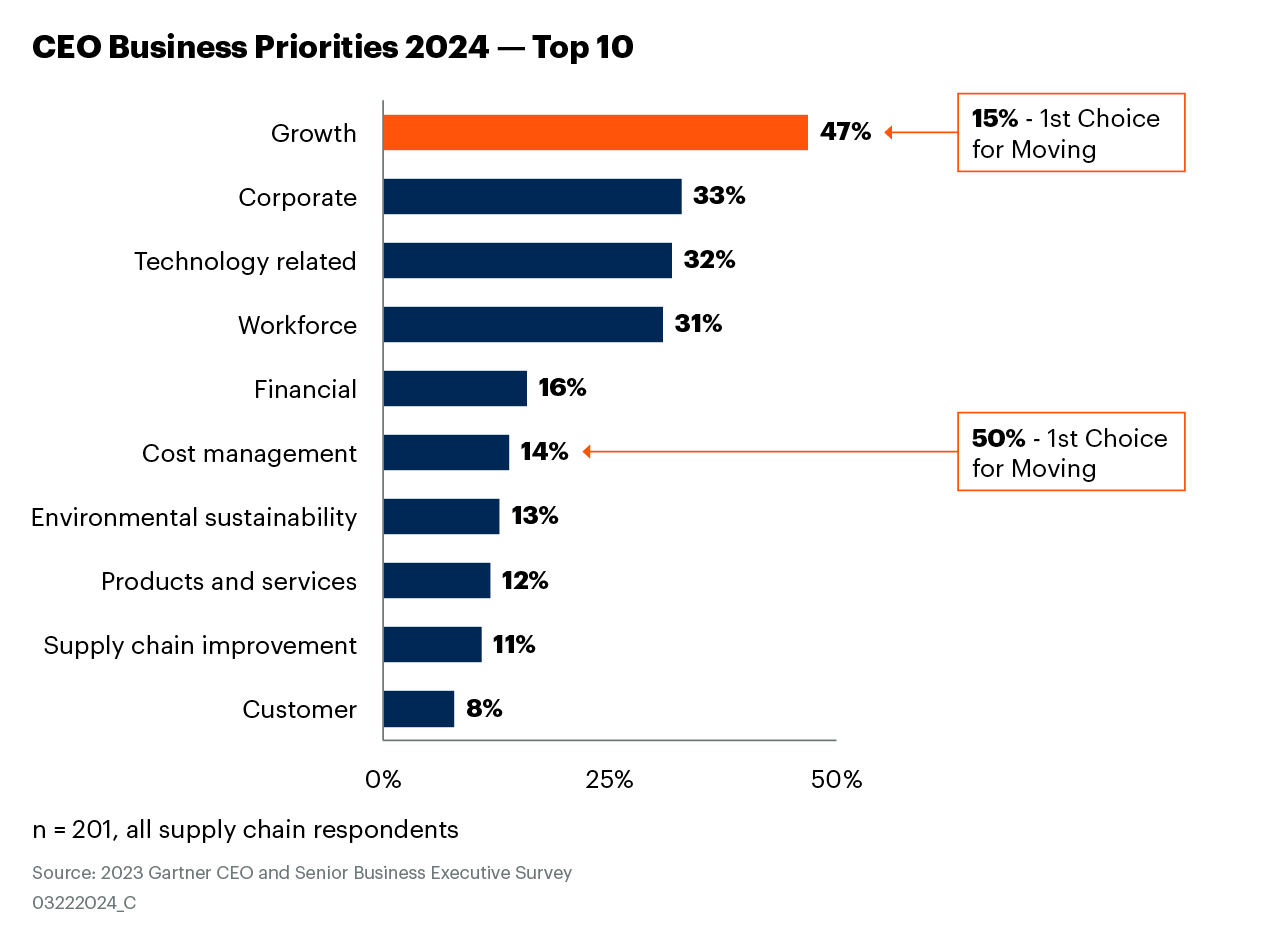
It’s not just about costs. There’s a recalibration about expanding into new markets to support growth. This move can be viewed in various ways. But what we can learn from this is that it aligns more closely with the top priority of the CEO.
Moving for geopolitical and trade reasons isn’t on the CEO's radar per se. However, cost management does make the top 10 priorities but is far down the list. If we shift views to the CFO, cost management is in their top five, and if we continue to change the perspective, we find that the board of directors has risk mitigation in their top five priorities. The bottom line: Providing a stable and predictable supply chain network is foundational to an enterprise. It supports multiple priorities in the C-suite and the board.
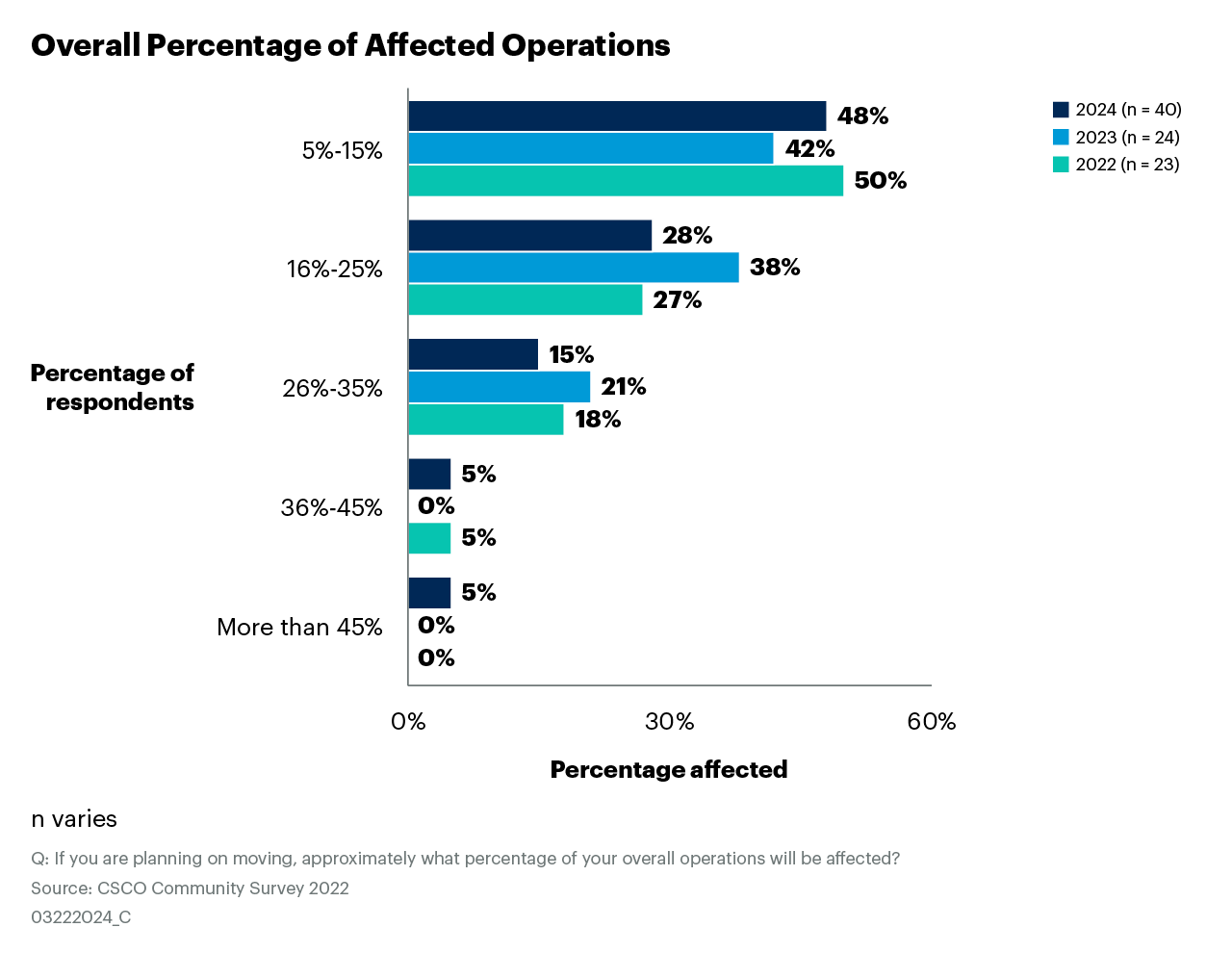
This data might lead us to believe that all CSCOs act along the same lines and take a conservative approach by moving small parts of the network over an extended period. So we decided to dig a little deeper and ask about the CSCOs’ role in making a move. Were they the initiator of the move or did they act in an advisory capacity? No surprises here: 50/50.
However, a considerable variation emerged when we compared the scope of the move to their involvement. Of initiators, 57% are moving between 16% and 35% of their network, while 71% of advisors are only moving 5% to 15%. What can we learn from this? Advisors should consider thinking bigger to avoid leaving possible gains on the table.
Over the past couple of years, moves show a migration to perceived safer shores with consolidation to North America and Europe leading the way. At the same time, trade flows from China have shifted to supporting regions and countries as companies implement their China +1 (or more than 1) strategies.
The sentiment for the coming two years signals moves towards lower-cost regions and emerging markets. Southeast Asia and India are now at the top of the list, with China making small gains.
CSCOs are recalibrating their networks, but it’s a little too soon to call this a long-term shift. Potential geopolitical impacts loom over the next year that could significantly impact supply chain configurations. But as of this moment, we might be there for a while.
Wade L. McDaniel
VP Distinguished Advisor
Gartner Supply Chain
Wade.McDaniel@gartner.com
Beyond Supply Chain
Subscribe on LinkedIn to receive the biweekly Beyond Supply Chain newsletter.