By Sabu Mathai | August 11, 2023
CSCO Outlook for 2027: Cloudy With a Chance of Moderate Growth
October 09 2026


By Sabu Mathai | August 11, 2023
Times are changing. For many supply chain leaders, the past three and half years of seemingly unending crises have felt like a blitz. Constant disruptions and a shortage economy have forced a rethink in supply chain strategy, with CSCOs justifiably devoting more attention and energy to resilience than they had during a bygone age of supply chain stability. As they still struggle to respond to a range of short- and long-term risks, companies today frequently set sustainability aside in favor of resilience.
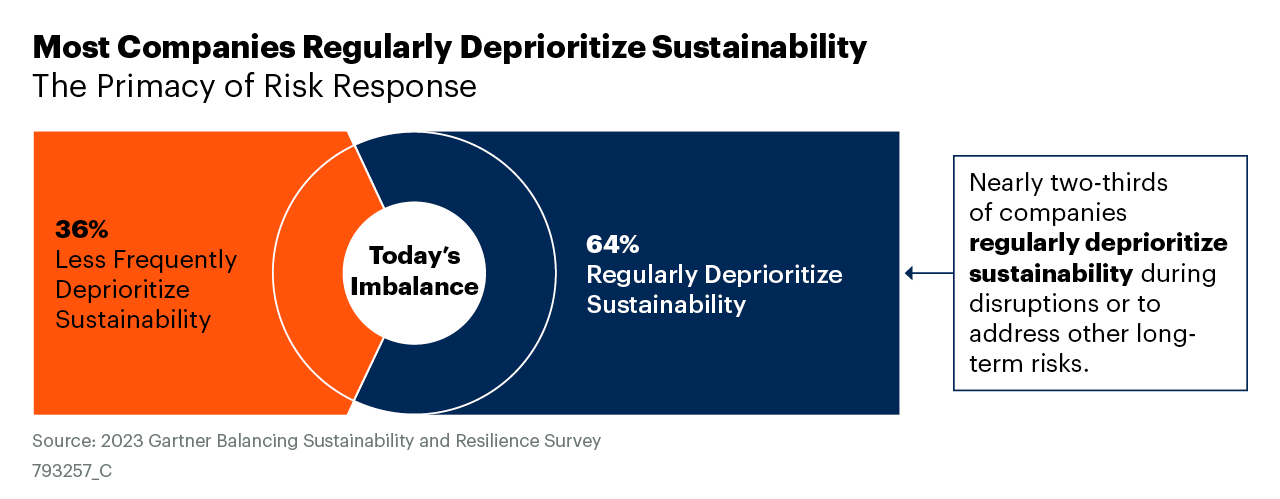
While turbulence and a lack of bandwidth contribute to this imbalance, so do perceptions that sustainability has marginal value to the business, or that sustainability and resilience are mutually exclusive rather than mutually reinforcing. To the contrary, progress on sustainability addresses downside environmental risks, including, for instance, from fast-moving changes in both environmental regulations and the environment itself (e.g., extreme weather, natural resource degradation). And with many supply chain leaders concerned that delayed progress on sustainability could result in lost market share, reaching for sustainability’s opportunities is crucial to mitigating risks and securing a better future for the business. Today, sustainability increasingly builds resilience.
As both physical and transition risks intensify, environmental risks either arising from or impacting the supply chain create both operational and strategic exposure for the supply chain and the enterprise. With urgency and pressure mounting for measurable and valuable progress on sustainability, it is now imperative for CSCOs to balance sustainability and resilience.
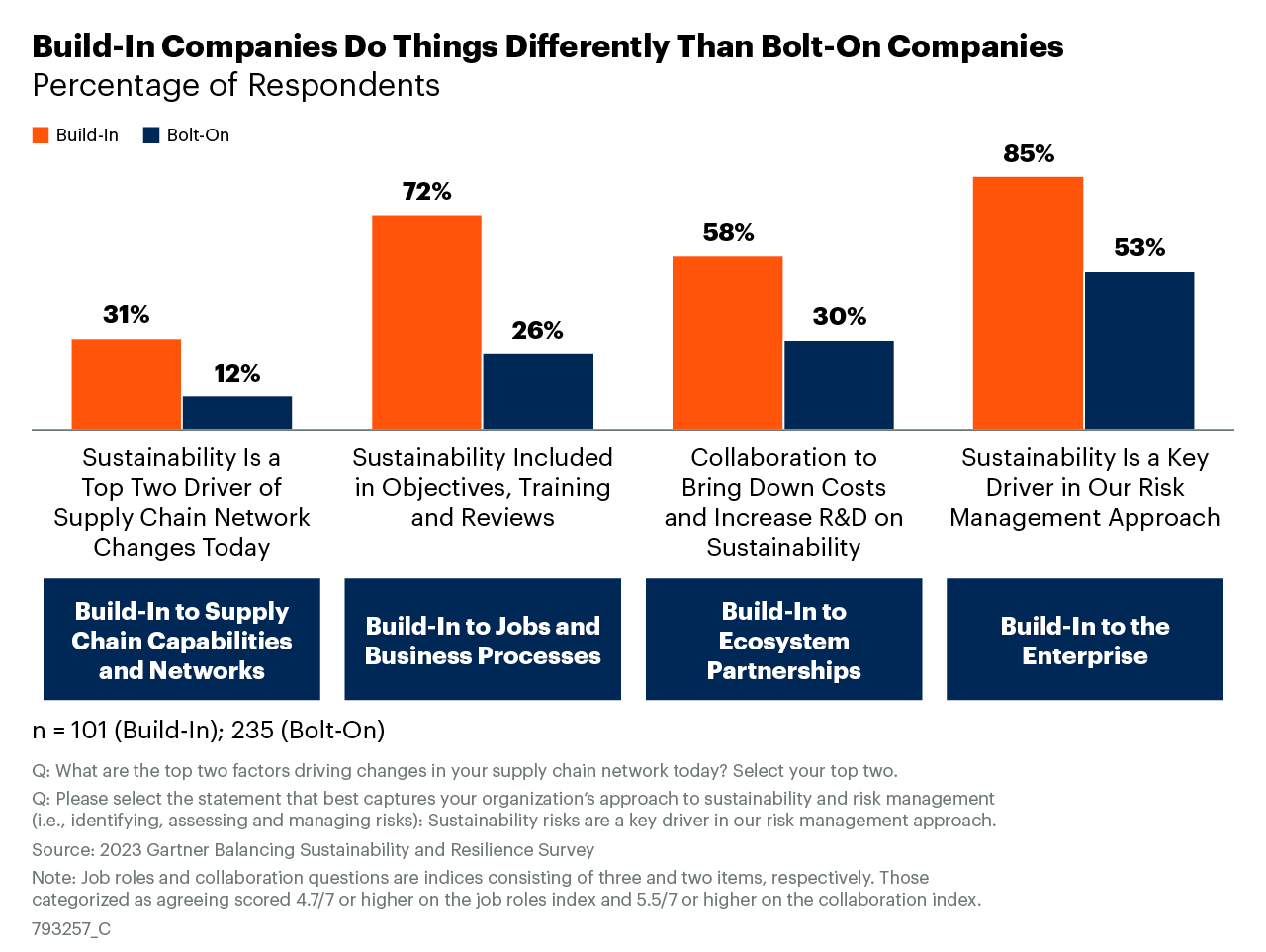
Through interviews and survey research, Gartner has identified an approach to balancing sustainability and resilience that only a minority of companies take today. These companies “build in” sustainability at the core of their business, rather than “bolting on” sustainability at the margins where trade-off decisions are heavily stacked against sustainability. Leaders in build-in companies say their firms are 3.7 times less likely to deprioritize sustainability than leaders from bolt-on companies who face nearly equal rates of disruption.

Better balance has results: build-in companies are more likely than bolt-on companies to have reduced their resource intensity year over year, and to have increased offerings that advance sustainability objectives over the past three years.
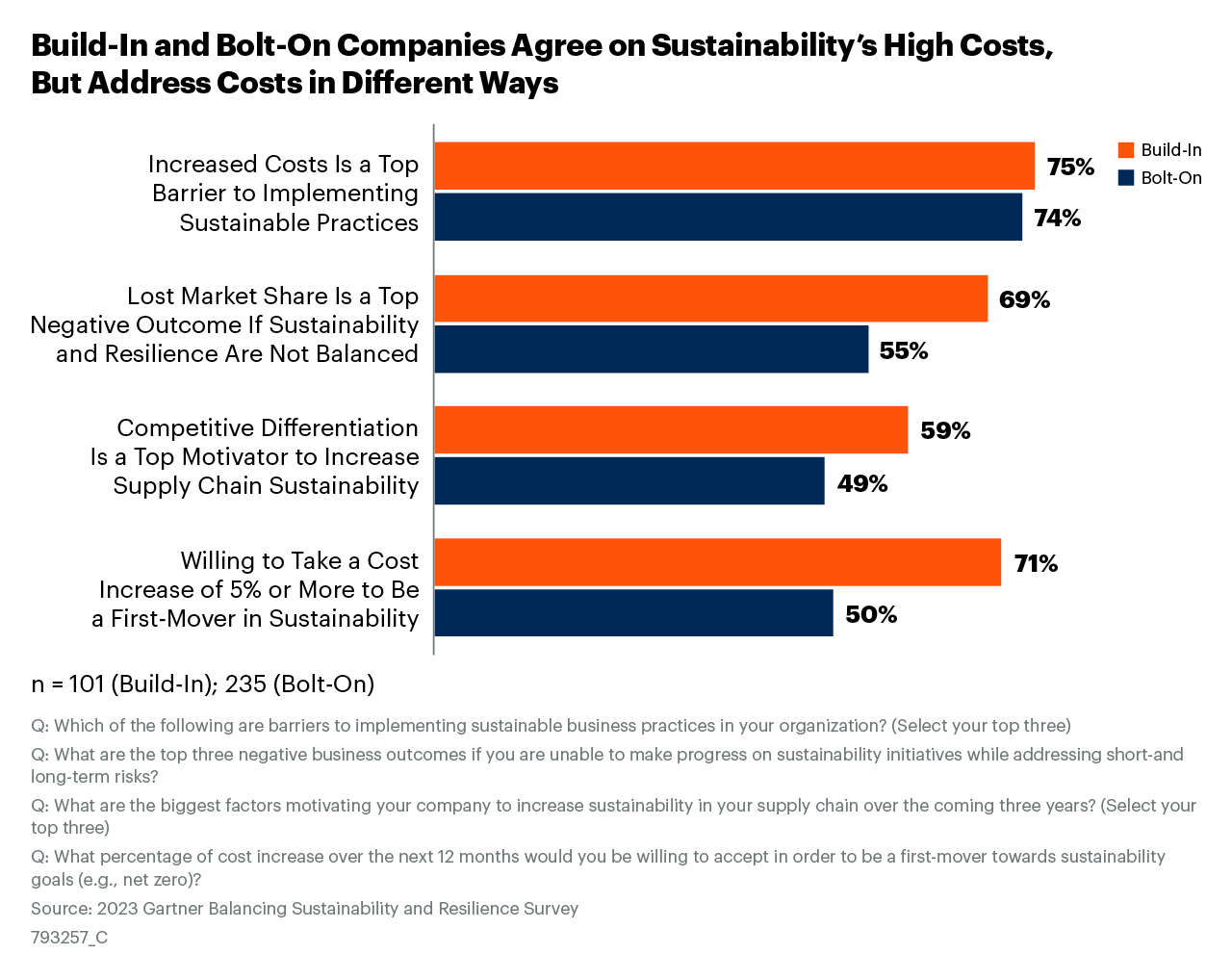
Build-in and bolt-on companies alike cite sustainability’s high upfront costs as far and away the most significant barrier to implementing sustainability business practices. However, build-in companies are more likely to perceive a significant threat to their business from environmental risks. They are also more driven to achieve, and to invest in, an enduring competitive advantage from sustainability.
Sensing risks and opportunities from sustainability, build-in companies integrate sustainability at their core. They build sustainability into:
Scope 3 carbon emissions make up the bulk of organizations’ strategic exposure to new rules and disclosure requirements governing carbon emissions. However, supply chain sustainability is not an objective that CSCOs can achieve on their own – progress requires an enterprise approach. With sustainability and resilience converging as environmental risks rise, CSCOs must play a leading role in driving an enterprise sustainability agenda that builds resilience. In this age of polycrisis, balance will bring progress.
Learn more about how supply chain leaders can strike a better balance between sustainability and resilience in Supply Chain Executive Report: Balancing Sustainability and Resilience For Our Climate Future (available to Gartner clients). The July report features examples from four leading companies that take a build-in approach: Siemens, Ericsson, Colgate-Palmolive and Dell. All audiences can learn more about this research on the Gartner Supply Chain podcast, available on Spotify, Apple Podcasts and Google Podcasts.
Sabu Mathai
Director, Research
Gartner Supply Chain
Sabu.Mathai@gartner.com
Join our free webinar for non-Gartner clients: CSCOs, Balance Sustainability and Resilience Amid Turbulence

Beyond Supply Chain
Subscribe on LinkedIn to receive the biweekly Beyond Supply Chain newsletter.