By Kevin O'Marah | October 23, 2015
CSCO Outlook for 2027: Cloudy With a Chance of Moderate Growth
October 09 2026


By Kevin O'Marah | October 23, 2015
Earlier this week the business press oozed with coverage of China’s dubious official GDP growth figure of 6.9% for the third quarter. The Wall Street Journal’s Europe edition led with an above-the-fold headline blaring “China GDP Stirs Skeptics”. Does this mean the world’s second largest economy is in trouble? Not at all. Rather it means three things, all more good than bad for world economic well-being.
Much has been made of the myriad ways to look at what China’s true economic growth rate is. Official numbers for 2014, for instance, claim 7.3% growth for the year. Sanford Bernstein’s investment analysts offer a different number based on consumer spending for things like movie tickets, Alibaba sales, airline sales and the like. Their guess for 2014 was 6.7%. Another estimate, constructed by CNN from Premier Li Keqiang’s preferred metrics, including rail freight, electricity production and bank lending, reckons that GDP actually shrank by 1.6% in 2014.
SCM World data adds one more input, which is planned supply chain job creation. Our data was collected last month and asked executives across industries and around the world to pick the top three countries where they planned to both add jobs and cut jobs over the next three years.
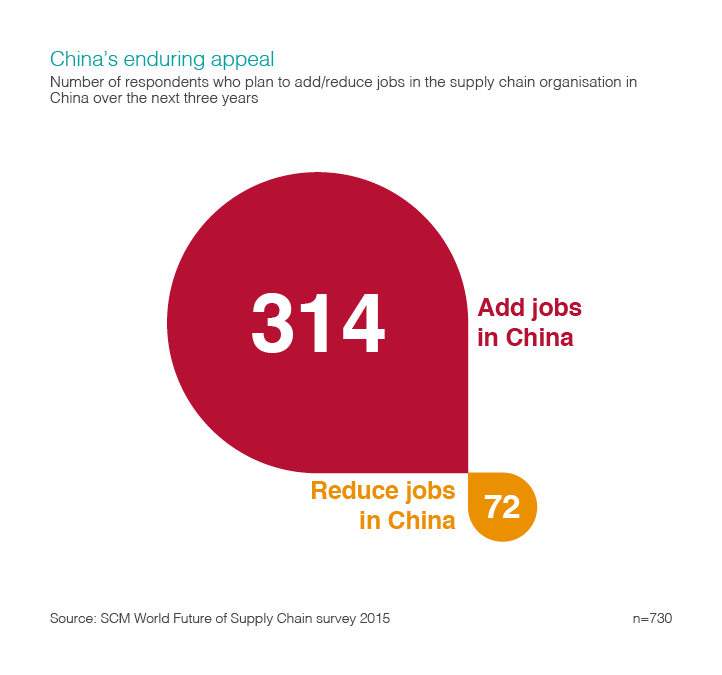
Despite a clear move away from China as the preferred low-cost country manufacturing location for exports, our respondents’ plans favour adding jobs by a ratio of more than 4:1. Out of 730 executives who answered the question, 314 placed China in their top three for job creation – making it the top country overall – against just 72 who planned to reduce the number of supply chain staff there.
The long-term trend is clearly towards more growth in employment, production and consumption. Equally important, and a large part of the reason that Chinese GDP growth is slowing, is that these jobs are clearly targeting more domestic demand with higher technology and intellectual property value-added goods and services. Such trends are harder to measure than containers full of shoes, machines and electronics bound for California. The shift to a consumer economy is happening, but traditional gauges can’t keep up.
As a graduate student at Oxford University in the 1980s, I studied the ambitious collection of topics known as PPE: philosophy, politics and economics. The three came as one because traditional scholarship saw them intermingled in the real world, and this is a key insight into China’s sketchy official figures. Little things like accurate government data matter a lot less than big things, like national destiny.
China doesn’t silo these matters as Westerners might, but instead starts with the philosophy that it is the Middle Kingdom and natural centre of humanity. As such, its politics demand stability and unity above all else. Economics is therefore a means to an end, which means improvements in public welfare serve the political need for stability and unity, all of which sustains the core belief in China’s ultimate greatness.
This should be seen as good news, since it has rarely manifested malevolently on the scale of some of its historic neighbours or enemies. China just wants to be a great nation for the long run and that is good for almost everyone.
Globalisation has evolved from an oft-derided code word for offshoring to an ambition for world economic advancement. In the process, radically different traditions of governance, justice and equity have been forced to mix. The reconciliation of right and wrong is often messy and dangerous. Under these conditions, what could be worse than a giant on the world stage appearing to lurch or lose control?
Chinese President Xi Jinping was in Britain this week building bonds of confidence and trust with the UK’s leadership at all levels. One noteworthy aspect is that the visit was not purely diplomatic, but also symbolic, historic and emotional. Another is that it followed extensive recent bridge-building with the United States. The way forward for China matters to all of us.
I am happy to see China focused on the long game, even if it means fudging the numbers along the way.
Beyond Supply Chain
Subscribe on LinkedIn to receive the biweekly Beyond Supply Chain newsletter.