By Jennifer Loveland | October 29, 2021
CSCO Outlook for 2027: Cloudy With a Chance of Moderate Growth
October 09 2026


By Jennifer Loveland | October 29, 2021
Even as a practitioner, supply chain complexity facts periodically shock me. This week, that complexity “Wow!” moment came upon learning that Amazon’s physical footprint roughly equals the size of where I live — Uppsala, Sweden. Uppsala has been here since the third century; Amazon grew its fulfillment and logistics square footage 50% in 2020.

Supply chains have always been complex — with thousands of suppliers, partners and products spanning a footprint with hundreds of sites and markets. Long, often fruitless, debates with commercial partners about reducing the SKU portfolio miss a bigger opportunity. Much of the complexity in a supply chain comes from decisions about its operating model — who does what as well as where and how they do it.
External pressures for adding operating model complexity such as new business models, shifts to selling solutions, diversifying customer expectations and increasing rate of disruption show no signs of slowing. While we cannot change much of the crazy times we are operating in, we can control how we address them. Right now, we just add more.
Over the next five years:
This growth in operating model complexity goes largely unchecked. How many projects were on your strategy last year? How many of them were about removing or stopping something? Over half of supply chains lack effectiveness in ending use of a process or technology, and one-third do not have a formal process to do so. We are adding more complexity, but we are not subtracting.
Complexity matters. Complexity enables value, but challenges execution. For every benefit of complexity, there is a downside.
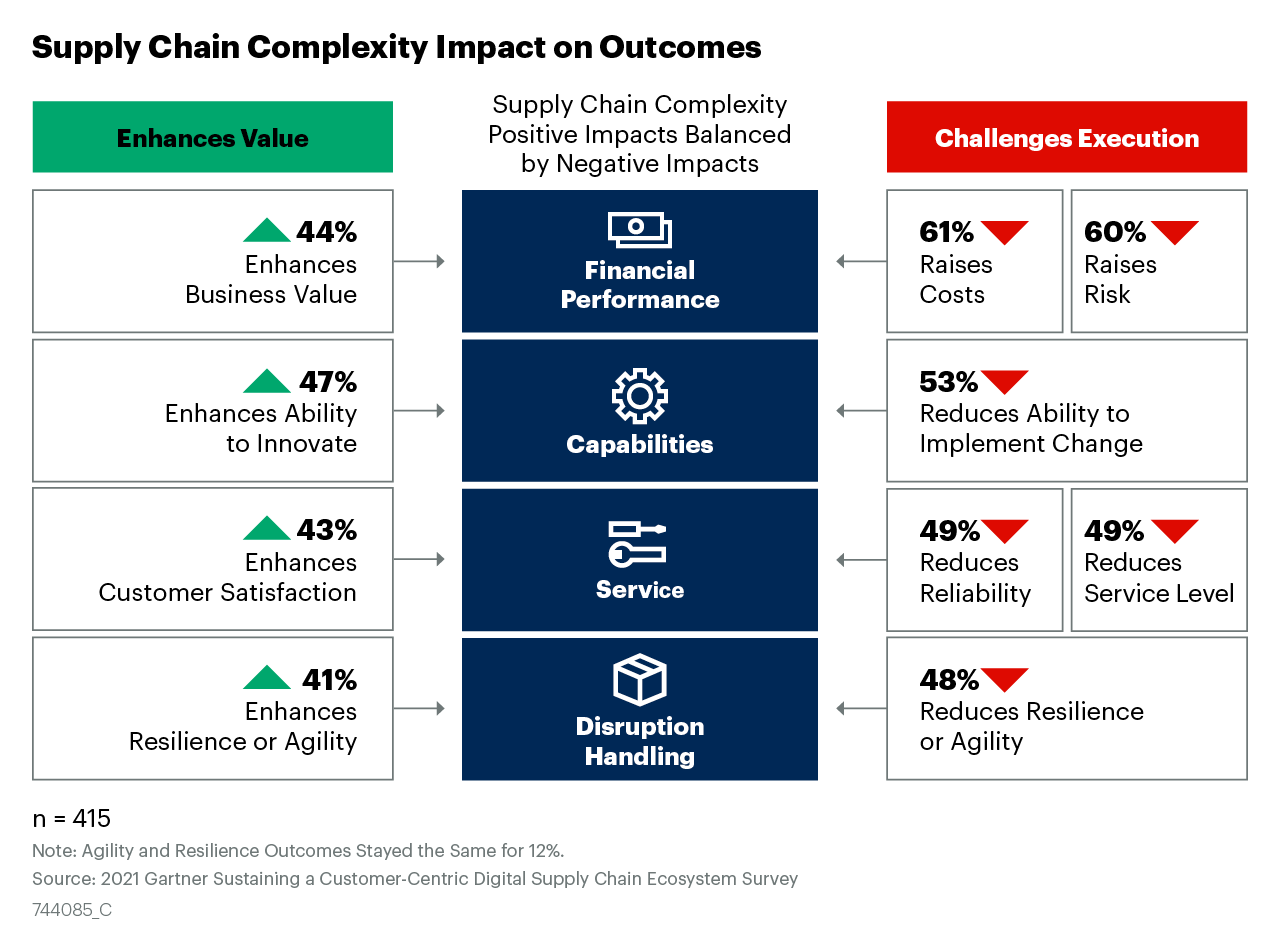
Operating model complexity creates coordination challenges, reducing agility and resilience, yet increases options to address disruptions. With more places for things to go wrong, complexity increases risk. Allowing all innovation ideas to flourish increases complexity and maximizes the potential value of the innovation to the business and customers. Yet, the weight of complexity makes implementing and scaling innovations difficult. The more complexity a supply chain manages, the harder it is to maintain reliability and service level, reducing customer satisfaction while increasing costs. Taming complexity requires a structured approach to separate the valuable complexity from the complexity that weighs down on results.
In product lifecycle management, there are concrete stages with roles and responsibilities from “cradle to grave” — or in circular models, “cradle to cradle.” I have hundreds of conversations about supply chain strategy every year. We talk much more about the “cradle” than the “grave.” There is ample executive discussion of what initiatives to prioritize. Most struggle to stop an initiative once they have started it. Adoption is often slow, or stalls before completion. Few, if any, make space in the discussion to talk about what existing activities must stop to make room for all the new priorities. Taking stock of if you should or can effectively keep doing everything is — at best done — done inconsistently, infrequently and in silos.
Applying a life-cycle management approach to the supply chain operating model is an antidote to complexity. Expanding life-cycle concepts to each supply chain resource — capabilities, technology, sites, processes, policies, partners — consciously shapes operating model complexity to stop unchecked growth. Taming complexity releases trapped resources to focus on innovation implementation and adoption.

So where do you start? Because our goal is limiting unchecked complexity growth and we are the worst at stopping activities, our supply chain architecture lifecycle (SCALe) starts with what we decommission or retire — making room for what comes next. Address issues across the five phases of SCALe to get more value sooner and with less resources:
Schneider Electric has experienced how a focus on operating model complexity translated to space and speed for innovation. An equal focus on what should stop, as much on what should scale, allows the organization to get value sooner.
As Jin Piao, vice president, global supply chain chief of staff at Schneider Electric, put it: “As a large, high-performing supply chain, we cannot just let complexity go. Every transformation must focus on reducing complexity to focus precious employee time on the most critical sources of value.”
We explore operating model complexities in the October executive report (available to Gartner clients) and in the accompanying podcast, which is available on Spotify, Apple Podcasts and Google Podcasts.
Jennifer Loveland
Senior Director Analyst
Gartner Supply Chain
Jennifer.Loveland@gartner.com
Beyond Supply Chain
Subscribe on LinkedIn to receive the biweekly Beyond Supply Chain newsletter.