By Michael Uskert | March 05, 2020
CSCOs Seem to Talk About the Same Things, But They Really Aren’t
August 28 2026


By Michael Uskert | March 05, 2020
Supply chains are much like financial markets — neither does well with uncertainty, but to deal with it they both look for parallels to help determine how to make sense of the present to forecast the future.
What makes this coronavirus different than every other disruption in our lifetime is its sheer scale in terms of unknowns and geographic breadth. I’ve read articles and blogs trying to draw parallels with the Spanish flu. That just doesn’t make sense. There’s nothing businesswise that can be drawn from a 1918 comparison.
COVID-19 has evolved from what was originally treated as a “supply issue” affecting supply chains that sourced out of China to a global event that requires a much more wholistic evaluation of the supply chain effects. This includes everything from the corporate headquarters to manufacturing plants and suppliers, contract manufacturing and ability to move product.
It is a lost cause to try to identify a single similar situation and apply learnings from the past to this situation. There just isn’t a parallel. The most accurate comparison may come from combining every supply chain disruption we’ve encountered into a single event and applying similar solutions.
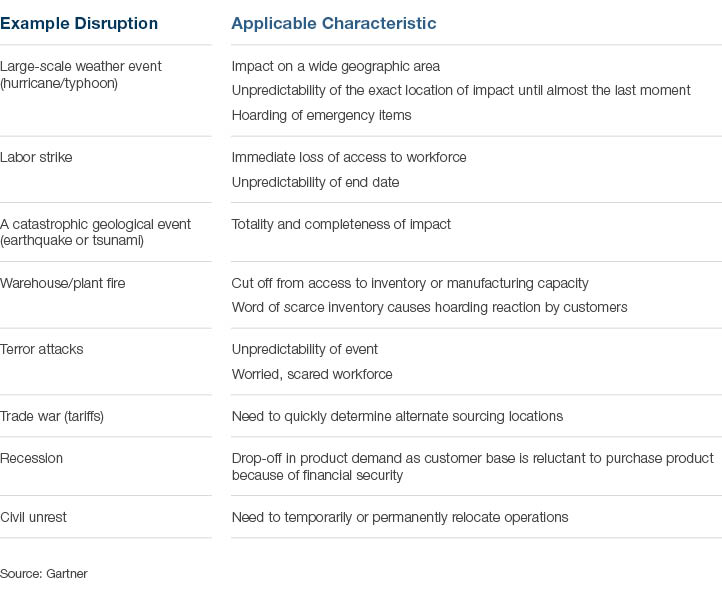
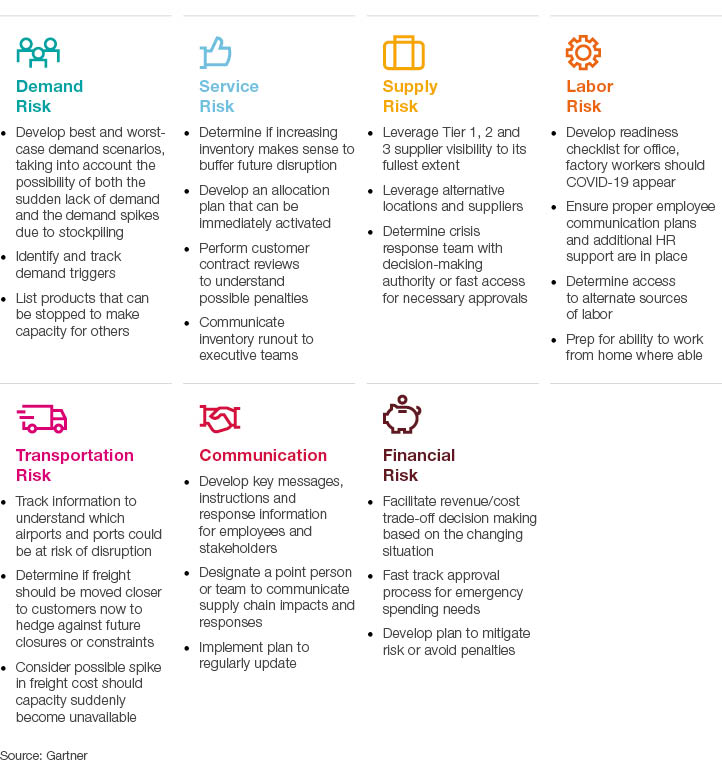
While it is improbable that a company had a global pandemic playbook in place prior to this year, it is likely that playbooks exist for some, if not many, of the more standard disruptions listed above. By breaking a seemingly impossible problem into digestible pieces that can be related to past experience, a playbook can come together.
For example, analyzing planned responses for more common disruptions may result in an overall plan that looks like this:
COVID-19 is a big problem that shouldn’t be minimized, but perhaps the best way to tackle its impact is to do just the opposite — think small.
Michael Uskert,
Chief of Research,
Gartner Supply Chain
michael.uskert@gartner.com
Beyond Supply Chain
Subscribe on LinkedIn to receive the biweekly Beyond Supply Chain newsletter.