By Kevin O'Marah | May 03, 2013
Navigating the Supply Chain AI Fog
September 18 2026


By Kevin O'Marah | May 03, 2013
Last week’s horrible collapse of a clothing factory building in Bangladesh marks a low point in the history of “demand-driven” supply chains. Details emerging now portray a thuggish real estate mogul who brazenly ignored explicit warnings that his building was unsafe on the day before it fell. One link behind him is a series of fast-growing local manufacturers. These suppliers are seeing surging demand as Chinese wages have risen, encouraging sourcing agents to find new pools of cheap labour.
Further still down the chain are apparel brands including JC Penney and Wal-Mart in the US, Primark in the UK and Benetton in Italy looking for low costs and fast turnaround. At the end of the line are shoppers scrapping for bargains. Consumer demand remains the ultimate master of essentially all supply chains, and evidence continues to show that we (consumers) don’t care much about what happens when we pull on that chain, even if it means 400 dead garment workers.
This week we published an extensive report on manufacturing strategies, which shows that cost is no longer the sole, or even dominant, driver in decisions about where and how to add production capacity. Low-cost country manufacturing is coming to an end with futures based more on a diversified portfolio of production assets located regionally with proximity to markets.
The underlying drivers of this movement include risk, the ability to respond quickly to market conditions and advantages of close ties to R&D for better and faster product innovation. For most industries these factors are beginning to drive at least some “reshoring”, as well as relocation of supply bases into many regions of the world. It seems, though, that many retailers still don’t see it this way.
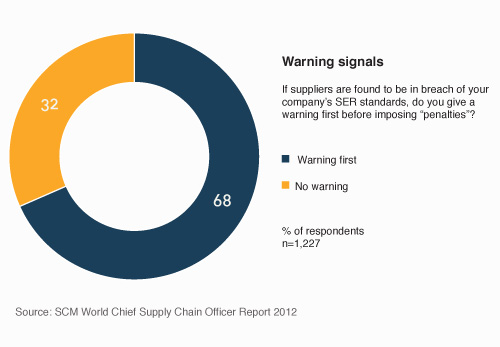
An interesting fact that emerged during our research is that ethical standards are considered by many supply chain leaders as a non-negotiable factor. Corruption may be standard practice in some places, but where it is the risk is that things can go very wrong, as they did in Bangladesh. Our survey data shows that supply chain executives are very strict when it comes to breaches of conduct among suppliers. Nearly a third metes out punishment without warning. Are Wal-Mart and JC Penney just averting their eyes to save us another nickel?
Cheap labour is certainly still out there, but more often than not it comes with strings attached. As the world looks on, brands that fail to protect their reputations will see them tarnished. Primark, to its credit, immediately took responsibility and promised substantial financial compensation, while Benetton tried to shed blame. Wal-Mart shareholders even reportedly voted down a proposal to require suppliers to monitor and disclose working conditions in their factories because it would increase costs. Do consumers really need another cheap pair of trousers? When should the retailer take a stand?
The retail sector has a poor track record when it comes to accountability up the supply chain – something we saw early this year with the horsemeat scandal in Europe. One criticism that seems fair is that retailers don’t look carefully enough at how their demand drives behaviour in the supply base. Another more damning criticism might be that too few retailers respect the integrity of their brand and how the supply chain affects it.
Retailers could learn from the experience of the hi-tech sector. Almost 10 years ago the computer industry was prodded by the Catholic Agency for Overseas Development to do something about working conditions in its supply base. The resulting industry pact, signed by bitter rivals including Hewlett-Packard, Dell and IBM, plus contract manufacturers Flextronics, Jabil and Sanmina, was the first Electronics Industry Code of Conduct (EICC).
The association continues to update its code of conduct regularly and currently counts as members 80 of the world’s biggest electronics firms. Today, issues like conflict minerals, hazardous materials and recycling are more likely to be faced head on by the industry rather than swept under the rug. (Last month’s response by Samsung to accusations that it was using tin mined by child labour in Indonesia is just the latest example.) The result is a level playing field and less incentive to cut corners upstream.
Maybe shoppers are like children – always ready to eat another sweet. Retailers who can’t say no could find themselves demand-driven to oblivion.
Beyond Supply Chain
Subscribe on LinkedIn to receive the biweekly Beyond Supply Chain newsletter.