By Kevin O'Marah | September 16, 2016
CSCO Outlook for 2027: Cloudy With a Chance of Moderate Growth
October 09 2026


By Kevin O'Marah | September 16, 2016
“All the old certainties have vanished.” This quote, from a recent opinion piece in The New York Times, says a lot about why so many people all over the world feel unsettled. It has manifested in massive political energy focused on halting or reversing change, and its power is far from spent.
And yet, change we must. Digitisation is coming fast, whether we want it or not. It’s eliminating jobs, but at the same time creating new ones.
New data this week on family incomes in the US shows a hefty 5.2% increase in 2015 alone. Some of this comes at the bottom of the pay scale with higher hourly wages, and some from the creation of entirely new jobs. It’s happening in manufacturing, logistics and retail, but it requires agility at both a personal level and in supply chain design.
Digital transforms work
SCM World has been tracking digital technologies from a supply chain strategy perspective for several years now. Early hints at the disruptive power of digital started with e-commerce revolutionising traditional store-based retail. More recent impacts felt with internet-connected hardware and better, cheaper automation technologies are changing the architecture of supply chains and the definition of work itself.
For three years in a row now, we’ve seen steadily increasing regard for the disruptive power of a raft of new digital technologies. We’re also learning that unlike more recent technology advances in hard automation or ERP implementation, this new wave won’t end any time soon. Like electrification in the early 20th century, digital is reshaping where, how and when work gets done.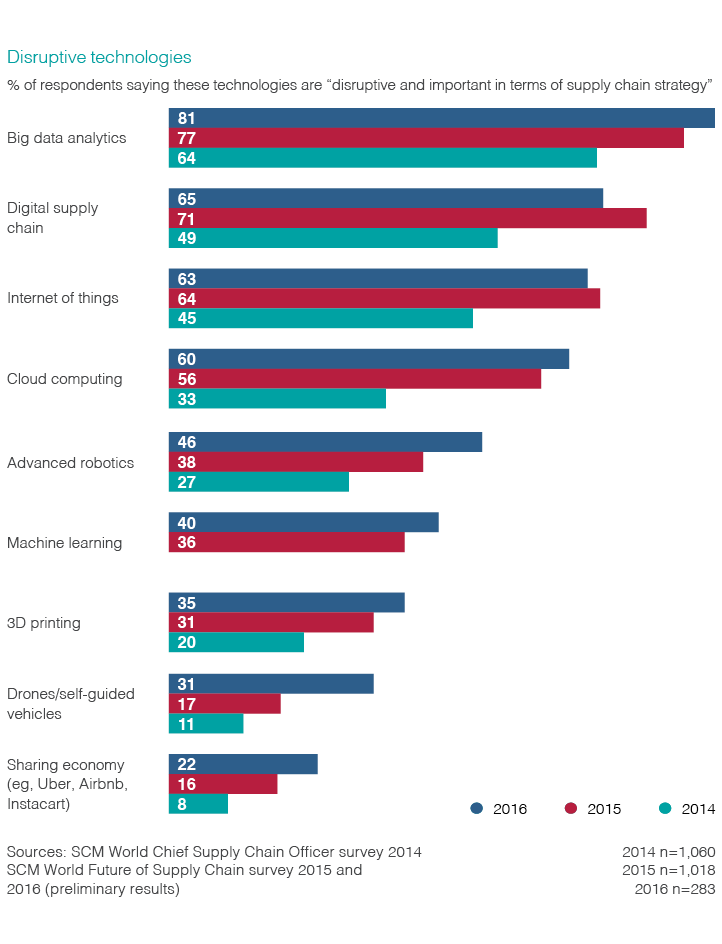 In terms of job creation, this means more opportunity in last-mile logistics like the increasingly ubiquitous Amazon branded delivery drivers or handymen-on-demand from Lowe’s for $100 per hour. In retail, the trend is moving away from lots of unskilled minimum wage jobs and towards a smaller number of better paid jobs.
In manufacturing, companies like New Balance use personalisation and domestic production to sell running shoes at premium prices. The company recently opened a huge new headquarters building in a former industrial area of Boston. A similar story can be told in Baltimore, where Under Armour is creating new work at the site of an old Procter & Gamble plant.
And consider Uber itself, which is experiencing a 150% increase in bookings this year alone. Sharing economy applications for supply chain have seen a three-fold increase in importance according to our data since 2014. Uber for trucking also looks to have a bright future.
Adapting to digital
Digitised supply chains mean blending better demand sensing using data analytics, cloud computing and machine learning with faster, more personalised supply response employing 3D printing, advanced robotics and digital supply chain. It may sound like science fiction, but this is exactly what Nike, Johnson & Johnson, General Electric and Harley-Davidson are doing right now. Each is fostering growth with better customer connectedness, while cutting costs by leaning material supply and manufacturing.
For a real-time example, consider Ralph Lauren’s runway show for New York Fashion Week held on Madison Avenue in front of a store full of the latest designs. The strategy is known as “see-now, buy-now” and depends on having product in stores immediately rather than six months later.
It’s derived from the fast fashion heritage of CEO Stefan Larsson, whose supply chain experience comes from H&M. The approach, which is very much like what Burberry’s CSCO Roberto Canevari described at an SCM World event last fall, is all about agility. It depends on a combination of digital technologies on the web, in stores, upstream in the supply chain and in product design.
A future worth pursuing
The article in The New York Times talked about Kentucky’s fading “steady middle class existence” built on coal, but conceded that unemployment state-wide is only 4.9% with a healthy auto industry and initiatives to expand broadband. Similar stories are playing out in Detroit, Baltimore and Milwaukee. Preliminary 2016 SCM World data shows US respondents adding three supply chain jobs for each one eliminated.
Change is happening and the agile are surviving just fine.
Maybe it’s time to forget the old certainties.
Beyond Supply Chain
Subscribe on LinkedIn to receive the biweekly Beyond Supply Chain newsletter.