By Kevin O'Marah | September 04, 2015
CSCO Outlook for 2027: Cloudy With a Chance of Moderate Growth
October 09 2026


By Kevin O'Marah | September 04, 2015
The presence of a Chief Supply Chain Officer indicates a certain amount of intelligence around the boardroom. Unlike sales, which has a clear mission to make revenue numbers, or finance, whose function is obviously tied to return on invested capital, or even R&D, which owes product innovation above all else, supply chain leaders face a tangle of conflicting priorities.
Cost is king, but so is service. For business-orientated supply chain executives, subtleties around when and where costs hit and how customers are affected is too often lost on everyone else. For this reason alone, supply chain definitely belongs at the C-level.
Cutting off your nose to spite your face
I spoke recently to a top supply chain executive whose new CFO is getting ready to gut his centralised organisation. The procurement savings already booked by this organisation are threefold the cost of running the group and its best-in-class handling of risk upstream in the supply base provides vital insurance against brand damage that could destroy billions in shareholder value almost overnight. To my mind this new CFO is solid proof that understanding when and where costs hit takes a lot more than a spreadsheet.
What we know about centralised supply chain is that it can be extremely effective in consolidating spend to get better prices and operating support from suppliers – 5% savings in the first year of a robust sourcing initiative is common. Companies from Vodafone to Konecranes and Bristol-Myers Squibb have all proven this.
We also know that shared distribution networks, channel logistics and field service operations can save money. See the results of Xerox, General Mills and KLA Tencor for examples. It is also clear from superior new product launch successes at companies like Microsoft, Axis Communications and Johnson Controls that well co-ordinated work between supply chain and engineering makes money.
Of course, Apple and Amazon, where supply chain is literally in the DNA of board-level leadership, help prove the point that business results – and therefore shareholder value – depend on deeply understanding the interaction of money, markets and materials.
Businesses that make or deliver physical stuff are solving an engineering problem, not just doing the numbers.
Structured for success
None of this, however, means that good organisational structure demands centralisation. The perennial trade off in organisation design is between central control – with benefits in standardised business processes, supplier specifications and customer commitments – and decentralised control, which confers customer responsiveness and market sensitivity.
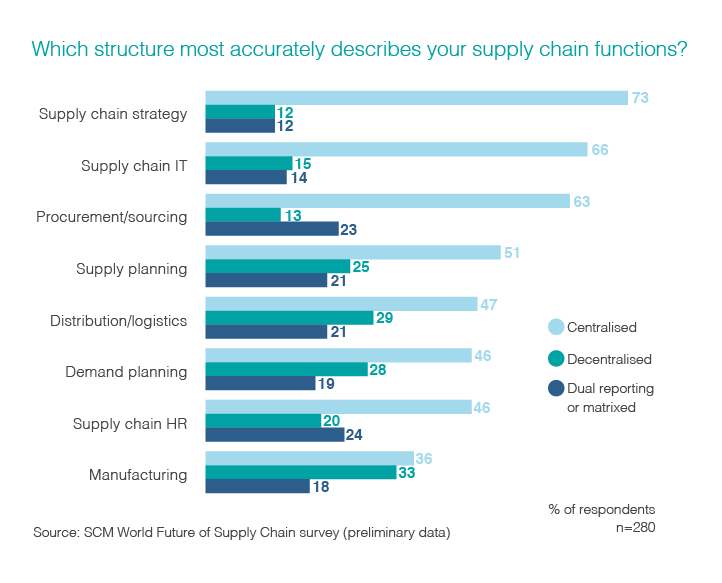
Most large global companies have swung back and forth between these extremes in response to the downsides of each: bureaucratic sclerosis for those too centrally controlled, margin-eating complexity for those too decentralised. Fresh data from our currently live Future of Supply Chain survey shows what is most often centralised, but the overall message is that centralisation is preferred.
Most telling of all is that supply chain strategy tops the list. This suggests that business leadership understands the urgency of supply chain as an element in competitive strategy. Second on the list of commonly centralised functions is supply chain IT, which means standardisation of essential things like order management, customer and supplier master data, and reporting.
Third most frequently centralised is procurement and sourcing, which shows how much gain there is in consolidating spend, even if it sometimes constrains local preferences for chosen parts or service providers. (These and other issues will be discussed at our Leaders in Action event hosted by BASF later this month.)
Strength in numbers
A legend from the life of Genghis Khan offers the lesson that while a single arrow can be broken easily, a bundle cannot. Companies form around such scale benefits even as activist investors seek to unbundle for short term gain. I have argued before that breaking up PepsiCo is crazy from a supply chain perspective when its businesses share so much in terms of sourcing, logistics and commercialisation. PepsiCo is not alone.
At the same time, businesses that share no operational activities have little to gain from being together. General Electric is remaking itself around this principle right now, while well-run industrials like Danaher and Honeywell continue to thrive on operational synergy.
Without supply chain leaders at the C-level, how can CEOs know what belongs in the operational bundle and what does not?
Save them a seat.
Beyond Supply Chain
Subscribe on LinkedIn to receive the biweekly Beyond Supply Chain newsletter.