By Stan Aronow | January 24, 2020
CSCO Outlook for 2027: Cloudy With a Chance of Moderate Growth
October 09 2026


By Stan Aronow | January 24, 2020
Scanning through the news last week, there were two big stories that caught my eye, first individually and then as inextricably linked. The first was from the world of finance, the other a report from our natural world.
Up first, Larry Fink, of giant fund manager BlackRock, dropped his annual letter to public corporations. BlackRock, which has $7 trillion (yes, with a “T”) in assets under management, said it would be increasingly disposed to vote against management and boards that don’t disclose climate change risks and plans in line with key industry standards. BlackRock and other large investment funds are increasingly putting focus on corporate sustainability due to the real financial costs and future risks associated with issues like climate change, water shortages and environmental pollution.
The other story was on fires killing more than a billion animals and raising the extinction threat for hundreds of species across Australia. The immense area of impact, which covers more than 20,000 square miles in New South Wales alone, is more than 10 times the size of the devastating wildfires that scorched California a year ago.
The Australian fires story is just one of a litany of other environmental crises regularly featured in the news. While there’s a risk that these repeated messages become background noise, one thing is certain —the threats are now a clear and present danger. Political ideology often clouds discussion on this topic, but the bottom-line reality is the independent partners funding our operations and insuring them against catastrophic risk are raising expectations on what we pay and how we mitigate.
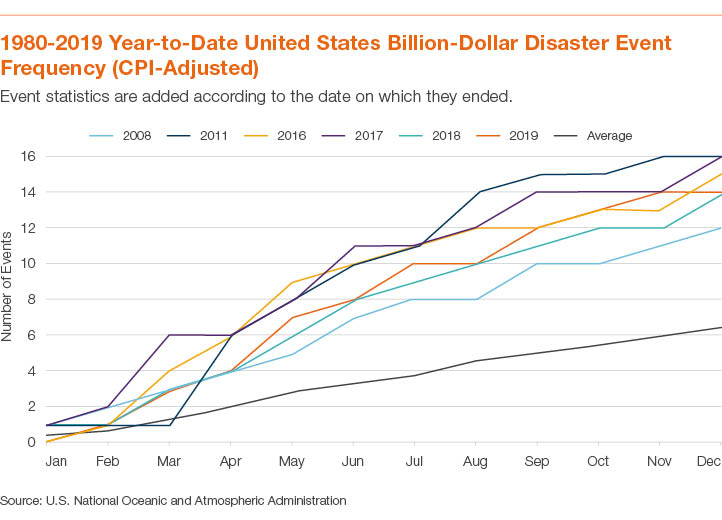
The following chart is specific to the United States, though it certainly scales at a global level and points to a distinct increase in the number of climate-related events causing $1 billion or more in damage over the last decade.
So What Can We Do?
It would be easy to throw our hands up based on the enormity of the underlying challenges involved in turning around our environment, but that’s not how the supply chain community operates. After all, we collectively make the world run on a daily basis.
One tactic that will not work is trying to solve these global environmental issues, solely, as individual entities. We, of course, need to take action as individual companies, but there also needs to be an ecosystem-wide approach to making this all work. Some suggestions:
A Call to Action
The pressure to act on environmental sustainability issues will only increase over the next decade. Fink and his counterparts’ voices at other environmental, social and governance (ESG) funds will only grow louder in our boardrooms. More work and partnership will certainly be needed.
To quote teen environmental activist Greta Thunberg’s recent address at the World Economic Forum in Davos, “Our house is still on fire.” Immediate action is required. Let’s do this supply chain!
Stan Aronow,
VP Distinguished Advisor,
Gartner Supply Chain
stan.aronow@gartner.com
Beyond Supply Chain
Subscribe on LinkedIn to receive the biweekly Beyond Supply Chain newsletter.