By Kevin O'Marah | May 29, 2015
CSCO Outlook for 2027: Cloudy With a Chance of Moderate Growth
October 09 2026


By Kevin O'Marah | May 29, 2015
Today, I had a meeting on supply chain futures with a couple of reporters from the Wall Street Journal. The unifying theme across topics as diverse as Uber, West Coast port problems and Amazon’s margins was how all these forces are affecting work. Macroeconomic data says unemployment is low in the United States, but still wages remain stagnant.
Middle-class jobs are an endangered species, by this logic. And yet, WSJ’s Loretta Chao just published a hot article calling out the talent shortage in supply chain. Her report focused on needs in big companies like Cisco and Kimberly-Clark, but trends in work look set to reward a wave of innovators able to tap emerging technologies to gain an operating edge.
The edge comes not from doing the same old thing a little better, but seeing something altogether new.
“Interesting, but…”
In our 2014 survey of over 1,000 supply chain executives, we found five emerging technologies that were deemed “interesting, but of unclear usefulness” by over 40% of respondents. Unlike big data analytics, which was decisively labelled “disruptive and important”, or drones, which most called irrelevant, these five are up for grabs.
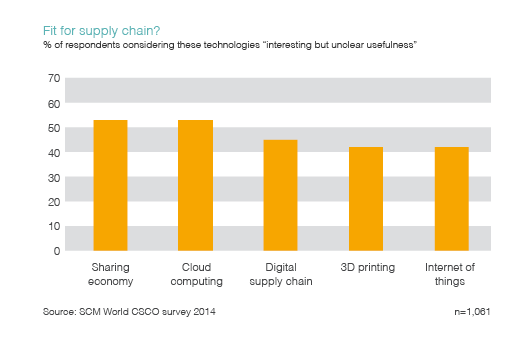
Once figured out, these emerging technologies offer some Wild West-style entrepreneurialism that could create wealth, jobs and competitive advantage for supply chain leaders who see over the horizon.
Sharing economy – Aka Uber, this tech trend scored lowest as “disruptive and important” – and yet, it tops in curiosity. The supply chain angle is about utilisation of idle assets, with a second-order effect in labour matching. Supply chain-friendly examples include Instacart, which is a winner for Whole Foods Market, or Cargomatic, which helps California shippers find trucks. These connect asset-leveraged entrepreneurs with corporate customers looking for incremental capacity. An Uber-style service for semiconductor fabrication, refrigerated warehousing or any other supply chain asset can’t be far away.
Cloud computing – Most in supply chain see that this is important, but aren’t sure what to do with it. Salesforce.com makes a world of sense for field sales operations, but what about ERP and supply chain systems where it would really help to have easy-on, minimal-integration support for order management or planning? This would work for companies of any size struggling to integrate acquired operations or harmonise global sites on different versions of big ERP. Kenandy, GT Nexus, One Network, and Kinaxis are doing it now for businesses like Del Monte and NCR. Why not you?
Digital supply chain – No one thinks this is irrelevant, but very few know how to exploit it. The obvious but unreachable icon here is Apple, whose consumer experience is mostly digitised, with apps “delivered” electronically after sale. In fact, many other use cases are also possible, including apps written for energy efficiency on a buildings control platform, such as Panoptix from Johnson Controls. The hardware (air conditioners, thermostats, condensers) is already there – better uses of it come from software, delivered electronically after the fact. Why not do the same thing with household appliances, cars and medical devices? Samsung, Tesla and GE are on it already.
3D printing – As a prototyping aid, this is old news. For production it is newer, but still largely limited to high-value, low-volume uses, like aerospace parts. Between these two poles, however, lies opportunity. For instance, production quality tools for blow-moulded bottles: limited-edition shapes in packaging might make sense to spur sales of sugary drinks or specialty shampoos. As an extension of the marketing or product development function, this begs for a different kind of talent. As a third party-contractor market, it is also ripe for creative start-ups.
internet of things – Smart hardware is everywhere. What to make of it, however, isn’t obvious. Inventory savings sound good, but most are pretty lean already. How about smart machines like the sensor-loaded earth-moving equipment from Caterpillar, whose Product Link system lets customers track and manage fleets of trucks and excavators more efficiently? Here again, entrepreneurs able to layer services on top of existing machine networks could thrive, serving both maker and user alike.
Schumpeterian destruction says new jobs will emerge from the charred earth of this technology revolution, but they won’t look much like the jobs they will replace.
Beyond Supply Chain
Subscribe on LinkedIn to receive the biweekly Beyond Supply Chain newsletter.