By Steve Steutermann | January 16, 2019
CSCO Outlook for 2027: Cloudy With a Chance of Moderate Growth
October 09 2026


By Steve Steutermann | January 16, 2019
Looking to the future can be a daunting task with many unknowns. Gartner projects that four factors will likely impact your supply chain over the next 10 years, and that they will all converge toward one major transformation. In 2028, supply chains will “ACT ON THEIR OWN,” with the ability to self-regulate and take appropriate actions. This will increase and augment the capabilities of humans well beyond today’s levels. Let’s review those four factors.
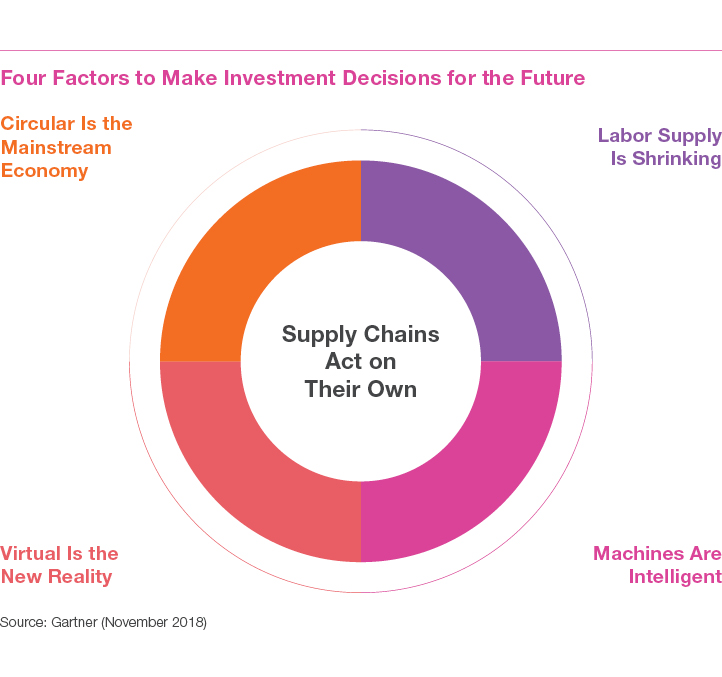
The Labor Supply is Shrinking
Talent planning for the future supply chain must embrace programs to address the shortage of talent and the shift in geographical location of labor impacting supply chains. A digital dexterity worker is essential to the future supply chain. Workers will need to adapt to technology at a more rapid pace and have the ability to use real-time tools to make better decisions and be comfortable with advanced analytics and artificial intelligence. They will need to be socially savvy to understand trends, and leverage AI tools to augment capabilities and solve supply chain challenges. Future supply chain leaders will need to do a digital dexterity scan to assess gaps in their organizations. Digital dexterity training will become an essential part of every supply chain talent program.
In 2028, humans and machines will combine to augment decision-making, and will function better together than either one does alone. It’s a big issue today — for example, planners already ignore AI-based forecasts or instances when planners do not believe and accept inventory optimization recommendations. Greater governance will be required to fully capitalize on humans and machines. Humans will continue to provide collaboration and ingenuity in 2028, while machines will offer speed and precision of decisions as well as brute strength when necessary to get tasks done.
Machines are Intelligent
Intelligence will deliver insights and automate actions. We already see this today, but by 2028 machine intelligence will permeate every part of society, supply chain included.
Take for example Pratt & Whitney aircraft engines. In the past, performance data that was previously relayed twice in a flight can now be sent every 2.5 seconds, providing real-time predications and prescriptive actions to improve operating performance and efficiency.
Today, supply leaders have the ability to sense daily demand down to customer lanes, through use of machine learning while handling daily tasks beyond the capability of humans. AI is being used in customer service to remove complexity, automate daily decisions, predict orders and remove costs. By 2028, virtual agents will participate in a majority of commercial interactions between people and businesses.
Virtual is the New Reality
Virtual capabilities will be varied and emergent, with impact across the supply chain. They will create efficiencies, lower costs and provide new value. Examples:
Circular is the Mainstream Economy
In 2028, the circular economy not only is the mainstream economy, it’s the only economy. Supply chains will not be allowed to produce waste as society will increasingly view waste as unacceptable.
A consumer products CSCO recently shared with Gartner a concern that his company will be unable to include plastic in its packaging or products 10 years from now given growing worldwide concern for our oceans, sea life and food chain. He believes companies must seek renewable plant-based packaging solutions.
The early beginning of circular started with compliance and satisfying government regulations. In the future, it’s no longer a linear supply chain as we think of it today. Less waste to landfill or less use of water will become outdated models. New metrics will measure the circular supply chain that recycles, renews, and produces no waste.
So prepare today for 2028 by addressing the following:
Steve Steutermann, Managing Vice President, Supply Chain Research & Advisory, Gartner
Beyond Supply Chain
Subscribe on LinkedIn to receive the biweekly Beyond Supply Chain newsletter.