By Kevin O'Marah | September 22, 2017
CSCO Outlook for 2027: Cloudy With a Chance of Moderate Growth
October 09 2026


By Kevin O'Marah | September 22, 2017
Bill and Melinda Gates co-authored an opinion piece in last week’s Wall Street Journal imploring us all to stay the course on U.S. foreign aid. They note that total U.S. foreign-aid spending amounts to less than 1% of the federal budget, which is not much.
The Gateses go on to cite data from the Organisation for Economic Co-operation and Development (OECD) that says American taxpayers spent $12.8 billion on global public health in 2016, a figure only about four times what the Bill & Melinda Gates Foundation itself spends. Their just-released report details the human impact in data and narrative form after nearly two decades of aggressive philanthropy.
The Gateses have earned the right to preach a bit here.
High ROI
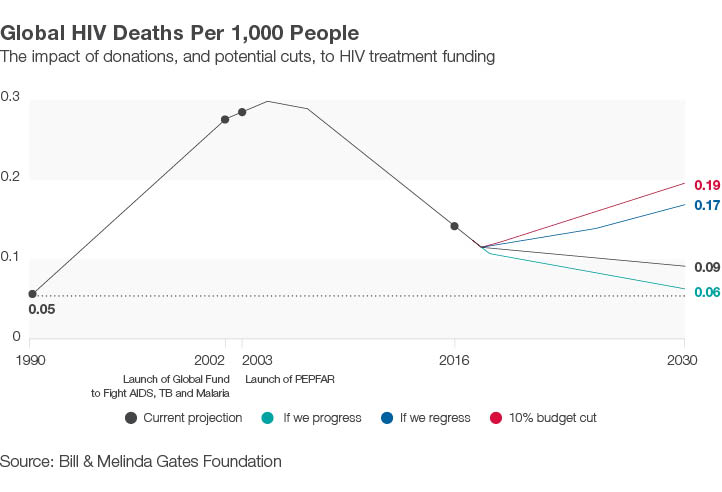
The bang for buck from all this generosity has been impressive. AIDS, for instance was dramatically slowed as a global epidemic in part by the President’s Emergency Plan for AIDS Relief (PEPFAR), launched by George W. Bush in 2003.
Infant mortality was also significantly reduced in Ethiopia, an important country of 100 million people, where deaths per 100,000 live births were cut by almost 60% with aid to public health. And in terms of the broadest measure of poverty, we’ve seen outright deprivation cut by over 70% since 1990.
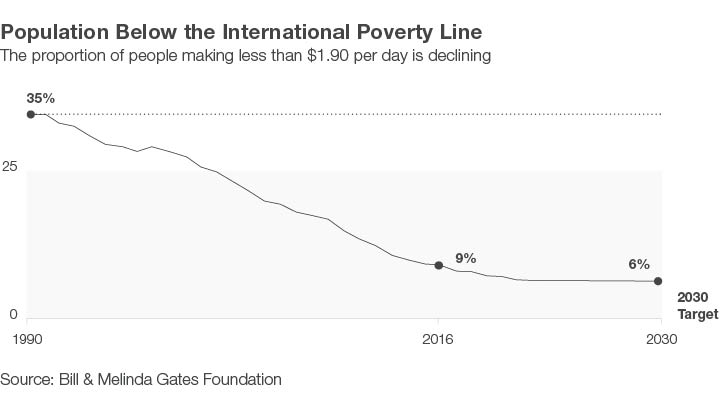
The Gateses are saying that, though we’re on the right track, we’re increasingly at risk of pulling back at just the wrong moment.
I agree.
Supply Chain Strategy and Investing in the Poor
Governments and charitable organizations have long played leading roles in channeling aid to the world’s needy. Judging by the television advertisements used to raise cash, the pitch rests on morality. The Gateses’ editorial says as much: “Disease and poverty are the clearest examples we know of solvable human misery, and the moral case for wiping them out is clear on its face.” To the Gateses it’s all about altruism, and that’s fine. But what if we look at it in selfish terms?
Here are four purely self-interested, operational reasons to support continued aid to the poor:
Supply chain leaders need not be political. They must, however, choose plant locations, develop distribution networks, hire staff, position inventory and prepare for disruptions. Investing in the poor is not charity so much as good housekeeping.
Let’s keep it up.
Beyond Supply Chain
Subscribe on LinkedIn to receive the biweekly Beyond Supply Chain newsletter.