By Kevin O'Marah | September 18, 2015
CSCO Outlook for 2027: Cloudy With a Chance of Moderate Growth
October 09 2026


By Kevin O'Marah | September 18, 2015
This week’s Wall Street Journal included a front-page headline that read “Worries Rise Over Global Trade Slump”. Its gist was that we’re in for trouble if globalisation rolls back in favour of more regional or local supply chains.
The implication is that far-flung manufacturing and sourcing strategies are better for business profits, economic growth and productivity gains. This may have been true between 1980 and 2010, but the world has changed and I think it’s for the better.
The phrase “shortening global value chains”, coined in a quote from the WSJ article, comes from Douglas Lippoldt, Senior Trade Economist at HSBC Holdings. It says a lot about what’s happening. Supply chain executives have, for at least the past five years, been reacting to rising risk levels, higher labour costs and a need to be closer to customers by regionalising their supply networks.
The catchy concept of reshoring (especially in the United States) distils the movement politically. In terms of supply chain strategy, however, it is really more about increasingly localised supply chain designs. The idea not only reduces risk and total landed cost, but also takes advantage of technology trends such as robotics, additive manufacturing and the internet of things to offer more customised products finished closer to the point of sale.
Data we’re collecting on trends in supply chain job creation show that this is really happening. US is adding two new jobs for every one it eliminates, while Mexico creates jobs at 12 times the rate it loses them. China, meanwhile, although still a net creator of new jobs, is now reducing employment substantially: more than 50 companies in our survey say they are cutting positions there.
Elsewhere in the global supply chain, big gains are clear in India, Brazil, Singapore and Vietnam, all of which are adding 3-5 times the number of jobs that they are eliminating (see chart). Even among the biggest net losers like the United Kingdom, France and Germany there are dozens of companies creating new positions.
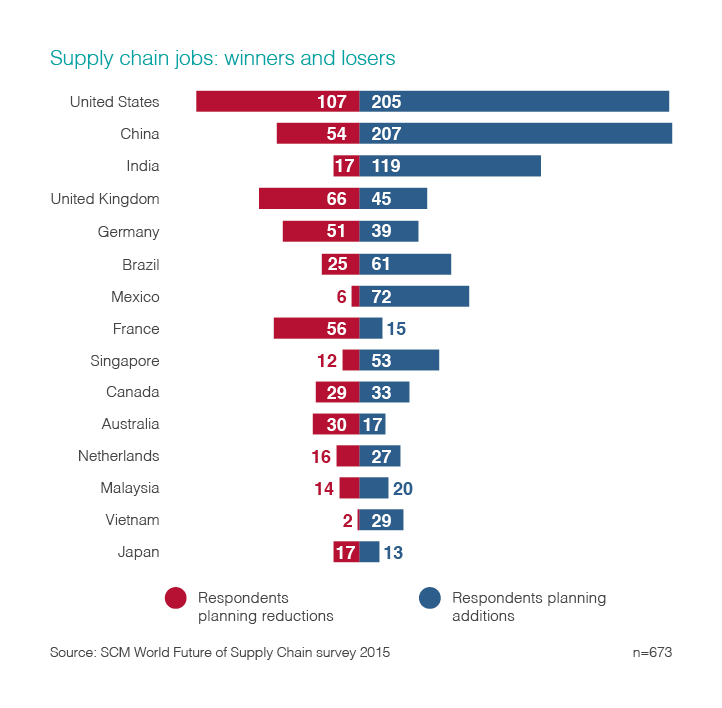
Globalisation may once have been more or less synonymous with low-cost country sourcing, but today it means leveraging valuable intellectual property including brands, designs and formulations with local or regional supply chains.
The benefits of manufacturing, sourcing and distributing goods close to their end-use markets run the gamut. Some, like Airbus which just opened a plant in Mobile, Alabama, want to be close to powerful customers who desire easy access to suppliers’ worksites. The same applies to Boeing, which is looking to open a new operation in China to target Chinese airlines.
Some, like Detroit Bicycle, want to establish credibility as craftsmen offering high-end personalisation at premium prices. Such a premise underlies almost 6,000 jobs sprinkled among small manufacturers at the Brooklyn Navy Yard in New York.
In other cases, the rationale is some combination of technical knowhow and market access – as is the case with Novo Nordisk’s new operation in North Carolina’s research triangle, which includes 691 jobs. Right down the street one can also new find apparel jobs offered by the Salt Life clothing brand of Delta Apparel, Prestige Clothing in Kentucky or Keer Group’s cotton mill, relocated from China to South Carolina.
This phenomenon is happening in Europe, too, with examples like Bentley in Crewe, UK, hand-making super premium cars or Twistlock reshoring 55 jobs from China for cast metal parts. The unifying thread is that making money does not necessarily equate to ever-cheaper sourcing.
In any case, as the WSJ article notes, China’s policy move away from export-driven growth and towards a consumer economy requires a fundamental rethink of global supply chain strategies. To be clear, we studied this in detail back in 2013 and predicted exactly what the data shows now.
The message to supply chain strategists is simple: use the emerging technologies of customer centricity to better understand demand and deploy the tools of smart manufacturing to more precisely make exactly what customers want.
In a world with social media listening, clickstream demand analytics, and smart retail fixtures we’ll know each customer intimately. Given tools like 3D printing, collaborative robots and flexible machinery, why not make things when and where they are needed?
Beyond Supply Chain
Subscribe on LinkedIn to receive the biweekly Beyond Supply Chain newsletter.