By Kevin O'Marah | October 20, 2017
Navigating the Supply Chain AI Fog
September 18 2026


By Kevin O'Marah | October 20, 2017
It is gospel that supply chain strategy starts with the customer and works backwards. For decades that meant crunching sales and marketing data delivered in occasional buckets of structured, but low-resolution information. More recently that sporadic flow has become a continuous and growing stream of data as customers click away on e-commerce websites. Soon it will feel like a tidal wave of demand information — noisy, unstructured, emotional and yet also mechanical.
What if we could understand and take advantage of it?
Finding Signals in the Noise
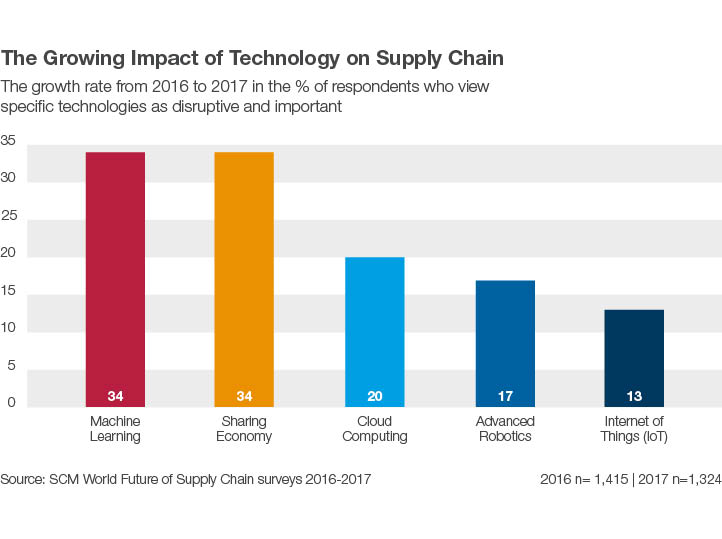
The fastest-growing disruptive technology in supply chain circles right now is now machine learning (ML). Its capabilities benefit from exponential advances in computer power, enormous new training data sets and refinement of algorithms for making sense of it all. The appeal of ML reflects hope that we’ll master the flood of new demand data and, in the process, sell more, with increasingly personalized offerings and an even leaner supply chain.
Demand sense is the starting point. Looking ahead, demand signals will come not only from point-of-sale systems and websites, but also from connected homes, voice-ordering networks, sensor-enabled machinery and wearable or embedded biometric devices. Finding meaningful patterns, pockets of opportunity and behavioral correlations could give supply chains a much sharper picture of what customers really want.
Machine learning is better at this than humans are. Plus, as next generation technologies for deep neural networks, quantum computing and even brain computer interfaces become available, the power of ML will grow. As it does, we may find it pervading our lives in ways we can barely imagine today.
Knowing Your Customer
During last weekend’s National Football League broadcast both Amazon’s Alexa-based and Google’s Home-based voice-ordering systems were advertised alongside pickup trucks and beer. Artificial intelligence, which lies at the core of these systems, has often been portrayed as a villain, but now it appears as a friendly face in the pantheon of consumer brands.
We are being conditioned to expect ML every time we search the web, use autocorrect while typing, or talk to Siri. It feels familiar and rewarding, and it certainly saves us time. Our daily use is rapidly increasing and the contact points we experience are proliferating.
The result is an ability to sense demand in context and guess what will be ordered before it is, also known as forecasting. The difference is that, unlike traditional forecasting, which worked reasonably well for aggregated demand, this new version works at the level of one.
From a supply chain perspective this sounds great. Automatic replenishment orders that are generated by smart appliances, like those in the works at Samsung, should make forecasting much easier. Suggested purchases, such as what we experience when watching Netflix or shopping on Amazon, similarly precorrelate who is likely to buy what, and when they’ll want it.
Be Prepared
In terms of supply response, the challenge will be knowing how to manage inventory, capacity and deliveries to keep up with customers’ expectations. Traditional planning cycles accommodate long production runs and full-truckload shipping. This trades off long lead times and lots of working capital in return for low unit costs.
That formula won’t work in a world where machine learning keeps upping the clock speed of demand sense. Supply chain response must change to keep up.
We can already see the evidence in our Future of Supply Chain survey data. Each year since 2013 the share of respondents building smaller, more local distribution centers has risen. Also, the percentage building direct-to-customer fulfilment capabilities is still rising. Just over a quarter now say they see little or no change in existing channels.
The question is whether we’ll be able to apply the powerful new tools arising with ML to the supply response side of operations in ways that match what we’re already seeing in demand sense. The good news is that experimentation with ML in areas such as inventory levels and location, route selection and delivery sequencing shows promise, as well as a learning curve that steepens with practice.
Forecasting is based on sensing demand. ML makes this dramatically faster and more precise. It’s time to go to school on how machine learning can work upstream.
Beyond Supply Chain
Subscribe on LinkedIn to receive the biweekly Beyond Supply Chain newsletter.