By Kevin O'Marah | July 10, 2015
CSCO Outlook for 2027: Cloudy With a Chance of Moderate Growth
October 09 2026


By Kevin O'Marah | July 10, 2015
The cover story on Harvard Business Review’s current issue shouts: “It’s time to blow up HR”. As an attention grabber for anyone concerned with people and talent management, this title works. The article inside, however, is somewhat less convincing. Its main recommendation is to “set the agenda now” and start “rethinking programs that have been around since the 1950s”. How bold is it really to urge business leaders to rethink 60-year-old ideas?
Along with its cover story, HBR offers several other analyst takes on how to improve the workings of human resources (HR). The common thread is essentially that alignment with business goals is important.
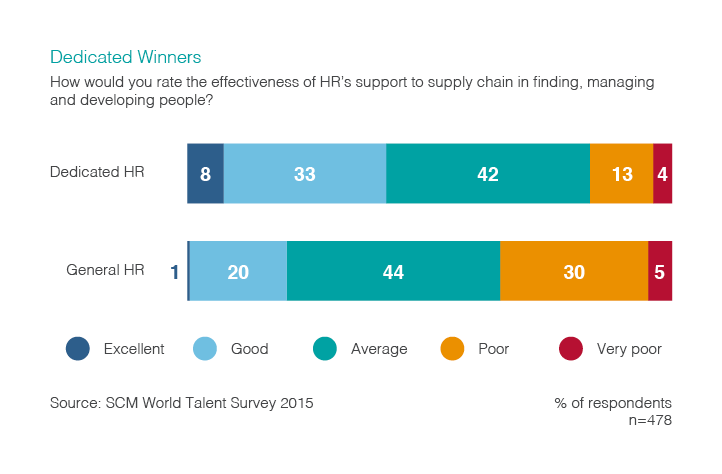
Having spent several years researching the persistent problem of talent management in supply chain, we at SCM World couldn’t agree more. In fact, our most recent field study on the topic shows that HR dedicated to supply chain (29% of our sample), rather than provided from a central administrative core (58%), is twice as effective when it comes to finding, managing and developing people.
Supply chain is, by its very nature, cross-functional. The best supply chain talent not only grasps the technical and mechanical implications of how inbound supply affects operations, or how sales forecasts affect cost and availability, but also knows how to work with people across departments.
This talent is all too rare, in part because the right people are hard to find in the first place, but also because skill development among those already on board is difficult.
Solving this problem seems to require blending two ingredients. The first is a strategic understanding of how supply chain impacts profitability, competitiveness and growth. The second is how human beings think, learn, communicate and are driven to perform.
Supply chain leaders know all about the first but little or nothing about the second. HR is just the opposite. This is probably why dedicated HR within supply chain works so much better.
The details of how this works prove the point. Among 11 specific capabilities we tested, the three with the greatest gaps in favour of dedicated HR for supply chain over general HR were financial acumen, cross-cultural leadership and cross-functional collaboration.
The first of these matters because basic finance is not enough to understand working capital and risk-adjusted return on investment analytics essential to supply chain. The second is uniquely important to managing global networks of plants and suppliers. The third is what makes supply chain special in the first place.
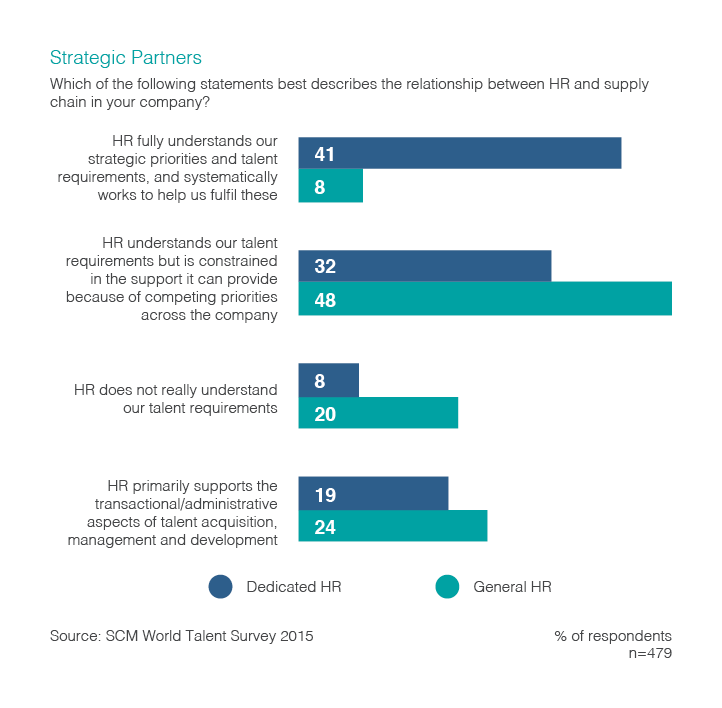
Dedicated HR meets these requirements so much better that our survey respondents are five times more likely to say that HR understands the specific talent needs of supply chain than are those relying on general HR resources.
HBR’s lead article recounts the historical correlation between HR’s influence and labour market tightness, especially in the United States. As a matter of professional pride, it urges getting ahead of this cycle by taking a business-driven angle to seize the agenda.
For supply chain, the timing is not cyclical but structural and based much more on new technologies and their impact on the function.
Our research on automation and robotics, for instance, clearly points to the need for serious upskilling in manufacturing. Key disruptive technologies also include big data analytics as applied to internet-of-things equipped supply chains and social media demand sensing, all of which requires more than just technical knowhow.
The game is moving to a new domain of work, calling for much more subtlety and people skill than ever before, especially in bread and butter areas like S&OP.
It is happening with companies as diverse as Baker Hughes, International Paper, Johnson & Johnson and VF Corporation – all of which are managing the supply chain talent challenge with dedicated HR professionals.
SCM World members that have invested significant leadership energy to this cause include General Mills, Schneider Electric, Mattel, Grainger, Under Armour and Intel. Leaders from these companies are among those sharing their lessons learned at our first ever event dedicated to capability development in Chicago this week.
Maybe what we need instead of blowing up HR is to learn how to partner with it.
Beyond Supply Chain
Subscribe on LinkedIn to receive the biweekly Beyond Supply Chain newsletter.