By Kevin O'Marah | March 20, 2015
CSCOs Seem to Talk About the Same Things, But They Really Aren’t
August 28 2026


By Kevin O'Marah | March 20, 2015
Those fearing a rates rise by the Fed this year should remember that inflation lost its teeth in 1996 and probably won’t ever gain them back. The rise is now on the cards, but the reason behind it is not to put the brakes on an overheated economy. The traditional idea of “too much money chasing too few goods” doesn’t stand, and rate increases in 2015-16 will be small and strictly symbolic.
The end of inflation
People in their 50s or older remember inflation. We saw it in the US back in the 70s when we were still a manufacturing-centric material economy. Oil was king then and most things people bought came from old-school smokestack factories with thousands of hourly workers slaving away. Loose monetary policy then could easily kick off bidding wars among consumers, government procurement agencies and business investors for truly limited resources. Classic inflation was a legitimate problem.
Almost imperceptibly however, the game changed. The trigger was a commercially available internet which tied old-fashioned physical productivity gains to the far steeper learning curve being ridden in information businesses. Hourly output rates in the US economy began growing on a faster trajectory than what had been known since the end of Wold War II.
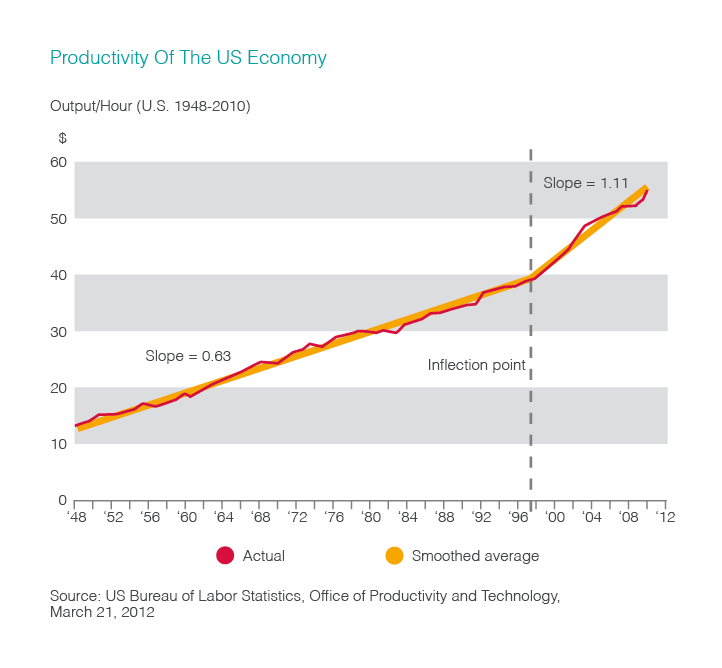
We were distracted – first by the internet bubble and then by the housing bubble – from seeing the underlying reality, which is that we no longer experience that classical phenomenon of too much money chasing too few goods. In fact, for anyone who has shopped at Costco or Wal-Mart, it’s quite clear that the opposite is true: US material productivity is presently growing faster than our ability to consume it all.
Our problem is obesity, not scarcity.
Thank you Wal-Mart
The breakthrough happened in 1996, when Wal-Mart made Retail Link and EDI available to its suppliers via the internet. This was the first really big step forward in binding information technology to manufacturing. It was also the dawn of supply chain as we know it today.
Prior to 1996, the conceptual image of a “supply chain” made sense, since information travelled along with physical product in the form of bills of lading, receipts and orders, most of which were printed on paper and filed in drawers. Massive information latency meant any increase in money supply translated quickly into inflation: store shelves, warehouses and factories could pretty easily run out, making price increases perfectly reasonable.
With Wal-Mart pressing consumer demand back into the supply chain and Procter & Gamble et al. diligently processing it into a deeper and better forecast, the demand-driven supply chain was born. Since that time, powerful operational principles like lean, postponement, and design-for-manufacturability have been developed, not only within companies, but between them. The simple fact is that a decent supply chain person can always find another 5-10% performance improvement in whatever operating metric he or she shoots for.
Meanwhile, population growth rates for the US have hovered around 1% per year since the mid-1990s and true material poverty is nearly non-existent. We make more than we need and our ability to keep doing so is running ahead of demand. Inflation is dead.
The robot age
The final ingredient has to do with labour and the end of union power. Scarcity was something that could be forced back in 1970, when steel, coal or transport unions could strike. Today’s manufacturing world is increasingly built on automation with far fewer unskilled jobs and much more information value baked into everything we consume. This, of course, includes the massive and fast-growing slice of consumer spending that goes to pure information products like iPhone apps, Netflix movies and Microsoft Office updates.
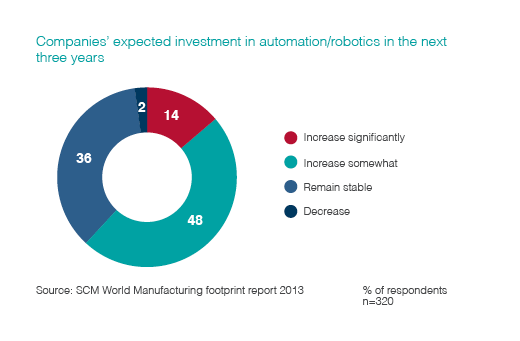
Between dematerialisation of the economy and the elimination of large-scale organised labour as a limiting factor in manufacturing operations, inflation will struggle to find a footing in the US economy ever again. Any temporary scarcity of a particular commodity will be quickly met with a workaround or technology breakthrough (e.g. oil with fracking and alternative energy). The economics of ideas run on a whole different platform, where pricing works in reverse.
Inflation doesn’t scare Janet Yellen. She’s doing us a favour mincing words.
Beyond Supply Chain
Subscribe on LinkedIn to receive the biweekly Beyond Supply Chain newsletter.