By Kevin O'Marah | October 04, 2013
Navigating the Supply Chain AI Fog
September 18 2026


By Kevin O'Marah | October 04, 2013
A recent Bloomberg article quotes Logitech CEO Bracken Darrell saying: “About half of what we sell we make, and half of what we sell we source from somebody else. It’s an interesting strategy. It’s really worked for us over time.”
The takeaway is that manufacturing in-house for especially sensitive or innovative products lets the Swiss peripherals maker protect its intellectual property while at the same time taking advantage of third-party manufacturers’ lower costs for products that lack secret sauce. The ability to systematically make this choice is not just about manufacturing, but also new product development and launch. Supply chain ideally handles both.
The notion of product lifecycle management (PLM) encompasses everything from ideation through design engineering, ramp-to-volume manufacturing, market launch and ultimately take-back. In the bad old days, big brains in R&D would dream up brilliant innovations and throw them over the wall to manufacturing and sourcing to get them built. From a business perspective this dynamic was often disastrous, with unnecessary complexity adding cost and time to the product innovation process and often also hurting quality and serviceability after sale. Increasingly this wall is coming down.
Last year we drilled into Apple’s supply chain strategy and reported on one key success factor – excellence in embedding new product development and launch into supply chain. As proof, we offered data breaking down the company’s operations job postings to show that a huge portion are in fact engineering roles, not classic supply chain roles. The business result is, of course, hard to argue with, including as it does massive sales, profits and market cap.
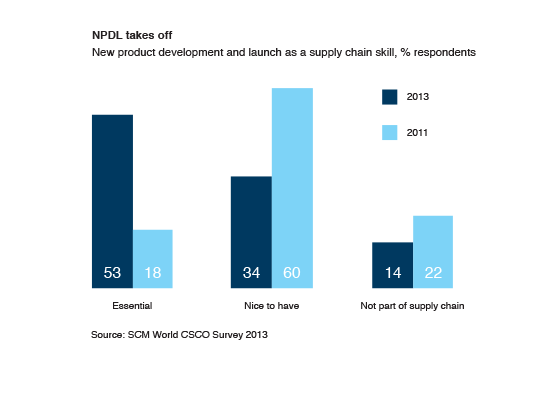
Having just finished digesting the data from our latest Chief Supply Chain Officer study, it is clear that this lesson has been internalised by many in the supply chain community. Two years ago we collected data on which skills are considered essential to supply chain, which are nice to have, and which are not part of supply chain at all.
For the most part, desired skill sets have changed minimally between 2011 and 2013. Classic supply chain duties like planning, sourcing and logistics remain at or near the top of the list. New product development and launch (NPDL), however, saw a threefold jump in importance, with more than half of all respondents deeming it “essential” this year compared to only 18% in 2011. NPDL, it seems, is the new must-have skill for a rising star in supply chain.
Ten years ago, I was deep into PLM as a research topic and found the oft-cited factoid that 80% of a product’s lifetime costs are set during early design very helpful when addressing audiences in either supply chain or engineering. Nearly everyone bought this idea, but for a long time few could really act on it because of organisational inertia separating those responsible for product design from those responsible for ramping supply. Could we finally be over this hurdle? I’d like to think so.
Apple – and apparently Logitech – are showing the way forward with a holistic approach to innovation that integrates product and process in one. The principle is neither new (IBM pioneered integrated product and process design in the 1990s) nor unique to hi tech (Renault, Zara, Clorox and Novartis are among other companies that have made it work). But it still seems to be hard to achieve. The key ingredients, in my experience, include two complementary things: discipline and a solid product data management (PDM) system.
Discipline is essential because someone needs to tamp down the natural enthusiasm of designers and engineers for pure creativity. I recall an uphill battle at Gap some years ago to corral its New York design team with materials standards set by headquarters in San Francisco. The concept made sense to the business, but not to the fashion crowd back east.
As for PDM, such systems are nearly as painful to adopt and use as ERP, but without them nothing can happen. Product specifications, configuration rules, order of operations and much more are the recipe for everything. Without a robust system of record underpinning NPDL, costly errors will multiply as the pace of innovation quickens and things like engineering change management start to hurt.
Bringing supply chain and product innovation ever closer together is a win for all concerned. Perhaps the time has come.
Beyond Supply Chain
Subscribe on LinkedIn to receive the biweekly Beyond Supply Chain newsletter.