By Kevin O'Marah | June 24, 2016
CSCO Outlook for 2027: Cloudy With a Chance of Moderate Growth
October 09 2026


By Kevin O'Marah | June 24, 2016
Three times in the past six days, I’ve worked with senior supply chain executives wrestling with the challenge of equipping talented, well-meaning people to drive change in their organisations. One was a branded CPG company, another hailed from automotive and the third was in healthcare. In each case the supply chain and business strategy were clear, but the path to mobilisation was not.
The hurdle for all was finding a way to quickly create change agents capable of persuading colleagues in commercial, R&D and business unit management to work collaboratively.
How do you sell the benefits of end-to-end thinking to people who’ve traditionally succeeded as solo performers?
That’s the question.
Articulating the obvious
“The only thing that’s certain about a forecast is that it’s wrong.” This classic rebuttal to supply chain’s timeless thirst for demand visibility is symptomatic of what we face when trying to change operations for the better. Just as silly is the finance-driven urge to pound suppliers for savings without offering any meaningful cooperation in return. And of course, marketing people can get pretty revved up about a cool promotion, but totally forget to warn product supply.
For supply chain people, the problem is tied up in getting everyone to understand how their actions affect the rest of the business. Purely revenue-driven salespeople declare victory with deals closed at the 11th hour only to give away margin on cost-to-serve. Service reps fall all over themselves “delighting” customers and in the process run up massive working capital bills with bulging spare parts inventory. Design engineers crave patents and critical acclaim, but too often specify materials that blow up product costs.
All of this is obvious to supply chain strategists but very challenging to convey across the business.
Leadership in supply chain
As digitisation speeds things up and investor pressure builds, the urgency of creating change agents mounts. Essential skills for emerging supply chain leaders are increasingly tilting away from left brain quantitative expertise with spreadsheets. In fact, the most essential skills are all soft – communication, strategic thinking and change management itself.
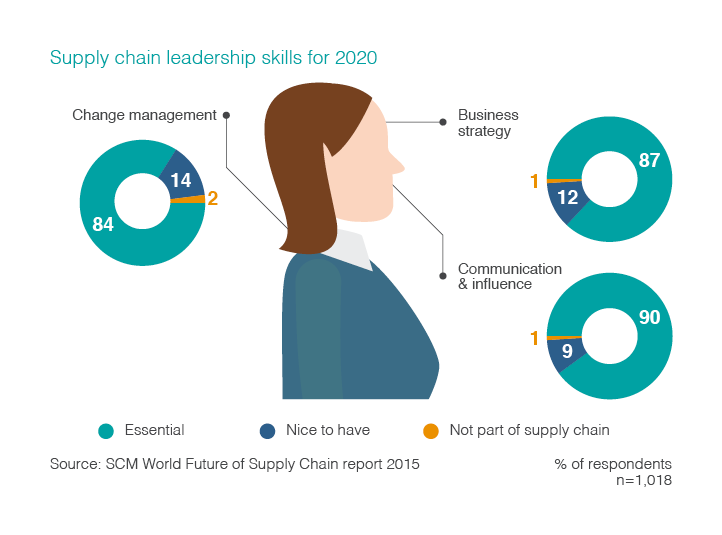
The takeaway is clear: it’s less about making the business case than selling it. Leaders aren’t only those who know what to do, but can get others to go along.
And make no mistake, this is not everybody’s job. Supply chain, by its cross-functional nature, is where end-to-end thinking is most easily understood. It also touches everyone else in the business on a daily basis. Sales guys in the field aren’t going to lead the charge. Nor are scientists in the lab.
Change management is your job.
Learn from the best
A few examples might be useful here. One of the most successful end-to-end transformations I’ve ever seen was at Intel, where impending cost pressures drove a complete rethink of order taking, supply planning, inventory management and, ultimately, even product design.
The rallying cry from the top down was “just say yes”. As a total cultural shift for an engineering-driven tech-hero culture, this phrase opened minds. As a practical matter, it also forced questioning assumptions about lead times, planning cycles and customer commitments. The role of supply chain leadership in this exercise was to unbundle the steps needed to make it work and navigate process redesign to get them done.
Another classic motivator comes from Procter & Gamble: its pioneering work in building a consumer-driven supply network hung off the concept of ‘moments of truth’. Like the Intel example, P&G’s catchphrase allowed all concerned from brand management to R&D to care in unison about end-to-end execution. Supply chain played the vital role of articulating, problem solving and actually delivering on the mission.
And finally, I’ll offer The Coca-Cola Company. Its culture is most certainly marketing-led, but it still managed to take a quantum leap in supply chain capability over the past decade. The key in Coca-Cola’s case was inclusion. Its Global Supply Chain Council comprises independent bottlers, company-owned bottling operations and leaders from commercial, marketing and technology functions in a week-long event designed to spread the word about transformation.
The essential ingredient is motivation from bold leaders telling a compelling story.
Inspiration is everything.
Beyond Supply Chain
Subscribe on LinkedIn to receive the biweekly Beyond Supply Chain newsletter.