By Kevin O'Marah | July 16, 2015
CSCO Outlook for 2027: Cloudy With a Chance of Moderate Growth
October 09 2026


By Kevin O'Marah | July 16, 2015
This week’s agreement to lift economic sanctions on Iran in return for a 15-year period of controlled and verified nuclear technology development could be a big win for businesses in all sectors. Leaving aside the political and military implications, the deal means that 79 million accessible, experienced consumers may suddenly be ready to buy nearly everything needed for a modern economy.
Consumer products will certainly benefit, but so too will healthcare, durables and of course industrial and civil infrastructure, as the entire Persian world refurbishes itself after years of economic isolation.
The Wall Street Journal this week published a brilliantly researched article on business opportunity in Iran, citing examples including Apple, General Electric, Coca-Cola, Boeing, Bayer and PSA Peugeot-Citroën, among others. At the company level, each of these represents substantial incremental sales, but at the macro-market level Iran is a real prospect for nearly all businesses with a decent supply chain organisation.
In terms of population, Iran is the 17th largest country in the world, slightly smaller than Germany and bigger than Turkey. Its GDP per capita at $5,292 is significantly greater than comparably sized emerging markets like the Philippines ($2,841), Vietnam ($2,502), Egypt ($3,436) and Ethiopia ($567).
This figure is well down on what it was in 2011, reflecting the worsening bite of trade sanctions. Compared to Turkey, for instance, Iran’s GDP per head of $7,644 in 2011 trailed by a mere 28%. Iran is ready to hook into the global supply chain as a customer immediately.
The country is physically accessible too, with plenty of ocean port access from the Persian Gulf and a substantial land corridor into greater Europe via Turkey. There is a well-established network of transportation and more than a dozen flights daily to Tehran from mega-hubs like Dubai and Doha.
And let’s not forget Iran’s relatively recent past as an active capitalist economy. Until the 1979 revolution, Iran was importing the full suite of economic output from the global supply chain and exporting plenty of oil. Persia is one of history’s great societies with pride, confidence and connectivity to the rest of the world.
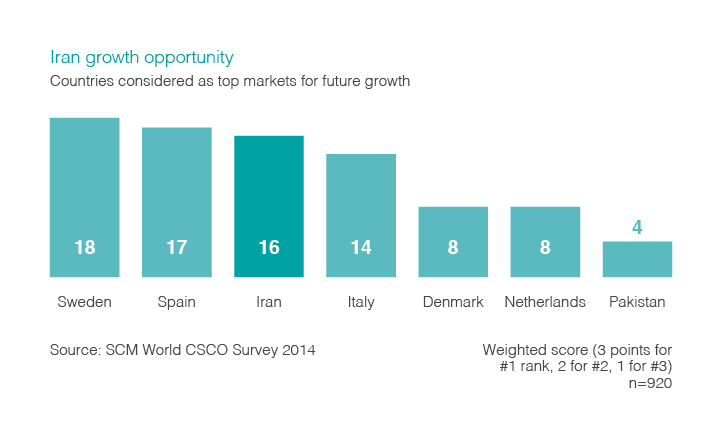
SCM World’s annual Chief Supply Chain Officer Survey reflects some of this potential, even though the data was collected 11 months ago when the prospects for the current deal were still dim. Asked to identify the top three countries their companies saw as opportunities for growth, some cited Iran. In fact, when the scores were weighted, Iran came in ahead of Italy, Denmark, the Netherlands and Pakistan and only slightly behind Spain and Sweden (see chart below).
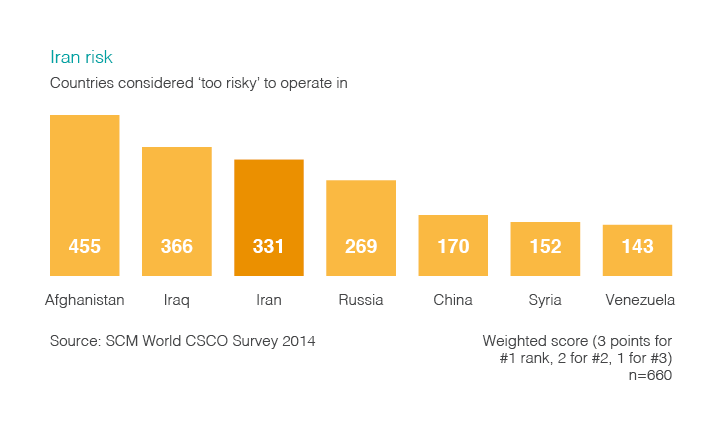
Of course, what’s the good of growth if it’s too risky to make a bet in the first place? The same survey asked respondents to list the top three countries they consider too risky to operate in. Iran stands near the top, along with war-torn places like Afghanistan and Iraq, as no-go markets, but remember that this data precedes the new agreement by nearly a year. Risk is all about uncertainty and the current deal does a lot to address this problem.
News reports on the agreement suggest that the main thing we’ll get is not so much a nuclear-free Iran or peace in the Middle East, but dramatically more interaction, observation and dialogue between Iran and the West. Since trust seems to be in pretty short supply in geopolitics, the goal here is all about verification.
Inspections and discussion mean feet on the ground, just like placing a sourcing person on-site at a supplier or contract manufacturer. The relationship grows and risk recedes.
If doors start opening in business and politics, and oil starts flowing, the ingredients are all in place for a big surge in trade. Most categories of inbound shipment to Iran need little more than the removal of sanctions to get started. Pricing, marketing and localisations for consumer goods should be simple enough, while opportunities in industrial business, especially around the energy sector, look very bright.
It may seem abrupt to be so bullish on Iran, but holding back might mean missing the window.
Beyond Supply Chain
Subscribe on LinkedIn to receive the biweekly Beyond Supply Chain newsletter.