By Kevin O'Marah | August 21, 2015
CSCO Outlook for 2027: Cloudy With a Chance of Moderate Growth
October 09 2026


By Kevin O'Marah | August 21, 2015
This week a heated public discussion has blown up around Amazon and its “bruising, thrilling workplace”. It started with a New York Times article that used interviews with over 100 current and former employees to drill deeply into the working lives of office staff at the company.
Amazon CEO Jeff Bezos himself responded with a letter to employees rejecting the “callous” image portrayed in the article and insisting that anyone aware of abuses raise them immediately for leadership to address.
So, is Amazon in the wrong?
Demand-driven to death
Amazon is an SCM World member and a huge customer to many of our other members. In my observations over the past four years working with our community, Amazon is doing what everyone else wants to do, only faster and often better. The common thread is an almost psychotic focus on the customer, who simply must have “what she wants, when she wants it, wherever she wants it”.
The important question isn’t really whether Amazon or Bezos personally is too harsh a taskmaster, so much as whether our obsession with the customer has gotten out of hand.
In 2013, when the Rana Plaza clothing factory in Bangladesh collapsed killing 1,129 people, I wrote an article titled “Demand-driven to death”, asking whether cheap labour was fading as the edge that supply chains needed to win customers at the point of sale. Risk, social responsibility and brand image were then seen to be rising in importance over merely lower costs.
A year later, however, UK retailer Primark, whose name was more closely associated with the disaster than any other, saw a healthy jump in sales. Consumers were apparently still hungry for bargains no matter the cost in human terms.
A similar dynamic plays out daily with green or sustainably sourced products. Companies like Procter & Gamble and Clorox invested money and credibility in environmentally friendly household products years ahead of the still accelerating climate change problem only to find that shoppers wouldn’t buy enough to make a solid business case.
The bottom line is that the customer is not always right. So why do we all ask “how high?” when the customer tells us to jump?
Triple bottom line
In the early days of sustainability the notion of a triple bottom line comprising social, environmental and financial accountability seemed appropriate. The past 20 years, however, has taught us that the only bottom line that matters in the short-term real world is financial. Progress on the other two is happening, but only after serving the money masters generously.
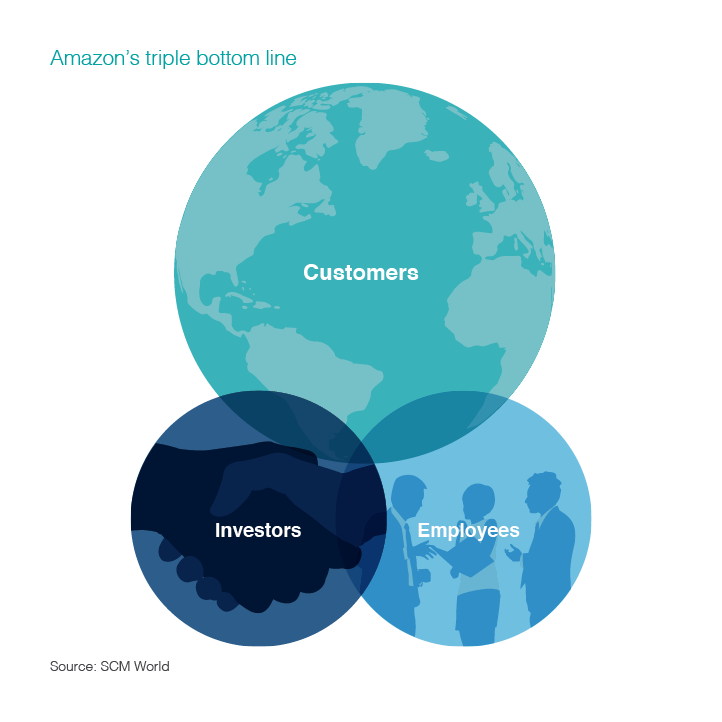
A similar principle is in motion at Amazon. Three constituencies battle for pre-eminence as Jeff Bezos drives to his vision: customers, investors and employees. Until now Amazon has been able to keep investors happy with promises of future profits and phenomenal growth. Employees, too, have been willing to make sacrifices in pursuit of whatever personal mission they’ve bought into as Amazonians. This leaves customers gorging on a value surplus that, according to economic theory, is not sustainable for long.
The battle for talent
Winning the customer is Amazon’s speciality. But the growth this brings builds huge demand for people able to keep up with the explosion of innovation and rising market expectations. The electric culture of a start-up, coupled with rising stock prices that can make everyday employees rich and a chance to add the prestige of Amazon (or Apple or Google or…) to one’s CV, is clearly enough to keep the talent pipeline full – for now.
Looking out a year or two, however, this equation could easily falter. Having crossed the 150,000 employee mark early this year, and especially in the face of poaching challenges from the likes of Uber and Airbnb, Amazon needs to think about whether its version of the triple bottom line needs tuning.
Millennials crave skill development above all other benefits. Amazon’s intense workplace certainly offers this, but perhaps at too high a price in terms of lifestyle. Bezos is no more a slave driver than the National Football League or Bolshoi Ballet, but he’ll end up needing a lot more bodies than they do.
Maybe it’s time to treat employees like customers for a change.
Beyond Supply Chain
Subscribe on LinkedIn to receive the biweekly Beyond Supply Chain newsletter.