By Kevin O'Marah | February 21, 2013
Navigating the Supply Chain AI Fog
September 18 2026


By Kevin O'Marah | February 21, 2013
Can you trust your supply chain? Two dominant trends have driven the dialogue in supply chain for the past couple of years: digital demand and risk. On the one hand, social media and the Amazon effect is delivering an absolute explosion of demand data that we’re all racing to digest while fickle customers abandon us at the drop of a hat. On the other hand, relentless pursuit of more stuff at lower costs has weakened many of us with overextended supply chains that we can’t readily control. A breaking point may be near.
Last week’s column closed with an admonition to food retailers that they ought to worry a little less about customers and a little more about suppliers. Within hours of publishing, the story changed (thanks to Dragos Marcai from Diageo for alerting me) from blaming a Romanian abattoir as the culprit to a French food processor called Spanghero who is now in big trouble for labelling horsemeat as beef. The failure was even closer to the customer than originally thought, making the infraction worse. Our system is out of balance.
I was pretty rough on Tesco, Carrefour and the rest of the grocery sector but of course they live on mighty thin margins and are increasingly expected to spend more money on heavy data analytics to better understand demand in addition to investment refreshing their stores. The cost pressure this creates is partly to blame not only for the horsemeat scandal but also for jobs moving to low cost countries, raw materials being sourced unsustainably and risks being taken with valuable IP, including both brands and proprietary technology.
We’re all working too hard to delight customers and not hard enough to educate them about what it all costs. I am reminded of Easter Islanders cutting down the last few palm trees as they worked feverishly to put up yet one more statue.
One of the most compelling findings in our field research last year (see 2012 CSCO report, chapter 2) was that digitally empowered consumers are far more likely to entertain value-added offers at higher price points than to simply push for lower prices.
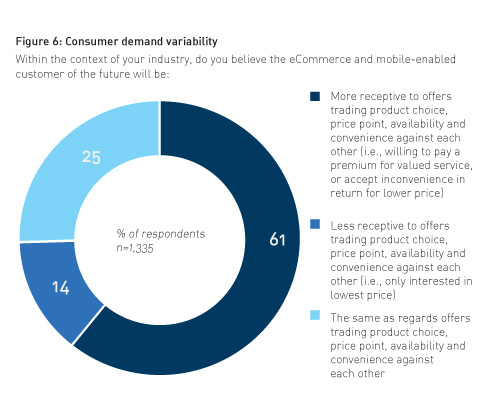
The implication is obvious: give customers a range of choices and you can win. Some will go bargain basement; some will pay up for convenience, service, assortment and whatever else you can dream up. But dreaming it up and profitably providing it are two completely different things.
Which brings me back to balance; too much energy and spending is going into big data strategies to understand demand and too little into strategies or systems to understand supply. Cost-to-serve calculations for many supply chain organisations are still based on standard or average cost models.Sales and operations planning practices have matured nicely in terms of driving to a single number forecast, but still generally fail to put a price on the flexibility (see S&OP report on Flexibility Pricing) demanded by powerful customers in terms of inventory, capacity or special order logistics expenses. After market service for capital equipment is still too often treated as a customer entitlement managed as a cost centre rather than a profit opportunity.
Supply chain’s inability to precisely cost the exploding variety of orders we are expected to deliver will not only mean too many 20 hour workdays, but also too much risk of catastrophic failure somewhere way upstream. Customers aren’t stupid enough to insist we cut down that last palm tree, but until we measure and communicate the full cost of what we’re making how will they know?
Kevin O’Marah
Chief Content Officer
SCM World
kevin.omarah@scmworld.com
Please contact me directly with any comments, questions or suggestions. I welcome your feedback.
Beyond Supply Chain
Subscribe on LinkedIn to receive the biweekly Beyond Supply Chain newsletter.