By Kevin O'Marah | April 04, 2013
CSCOs Seem to Talk About the Same Things, But They Really Aren’t
August 28 2026


By Kevin O'Marah | April 04, 2013
I had an illuminating chat recently with an old friend, Jack Garrahan, the founder and CEO of a firm called ClearEdge Partners that specialises in helping buyers of big, complex information technology systems get their money’s worth. The phrase he used to describe old-school purchasing folks who employ scare tactics like bluffing, quarter-end pressure cookers and simple obfuscation was “knuckle dragger”. It resonates with me because it points to the worst possible practice in supply chain management – acting like a thug when dealing with suppliers.
What could be crazier in a connected world like the one we all live in than to beat up suppliers in the name of creating value? Having spent three-plus years myself at Oracle doing sales ops (comp plans, territories, revenue recognition, etc) I know how nasty the final strokes of a big deal can feel for all involved. In the ensuing 15 years at AMR, Gartner, Stanford and now SCM World, the main thing I have learned is that we’re all in this together. Knuckle draggers and their erstwhile opponent, the slick salesman, do a lot more harm than good when it comes to managing the relationship over time.
This reality is true whether you’re buying parts (see my post from 1 March on “bad collaboration” for an example), manufacturing services, logistics, software or consulting. No one does business to lose money. Buyers who overplay their hand may well get the price they want, but the unlucky supplier is not going to absorb all that pain alone. They will either trim their expense in delivering to you or be squeezed out of business. Detroit’s Big Three auto makers saw this in the 1990s as their supply base went from fat and happy to needing lifelines. Apple could be doing the same thing today.
The solution, it turns out, is simple: be a better customer. We have spent decades working to streamline supply chains under the broad assumption that the customer is always right. That may be true, but for big complex deals like 3PL contracts and ERP systems the “customer” often speaks with many different voices. Slick sales guys know this, of course, and will find the voice they like best when striking the deal, often to the detriment of how well the deal works down the road.
Our just published report Managing Service Providers is all about how to be a good customer. We had considered doing a “voice of the customer” vendor assessment along the lines of the Magic Quadrant, but were steered away from that by our Executive Advisory Board. In response to their input, our field survey was designed instead to dig more deeply into what practices work best when managing these long, complicated “solution” relationships. The result is pretty clear: those who manage their vendors (“service provider” is the politically correct parlance, by the way) with respect, transparency and true collaboration get much better results, as the following chart illustrates:
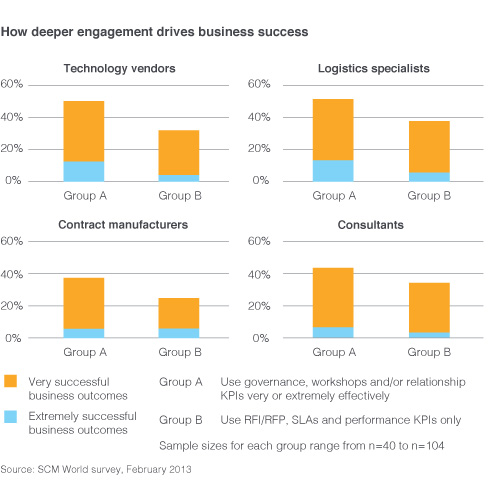
In the world of conference organisers, there are few greater sins than tossing an unwary “prospect” into a pool full of sales sharks. An attitude can develop around this dynamic that views suppliers as dirty. There is no question that being cornered by an aggressive business development guy ruins a cocktail party. But let’s not conflate this to a sweeping dismissal of the entire supplier kingdom. Who could argue that contract manufacturers are expert at production or that logistics service providers know how design a distribution centre? And as for software firms, conditions most certainly are ripe for overselling, but the benefits of systems like those from SAP, JDA, Manhattan Associates and e2open are hard to argue with once the customer really knows how to handle what they’ve bought.
I’ve written often about information technology accelerating productivity growth rates in physical supply chains. I do believe we’re doing something truly important. No thanks to the knuckle draggers.
Kevin O’Marah
Chief Content Officer
SCM World
Please contact me directly with any comments, questions or suggestions. I welcome your feedback.
Beyond Supply Chain
Subscribe on LinkedIn to receive the biweekly Beyond Supply Chain newsletter.