By Pierfrancesco Manenti | April 05, 2019
Navigating the Supply Chain AI Fog
September 18 2026


By Pierfrancesco Manenti | April 05, 2019
From my childhood, I distinctly remember Muhammad Ali, the American professional boxer widely regarded as one of the most significant and celebrated sports figures of the 20th century.
“What made Ali such an outstanding exponent of his sport? It certainly wasn’t sheer strength and power … Rather, Ali’s speed, agility, footwork and general athleticism were among the attributes that most distinguished him from other competitors.”
In sports, agility is the ability to change the body’s position efficiently, requiring a combination of several characteristics:
Learning Agility From Sports
As in sports, many large corporations have traditionally been built for sheer strength and power rather than for agility and athleticism. This takes on many forms. There are hierarchical organizational structures, with people’s skills focused on functional specialism. Long new product development times aim to develop products lasting for many years. Solid factories mass produce for a market open to undifferentiated, standard products. This traditional supply chain foundation clashes with the reality of today’s fast-paced marketplace, and for many companies strength and solidity have become a penalty rather than an advantage.
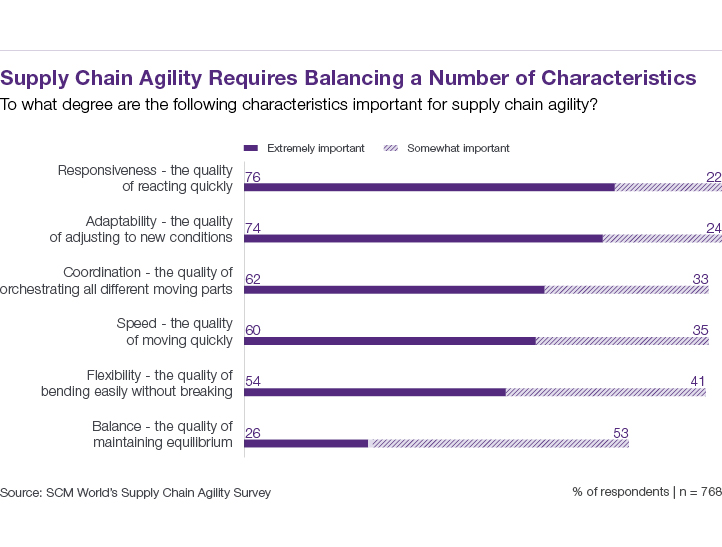
Would supply chain benefit from these same six characteristics of agility? Survey respondents from our Supply Chain Agility 2019 survey provide a clear opinion. Yes, the six characteristics of agility in sports are also relevant for creating more agile supply chains. Not only that, but all six are important to have. Supply chain agility is emerging as a complex, multi-faceted capability.
Learning From Leaders
To be agile, supply chain needs to show the following characteristics:
There isn’t any strategic supply chain transformation nowadays that doesn’t include agility as a key target. However, for many of these strategies agility is often just a buzzword, sometimes seen as the panacea to all possible supply chain issues.
Many supply chains are staking their future on being something that isn’t totally clear. Therefore, we felt the need to develop more research about defining what agility is and illustrate how supply chains are dealing with this expectation. Clients should check out the next executive report for more on this issue.
Beyond Supply Chain
Subscribe on LinkedIn to receive the biweekly Beyond Supply Chain newsletter.