By Kevin O'Marah | July 05, 2013
CSCO Outlook for 2027: Cloudy With a Chance of Moderate Growth
October 09 2026


By Kevin O'Marah | July 05, 2013
Globalisation has so completely engulfed the supply chain profession that we’ve all gotten used to 24-hour workdays with conference calls tying five time zones together around the world. We’ve also come to embrace the idea that emerging markets have “emerged” to become our most important growth opportunities and that global supply is about tapping expertise more than it is about exploiting low-cost labour. Yet, for all this evolved thinking, we still struggle with the basic blocking and tackling of global trade.
This week I met with a supply chain executive in the biotech industry who told me the biggest driver of plant location decisions in the broader pharmaceuticals world is tax treatment. I’ve had similar discussions with people in automotive, apparel and electronics supply chains about the surprisingly large role played in supply chain strategy by what I’ve come to call the three Ts: taxes, tariffs and terms.
These elements, which can easily amount to 20% of the total cost of final product in extreme cases, are more than capable of swamping everything we do with leaner inventories, optimised transportation and lower component costs. Despite this fact, many companies still approach this problem as a bit of an afterthought.
News reports over the last few months have wallowed in the drama of Apple’s exploitation of tax rules, which have enabled the company to pay what many commentators think is too little tax. In his testimony before the US Senate, Apple CEO Tim Cook was unapologetic, saying that it is simply playing by the rules set by governments. “We don’t depend on tax gimmicks… We don’t stash money on some Caribbean island. We don’t move our money from our foreign subsidiaries to fund our US business in order to skirt the repatriation tax,” he told the committee. Legal details aside, Apple clearly knows how to manage its supply chain in a tax-efficient manner, with a $150 billion cash hoard to show for its trouble.
The thing to keep in mind from a supply chain perspective is that exactly where each value-adding step takes place has a big impact on how profitable the operation is in the end. Global sourcing, for instance, as managed out of Luxembourg by Vodafone, has delivered hundreds of millions of dollars in savings through consolidated purchasing, but has also avoided nearly a billion pounds in taxes by taking advantage of transfer pricing rules that legally flow tax losses to its UK unit.
In the area of tariffs or duties, companies like New Balance, which makes a portion of its shoes in the US, can legitimately elude part of the 12% duty on imported footwear that everybody else has to eat. And, of course, when big investments in new plant are under discussion with state or national governments, any number of preferential terms is up for grabs. Just ask Hyundai in Alabama.
As obvious as these factors are, new field data shows that most companies are still winging it with a minimum of automation and process rigour around the rules governing global trade. Export compliance, for instance, is handled manually with spreadsheets by 26% of the 114 respondents to a recent SCM World survey.
Import compliance is little better, with 23% relying on spreadsheets, and in the case of free-trade agreement management, fully 43% do the job with no automation or systems of any kind. Given that the rules we’re all trying to follow are politically driven and are proliferating as once poor countries develop some attitude, it should be little surprise that money gets left on the table when manual systems can’t keep up.
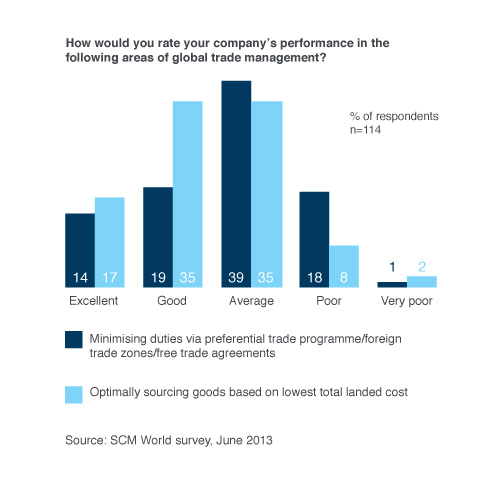
When asked for self-assessments of performance in global trade, there is confidence about how well we source from a total landed cost perspective, but an admission that keeping up with details like duties and country-of-origin regulations is a bit more challenging. Supply network design should certainly take account of such factors, but with considerably less glamour than building factories or selecting transportation modes it seems we’re a little short on focus.
For me, the thrill of supply chain lies in engineering, economics and technology – not legalese. Unfortunately, ignoring the fine print in the three Ts can undo a lot of the good work through costly mistakes.
Kevin O’Marah
Chief Content Officer
SCM World
Please contact me directly with any comments, questions or suggestions. I welcome your feedback.
Beyond Supply Chain
Subscribe on LinkedIn to receive the biweekly Beyond Supply Chain newsletter.