By Kevin O'Marah | September 13, 2013
CSCO Outlook for 2027: Cloudy With a Chance of Moderate Growth
October 09 2026


By Kevin O'Marah | September 13, 2013
One year ago, the stock price of US electronics retailer Best Buy was around $18 – nearly identical to its low point following the 2008 economic collapse. At the time of writing, the stock had climbed to an impressive $37.71 per share. New CEO Hubert Joly, who joined last fall, undoubtedly deserves much of the credit, but the operating formula is available to all.
Until recently, Best Buy struggled with “showrooming”, a practice that brutalises bricks and mortar retail by leaving costs (inventory, staff, real estate) in the store while sending money to Amazon for merchandise the shopper examines in the real world but buys in the digital world.
With sales stabilising now, hundreds of store-within-a-store outlets opened with powerful partners like Microsoft and Samsung, and its Geek Squad service operation better linked between the website and service counter, things are turning around fast. Best Buy appears to have embraced the concept of omnichannel retailing and successfully turned the staggering power of digital/mobile consumers to its advantage.
The key ingredients to this strategy include more skilled and empowered store associates, total inventory visibility and any tactics that allow retailers to use the store as a supply chain asset (see our report Revolution Retail for more on this). Best Buy appears to have done many of these things – for instance, by allowing store associates leeway in offering deals to shoppers who find better prices online and enabling store-specific, unit-level inventory checks across the network.
The Samsung Experience Stores and Windows Stores also do more than just stock product and showcase brands: trained associates help consumers with buying decisions and user instructions. Stores equipped this way are better than Amazon because the human interface still beats the web for some classes of merchandise.
I know these things are true at the micro level because I recently suffered a lightning strike to my home that destroyed all kinds of electronics, including my PC, which had (I hate to admit) not been backed up. I called my local Best Buy to see what they could do. They said that data retrieval from a dead Dell desktop was no problem.
Upon arriving at the store I was helped by competent staff who took the machine apart, confirmed that the hard drive could be salvaged, and sent me on my way with a promise to get it done in 48 hours. The next day I checked the Geek Squad website with my order number and saw that the work was already completed. I picked up a new external drive with all my data safely filed away and went home happily back in business. Oh, and I bought a new printer while I was there.
Retail has a powerful merchant tradition that too often marginalises supply chain in favour of the glitz of sales. Omnichannel works for shoppers because it fits the way we think, which includes checking our smartphones, tablets, friends and family for what and where to buy, and our expectations that we’ll get what we want pretty much immediately.
Behind the curtain, however, someone better be holding the stock, be able to keep track of where it’s going and be sure the money is in hand before shipping. Supply chain therefore has to be dramatically more flexible, reliable and informed than in the pre-omnichannel days when all that really mattered was on-shelf availability. SCM World has gathered field data on how this movement is affecting supply chains and it’s clear that the bar is getting higher. By more than 2:1, survey respondents across industries say digital/mobile consumers want more variable offers.
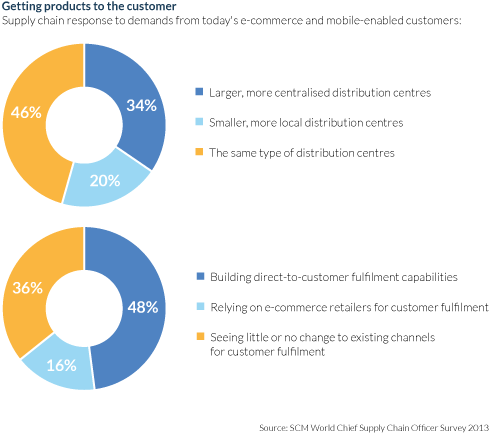
Most supply chains say they are supporting significantly more SKU variety, and almost half are currently building direct-to-consumer fulfilment capabilities. At present, 34% say they are building larger, more centralised distribution centres, while 20% say they are building smaller, more local DCs. Expectations for the future indicate even more supply chain complexity ahead.
Best Buy seems to be getting the front end of this right, and as long as the supply chain behind the scenes can keep up, things look promising. If the distribution network, order management system and supplier relationships aren’t scaling with the advances being made in the stores, however, things could unravel pretty fast.
Best of luck to Best Buy.
Kevin O’Marah
Chief Content Officer
SCM World
Please contact me directly with any comments, questions or suggestions. I welcome your feedback.
Beyond Supply Chain
Subscribe on LinkedIn to receive the biweekly Beyond Supply Chain newsletter.