By Supply Chain Research Team | July 27, 2018
CSCO Outlook for 2027: Cloudy With a Chance of Moderate Growth
October 09 2026


By Supply Chain Research Team | July 27, 2018
Digitalization is so buzzworthy that the topic has transformed into a discussion about whether digital is a strategy or a way of life. As a supply chain leader, are you looking for a way to apply digitalization in your existing strategic roadmap, or is the supply chain being entirely reinvented as a digital ecosystem?
This discussion is especially pertinent in the context of planning technology. When Dick Ling “launched the first sales and operations planning class for the Oliver Wight Companies in 1985,” the intent was to introduce “aggregate planning” so that multiple functions could work together. As the process came to resemble the demand and supply planning reviews, reconciliation processes, and executive level meetings of today, planning technology evolved as a tool intended to make the process better.
However, by fall 2015, the supply chain community was not convinced. As part of SCM World’s annual Future of Supply Chain study, supply chain leaders were asked to describe how valuable planning technology was to the S&OP/IBP processes. In aggregate only 42% of the supply chain community said planning technology was effective and impactful, with another 33% feeling that planning technology was a necessary evil, but still added some value. The practitioners most likely to see value from planning technology were those at the lowest levels of the organization; they were also the most likely to directly interact with the technology.
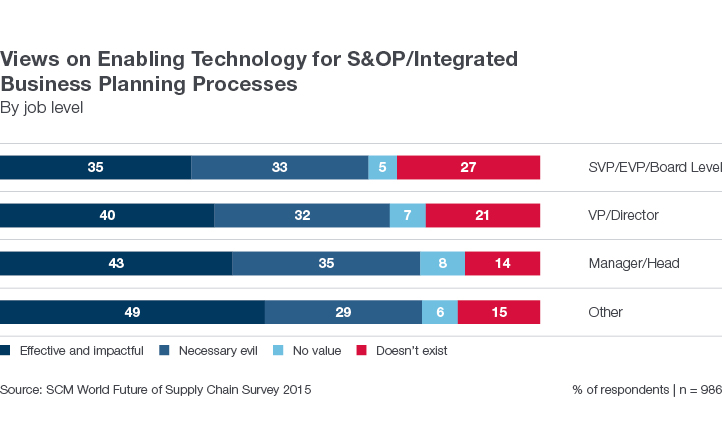
Despite being the most optimistic about overall S&OP programs as impactful to the business, senior leaders were the most pessimistic about the role of planning technology. In fact, nearly a third of executives did not believe that planning technology impacted the process at all, either because it was ineffective or didn’t even exist. While the concept of digital supply chain was relatively new at that time, a significant number of executives had yet to see a role for planning technology in the foundational process of S&OP.
Flashing forward to a year later, as part of the Value Chain 2020 study, SCM World again asked about planning technology, but with a more collaborative angle. In this case, we asked about how supply chains collaborate cross-functionally through the use of planning technology. Overall, 13% said their supply chains collaborated using planning technology that was widely shared; 57% said collaboration exists, but resources are managed independently; and 30% said that no structured collaboration exists across their supply chain partnerships. When examined according to job level, gaps were again apparent but the roles of pessimist and optimist were reversed.
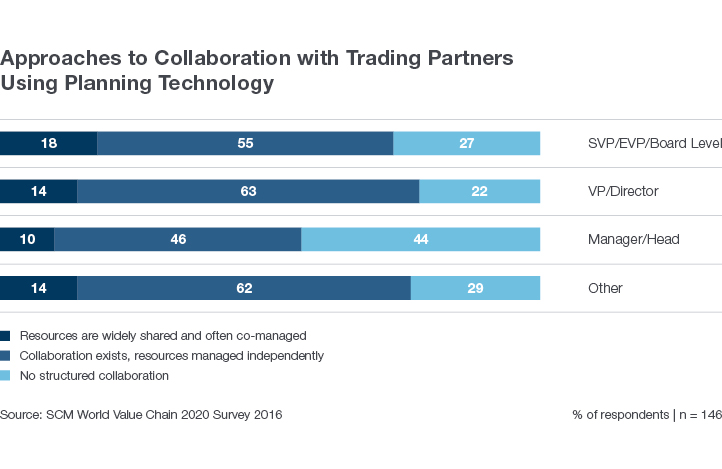
These two data points shine a spotlight on how disconnected executives can be when comparing their perceptions against how planning technology is really used. From the highest level, it may seem straightforward to employ a solution and let it run, but execution frequently requires significant process, and cultural changes.
Successful instances of control towers are examples of how this is possible. Control towers, as Kevin O’Marah said in his October 2016 blog, “vary widely in technology enablement and user base, but they share one thing universally: business urgency dominates process discipline.” For example, Colgate-Palmolive consistently re-evaluates its supply chain structure and capabilities based on business needs. Over time that has meant a transition from local, to regional, to global, to end-to-end organizational configurations. By coupling these organizational transformations with technology implementations and process redesigns, the “why” behind the changes becomes as important as the changes themselves.
The supply chain leader of today and tomorrow who is considering the role of planning technology should keep in mind the following:
Beyond Supply Chain
Subscribe on LinkedIn to receive the biweekly Beyond Supply Chain newsletter.