By Kevin O'Marah | February 13, 2015
CSCO Outlook for 2027: Cloudy With a Chance of Moderate Growth
October 09 2026


By Kevin O'Marah | February 13, 2015
When we survey the SCM World community each year to gauge what supply chain management skills are most important, “planning” comes first every time. Last year for example, 85% of 1,020 people queried said that planning is an “essential” skill, the highest of all twelve skills considered.
Near the bottom was sales skills, with 38% calling it “nice to have” and nearly a third saying it is “not part of supply chain” at all. This chasm may explain why S&OP, which is so hot among supply chain practitioners, often leaves general management a bit cold.
During a conversation I had this week, just the typical megatrend emerged that is pulling S&OP away from its process-centric roots. The company I was discussing with is a hi-tech manufacturer whose planning processes are well established, but for whom the real action boils down to a weekly “capacity review meeting” with the General Manager of the biggest business unit in the company.
Each week, this is where decisions are made about deals that are on the table and what supply chain resources are available to make them happen. One of the keys to its success seems to be avoiding calling it an “S&OP” meeting.
The psychology behind this example says something about what’s wrong with S&OP: we know, for instance, that S&OP process ownership is overwhelmingly the province of supply chain and that the most pursued metric of improvement is forecast accuracy.
We also know that sales skills are low priority for most in supply chain, which means that any focus on making revenue targets for the quarter is usually assumed to be someone else’s job. The fact that the “someone else” is general management may explain the lack of enthusiasm for an S&OP meeting that feels like some kind continuous improvement exercise.
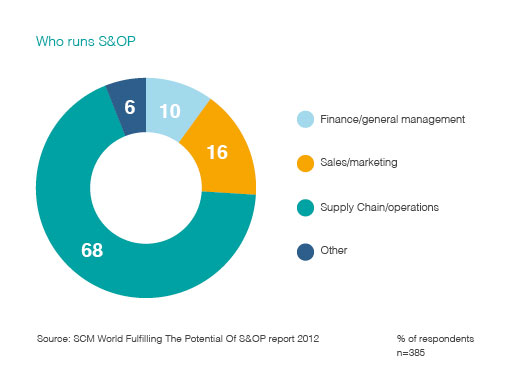
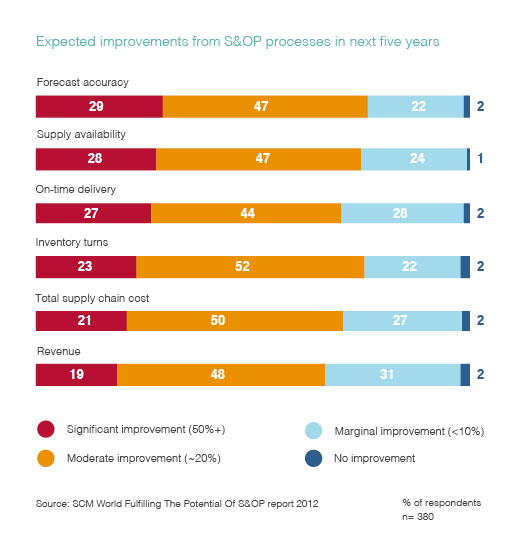
Another interesting fact drawn from the survey data is that those S&OP processes which are run by sales (16% of the total) are the least likely to seek improved forecast accuracy as an outcome. More often, their aim is to identify trade-offs between customer demands, capacity constraints and cost implications attached to making deals in the now.
S&OP is hot when it helps business leaders make their targets, but cold when it’s all about process maturity.
The hi-tech manufacturer described above is little different in terms of attitude from what I’ve seen in other industries. One big-name CPG company, for instance, told me that their S&OP effort had been frozen after several years by a CEO who saw little link between it and his ability to make the quarterly targets.
In another case, an apparel brand owner told me that their S&OP programme was being redesigned around exceptions and the need for new metrics and better data to enable profit-maximising decisions. All want more precise information around trade-off decisions that traditionally are made with gut instinct – like carrying extra inventory to assure a higher service level.
In the short term, planning excellence means having the right data to see how decisions about shorting a customer, expediting an order or otherwise juggling resources will affect current period performance. In the longer term, planning excellence is about analysing investment decisions that create those resources in first place.
Weekly S&OP has to offer participants a chance to course-correct immediately, while integrated business planning (IBP) needs to support supply-demand balancing decisions over time.
The problem may be that we’re trying to cram too much analytical scope into a concept that isn’t big enough to cope. S&OP is one type of planning, IBP is another, and strategic planning may be yet a third. I wonder whether we’re just choking on semantics.
Supply chain normally owns the inventory, production capacity and shipping volume needed to meet customer commitments. Unfortunately it is almost always someone else’s job to say yes to the customer in the first place. No one wants to be perceived as the deal prevention unit, which means our top planning priority must be articulating critical business trade-offs before they happen.
S&OP needs management buy-in to succeed, but maybe it’s best to talk about deals and customers, instead of inventory and forecast accuracy.
Beyond Supply Chain
Subscribe on LinkedIn to receive the biweekly Beyond Supply Chain newsletter.