By Kevin O'Marah | July 28, 2017
CSCO Outlook for 2027: Cloudy With a Chance of Moderate Growth
October 09 2026


By Kevin O'Marah | July 28, 2017
The Trump administration is doing nothing about infrastructure, despite having promised the moon. Politics as usual you might say, except that this promise has by far the most broad-based, non-partisan support of any idea floated during the 2016 presidential election cycle.
I’ve written about this before, and with a positive spin. Now that the administration has apparently kicked infrastructure back to be studied for 18 months, however, it seems clear that the long-run trend of underinvestment is set to continue.
What a wasted opportunity.
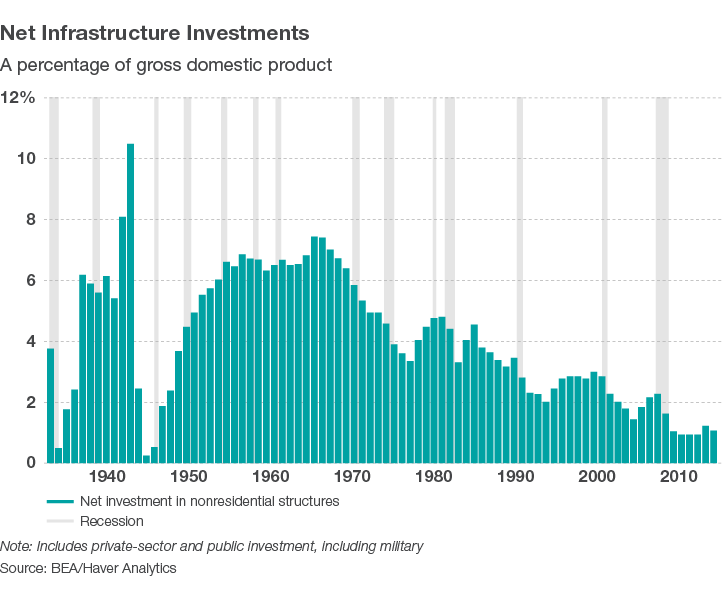
Time Is Not on Our Side
One might look at the chart above and conclude that this situation is really nothing new, and in any case has nothing to do with politics. Following an impressive post-war boom in United States infrastructure investment, we have seen a very steady decline in real terms.
The issue is not merely a matter of crumbling roads and bridges. Nor is it timely just because capital is cheap and job creation is high priority. From a simple survival perspective we’ll get through the next month, year or even decade on most of this stuff. Try connecting through LAX or JFK to experience the bearable, but costly effects of life on an obsolete platform. It’s terrible, but still we could procrastinate.
The urgency arises instead from what is expected about where our digitally-enabled, connected world is headed. Digital technology is surging ahead across familiar content platforms like mobile devices, televisions and PCs, but increasingly it is also bleeding into the very ground we walk on.
Smart buildings, roads, railways, utilities and infinitely more are just now beginning to connect, interact, and actually operate differently than ever imagined in 1965. Digital supply chains can distribute instructions over the cloud while continuously collecting data on field performance. The internet boom we all know so well with Facebook, Google and Apple is happening, albeit less visibly in the physical world we inhabit.
The internet of things (IoT) is here, but it needs an infrastructure update to really work.
IoT is being developed and deployed rapidly by private industry, with giants like General Electric, Boeing, and Verizon all working hard to establish platforms for new business models based on smart infrastructure. I have experienced the effect of an IoT-enabled smart train on a 200-mile per hour ride from Rome to Naples and seen huge documented savings on maintenance as well as higher availability and reliability in use.
It is ready now.
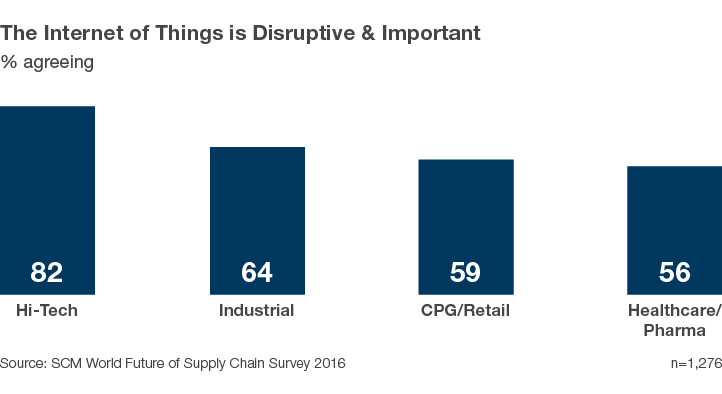
In fact, across all industries the majority of supply chain professionals surveyed believe IoT is a disruptive and important technology for their operations. Business, and supply chain in particular, is doubling down right now on a smart infrastructure for operations that will save money, space and natural resources while improving service uptime for everything from air conditioners to CAT scans.
Why Now?
The urgency is a matter of balance and competition. The United States is booming right now with new technology. Driverless cars, remote-controlled machinery and self-provisioning communication networks are essentially ready now. The potential value in fuel costs, labor hours and asset downtime can be demonstrated in pilots, but not harvested without IoT-enabled infrastructure. We could end up with the 21st century equivalent of Detroit muscle cars driving 20 mph along dirt roads – out of balance and frustrated.
Of equal concern is the prospect of being leapfrogged on infrastructure. The historical example of Eastern Europe’s quick jump to wireless serves as a proof point. China, the Middle East, and possibly soon India too, are all on a decades-long infrastructure binge akin to what happened in the US between 1950 and 1970.
The ability to accommodate the potential of IoT and to exploit business opportunities based on smart equipment could end up better outside the US, which might send incremental investment abroad. What a shame it would be to American companies like Intel, Analog Devices, Caterpillar and Johnson Controls if all the best use cases of their work happened somewhere else. Infrastructure is the platform upon which an economy and a society are built. The United States’ platform was great for a long time, but not anymore.
It’s time for an upgrade.
Beyond Supply Chain
Subscribe on LinkedIn to receive the biweekly Beyond Supply Chain newsletter.