By Kevin O'Marah | December 05, 2014
CSCO Outlook for 2027: Cloudy With a Chance of Moderate Growth
October 09 2026


By Kevin O'Marah | December 05, 2014
A documentary shown recently on PBS tells the story of Frontline’s probe into Firestone Tire & Rubber and its links with Charles Taylor, Liberia’s infamous warlord. The investigators exposed Firestone, which has run a rubber plantation outside of Monrovia since the first half of last century, as a financial enabler of Taylor’s brutal regime in the early 1990s.
Candid interviews with the expat management team in place at the time conveyed the ambiguity surrounding what in retrospect looks like a slippery slope mishandled. Twenty years removed, the episode offers lessons for global supply chain strategists about risk management, including the wisdom of spreading your bets and the importance of sourcing with respect.
Firestone’s move into Liberia came early in the industrial boom when 70% of global rubber production was flowing into the United States, largely for tyres. The supply chain ethos then was set by Henry Ford and his mega-production approach based on extreme standardisation and rigid supply lines. Scale was king and the Liberian operation was built accordingly.
In 1990 Firestone was sourcing 40% of its latex from the Liberian operation, at which time Charles Taylor and his vicious army arrived. The management team initially hung tight assuming things would get back to normal quickly enough. After nine days, however, it was clear that this was much worse than your typical coup d’état, and the expats fled.
Up to this point the supply chain story is simply one of a lost production asset and the urgent need to find a new source. Workarounds are difficult, as when floods in Thailand impacted hard disk drive production or in Japan when an earthquake cut off supplies of some essential automotive electronics components. Scenario modelling, contingency planning and, most commonly, supply diversification are all widely used techniques to manage supply chain risk.
Lesson one, then, is to avoid the gigantism and hubris that accompany a supply chain built exclusively for scale without due concern for flexibility. Research we conducted in 2013 found that global manufacturing footprints are moving steadily toward regional supply networks that are closer to customers and offer risk diversification in the event of disaster.
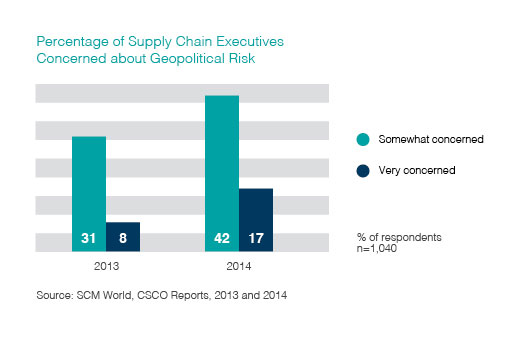
Our annual Chief Supply Chain Officer Survey data on geopolitical risk, in fact, shows a big jump in concern over the very type of problem that Firestone faced back in 1990. For those with plants in the Middle East, Africa, the former Soviet Union and even parts of Latin America, this issue is well worth your attention.
The second big takeaway from Frontline’s documentary is more subtle, but much more important. Again, a trip back in time sheds some light.
Liberia was founded in 1847 by freed American slaves who established a near replica of the plantation economy they knew from the pre-Civil War southern United States. These colonists, many of whom were mixed blood and therefore decidedly not tribal relatives of the native occupants of the area, sat atop society and established a legacy little different from apartheid South Africa.
Firestone naturally aligned with this ruling class and, while it provided paying work for thousands of Liberians, perpetuated a fundamentally extractive economic model that bred deep resentment. Attacking Firestone for this is unfair since no one in Europe or North America at the time recognised Africa as a potential market or its people as eventual partners, but the damage was done nonetheless.
Firestone returned to Liberia and continues to run the plantation today, where its investments in schools and infrastructure support a community of 80,000 people. In fact, Firestone’s response to the recent Ebola outbreak was lauded in an NPR article this past October.
Today, many supply chain leaders see the market potential of countries like Nigeria, Mexico and Indonesia as an important part of their remit rather than just low-cost country sourcing options. The global supply chain is now a two-way street, which means production assets in emerging markets serve both as supply sources for global markets and as development engines for local markets.
Social responsibility is more than just fairness. It is about respect and that demands investment in assets and people.
Beyond Supply Chain
Subscribe on LinkedIn to receive the biweekly Beyond Supply Chain newsletter.