By Kevin O'Marah | April 27, 2018
CSCO Outlook for 2027: Cloudy With a Chance of Moderate Growth
October 09 2026


By Kevin O'Marah | April 27, 2018
I heard a compelling story this week from a veteran supply chain leader in the apparel industry. The story, which is now a few years old, involved the elimination of chargebacks made by the purchasing arm of an American intimate apparel brand to its Middle East-based supplier. The executive in charge saw that the practice had become so detached from principle that it was “nearly a profit center.” This destroyed trust in the trading partner relationship and also let the purchasing team off the hook for poor planning and communication.
The first result of ending all chargebacks was unexpected but very welcome, as the vendor in question lowered their cost of goods sold by 7%. This was possible because rampant chargebacks had forced the vendor to bake such costs into their quotes.
The second result was deeper and ultimately more important — everyone saw the meaning of “value chain.”
Jerking around Suppliers is Dumb
There is a phenomenon known to essentially all supply chain professionals as the “bullwhip effect.” It says that perturbations in demand ripple back from the customer through tiers of supply with ever greater amplitude. The uncertainty felt by suppliers dealing with increasingly volatile demand is met with buffering. This means more inventory, longer lead times, padded cost estimates and general sloppiness that is the opposite of lean.
A portion of the problem arises naturally from consumers who are constantly pressing for more variety, lower prices and easier fulfillment. This is why we are all so keen to build agile supply chains.
The rest of the issue, however, is a product of bad purchasing behavior. Laziness, expediency or just lack of respect among purchasing people is often the root of jerking suppliers around.
Enlightened supply chain professionals, especially those who’ve personally worked in the supply base, understand what’s going on. We all operate as value chains with demanding customers downstream and fixed asset constraints upstream that can only be cost-effectively run if information greases the gears. It is not exactly rocket science and yet, we’re still learning to institutionalize the practice.
Collaboration and Customer of Choice
My first encounter with the idea of collaboration in pursuit of a better value chain came with “ECR” in the 1990s. Efficient Consumer Response was a European consortium effort to systematically stop jerking around suppliers in the fast-moving consumer goods (FMCG) business. Chargebacks were part of this story too along with returns, promotional spending and assorted other obfuscations of the underlying demand signal. The industry hasn’t yet slain the dragon, but it is certainly better than it was.
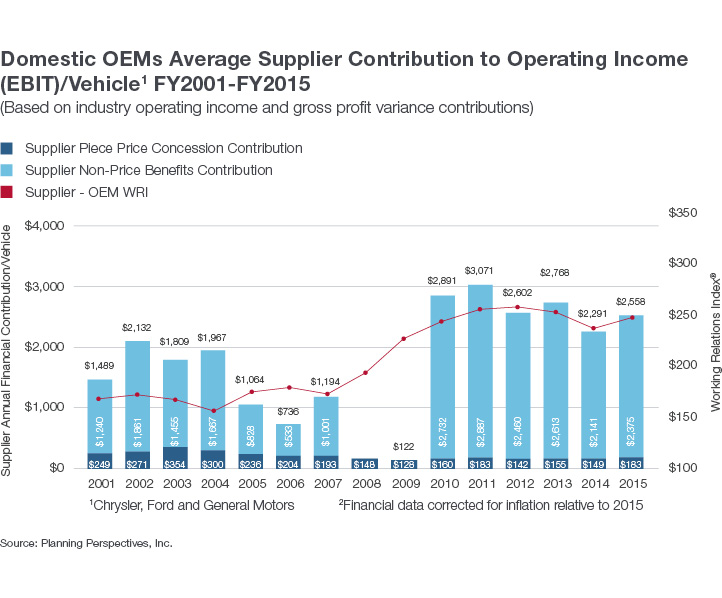
It’s also been studied by John Henke of Oakland University in Detroit who has spent 17 years surveying supplier working relations within the automotive industry. I’ve met John and seen his material. It is extraordinarily detailed and shows convincingly how better supplier relations contribute directly to higher profits for carmakers.
My Gartner colleague Geraint John has also studied this question and has done an excellent job of distilling best practices in terms that purchasing people will easily recognize. He uses the concept “customer of choice“ to describe a set of ten principles that build trust, enhance communication, accelerate innovation and generally foster the development of a true value chain.
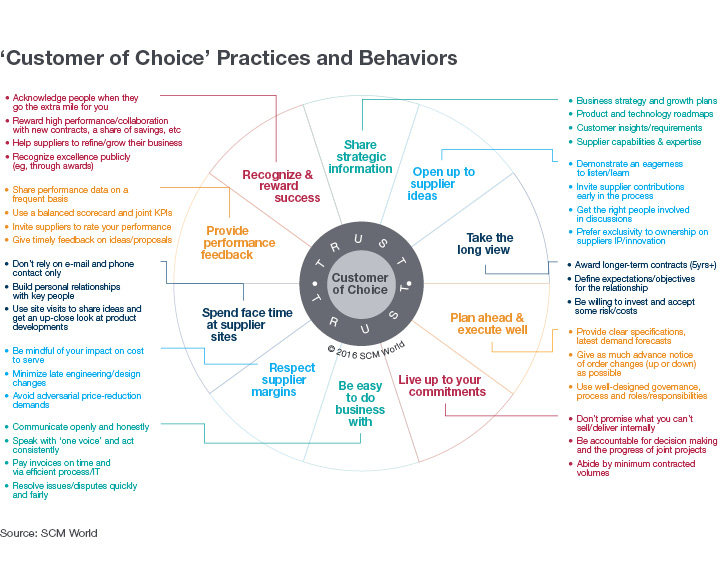
Much of this is obvious if one thinks in terms of supplier partnerships. The core of it is shifting one’s action orientation away from competition and toward cooperation. It normally manifests as a top tier of strategic suppliers who are invited into forecasting processes, product roadmapping and network planning.
It often also involves co-development of technologies and collective engagement with regulators and other external entities. In extreme cases it can even reverse the traditional purchasing urge to avoid sole-source supplier relationships.
Winning Doesn’t Depend on Someone Else Losing
If there is a villain in this story it has to be the kill-or-be-killed instinct underlying old fashioned rapacious business practices. Some still see victory exclusively in terms of a defeated foe. Among purchasing troglodytes this foe is the servile supplier who kneels before the power of the buyer.
Bare knuckle negotiating tactics may render short-term triumph, but usually at the expense of building a true value chain for the long term.
Beyond Supply Chain
Subscribe on LinkedIn to receive the biweekly Beyond Supply Chain newsletter.