By KC Quah | December 14, 2018
CSCO Outlook for 2027: Cloudy With a Chance of Moderate Growth
October 09 2026


By KC Quah | December 14, 2018
How many times have you heard that the clock speed of business is accelerating?
Companies feel this is many ways:
When was the last time you paused and asked yourself these questions?
The book, “Thinking, Fast and Slow,” by Daniel Kahneman, talks about human judgment and decision-making and the fact that there are two “systems” at play in the process. “System 1, the fast thinking system which operates automatically and quickly with little or no effort, and no sense of voluntary control.” This of course is not really a system, but it’s a convenient way of referring to our ability to distinguish the surprising from the normal, and responds more strongly to losses than to gains. This fast thinking has the evolutionary advantage of keeping us alive. If there is danger or a situation happening, we don’t have time to collect data, analyze, discuss and come to consensus on what action to take. We need to be able to assess the situation with incomplete data and react.
“System 2, on the other hand, allocates attention to the effortful mental activities that demand it, including complex computations.” When both systems agree, impressions become beliefs, and beliefs in turn influence decisions and actions. But System 2 is inherently lazy, and while it could be a good pause and control system, it does not like to expend much effort.
System 1 is fast, intuitive and emotional, while System 2 is slower, more deliberative and logical.
I believe there is an analogous parallel in how organizations make supply chain decisions. The question is whether System 1 is habitually over activated given the accelerating clock speed of business, leading to solution and conclusion jumping. Do we look for data that is biased to believe and confirm quickly so we can drive some activity? If we have to focus on many things at once, System 2 can get distracted and therefore not act as the deliberative controller as a balancing counterpoint to System 1.
Let’s examine some supply chain planning processes in terms of fast and slow decision-making (see Table 1). All the processes below are absolutely needed, but a balance needs to be established to deliver the most effective outcomes. Ask yourself:
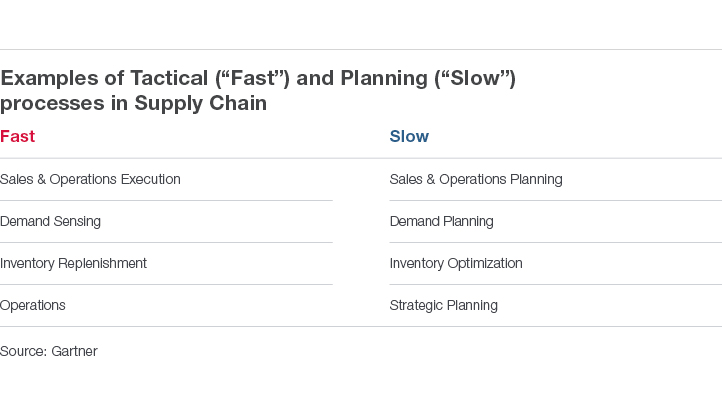
Just like the System 2 of decision-making of our brain, the “slow” processes usually require a lot more data, deliberateness in decision-making and a more complex logic (e.g., statistical models, simulation models, heuristics and playbooks).
Perhaps supply chain is one of the biggest misnomers we have embraced as a description of how all of these activities connect. It’s not so much a chain linked in a series, but rather a network of connected fast and slow decisions being made over and over again. It’s more akin to a supply neural network, working like a massive “brain.” Karl Friston, ranked among the top 10 most influential neuroscientists, boiled it down to an idea that the brain essentially functions like a Bayesian model that tries constantly to minimize prediction-error signals. In supply chain planning, I would argue that what we’re really trying to do is to minimize prediction-error signals, or make more right versus wrong decisions over time.
So, as you approach the end of the year and the frenzy of the holidays start to creep in, pause to think about all the ways you are trying to minimize prediction error in your supply “chain.” Be mindful of the fast and slow decisions you’re trying to make and whether a balance synergy has been achieved.
KC Quah is a Research Director in Gartner’s supply chain research group
Beyond Supply Chain
Subscribe on LinkedIn to receive the biweekly Beyond Supply Chain newsletter.