By Kevin O'Marah | October 16, 2015
CSCO Outlook for 2027: Cloudy With a Chance of Moderate Growth
October 09 2026


By Kevin O'Marah | October 16, 2015
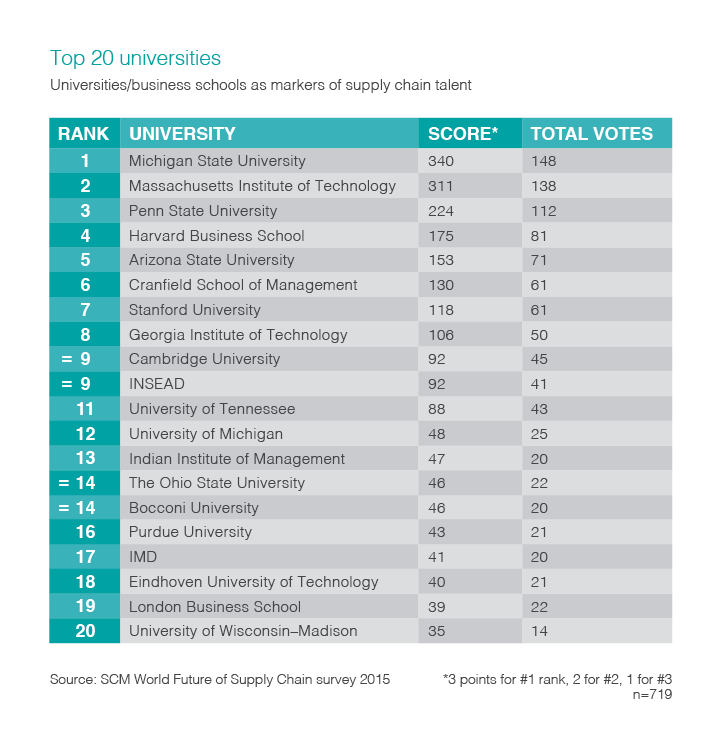
We polled 719 supply chain professionals last month and asked: “As a marker of supply chain talent, please select your top three universities.” Respondents were given a drop-down menu comprising 192 universities known to have supply chain offerings within their business programmes.
The list reflects only what working supply chain practitioners think of the brand value of these business schools and is not an assessment of their research, academic strength or even whether they offer formal supply chain degrees. Many do not.
Our list is a complement to existing rankings from US News & World Report, which uses a multi-factor scoring system to generate what many consider the definitive ranking of MBA programmes in the United States. US News includes a top 10 ranking of supply chain/logistics specialties, along with the broader list based exclusively on opinion polling of deans and programme heads.
Practitioners, especially outside of the US, seem to prefer the classical business school education over the technically grounded programmes in traditional hot spots like Michigan State and MIT. SCM World’s fourth ranked programme, for instance, is Harvard Business School, which tops US News’ overall MBA ranking, but is not even in its top 10 for supply chain/logistics.
Harvard may not specialise in supply chain, nor make noise about its tradition of thought leadership in the field, but for those who know Michael Porter’s work on the concept of “value chains” it is certainly fair for hiring supply chain executives to look favourably on a resumé that features a Harvard MBA.
The same could be said of some prominent non-US programmes with traditions of excellence in engineering, economics or business but not explicitly supply chain. These include Cambridge University and INSEAD, which tied for ninth place on our list.
Global rankings of MBA programmes include one from the Financial Times, which works a bit like US News’ version but without an assessment of supply chain as a speciality. Its top names feature many that appear on our ranking, although those with strong technical traditions like Cranfield School of Management in the UK and Eindhoven University of Technology in the Netherlands fall well down the FT’s list of general MBA leadership.
The story is one of business acumen and technical mastery blending to create the best prospects for future talent in supply chain. SCM World’s recent Future of Supply Chain survey found that the core functional skills (plan, source, make, deliver) were no more essential to success than communication and influence, and only slightly more important than business strategy and change management. Future leaders, it seems, will be those who combine operational and commercial sophistication.
Supply chain has historically not been seen as a path to the top, but prominent CEOs like Tim Cook at Apple, Mary Barra at General Motors and Brian Krzanich at Intel offer hope that ambitious MBAs with an operational edge could fare well in the future.
The trick will be integrating the fundamentally engineering-centric realities of supply chain as a materials management discipline with the purely financial and marketing orientated thinking that underpins classical business strategy. Some schools’ reputations are being propped up by leadership in supply chain. Michigan State, Penn State, Arizona State, Georgia Tech, Tennessee, Ohio State, Purdue and Wisconsin all make the SCM World top 20, but none are higher than 30th spot in US News’ MBA rankings.
In other cases, the reverse is true. Northwestern, University of California Berkeley, and Dartmouth’s Tuck School all make US News’ top 10, but none are higher than 48th as ranked by supply chain practitioners. In these cases, top business schools are failing to resonate with supply chain executives in the field.
The supply chain discipline is still very new and constantly changing as technology and economic shifts continue to rewrite the rules. Academics are as often as not chasing practitioners in the learning process. To keep a finger on the pulse of this we’ll track what practitioners think.
The SCM World University 100 will be published at our Live Americas event in Miami on 11 February 2016. Between now and then we’ll keep the poll open and encourage other supply chain professionals to vote.
Beyond Supply Chain
Subscribe on LinkedIn to receive the biweekly Beyond Supply Chain newsletter.