By Kevin O'Marah | February 28, 2013
CSCO Outlook for 2027: Cloudy With a Chance of Moderate Growth
October 09 2026


By Kevin O'Marah | February 28, 2013
We’ve done a lot of research on sales & operations planning over the past year and drawn plenty of obvious conclusions about how to approach this critical ongoing effort. Among the key golden rules are to develop and maintain:
We have also seen relentless efforts across all industries to push S&OP ever more deeply into the functional domains of the business, including not only sales and operations but also product development and financial management. Progress, however, seems held up on the even more fundamental stumbling block of bad collaboration.
This week at our SCM World Live event in Miami, one session dedicated to S&OP cracked open the hidden story behind an epic example of how collaboration breakdowns between trading partners can destroy value in a supply chain. In this case, a big hi-tech manufacturer was cornered by a key component supplier temporarily in command of a short capacity situation. The relationship had been sole-sourced up to this point and, one might presume, conducive to a collaborative environment because of co-dependency.
Not so. The supplier’s CEO in this case chose the low road, pressing for such outrageous terms that they were removed from the company’s approved vendor list. The customer paid dearly to qualify a new supplier and absorb the costs of transition in production rather than accept punitive terms under duress.
What makes this example so egregious is that these two parties (names omitted out respect for confidentiality) were perfectly positioned to take the high road of building tighter inter-company S&OP processes. Their supply chain is well suited to creative uses of postponement strategies, part substitution options, and family as well as item-level capacity forecasting, all of which could have saved inventory and logistics expense for the whole value chain. Instead, warring egos took command and money was wasted.
The lesson in this example goes back to S&OP because process alone is powerless to overcome distrust. Much of what drives S&OP is the thirst for visibility, especially to demand. The case study here is less about one bull-headed CEO overplaying his hand than it is about a relationship where trust was already strained. The supplier’s side of this story includes a history of falsely high demand forecasts driving costly overbuilding. Such bogus forecasts make even the most robust Olly Wight S&OP meeting feel like a charade.
An extensive survey we conducted late in 2012 drilled into S&OP maturity, including the degree of business value captured in terms of forecast accuracy, supply availability, inventory, on-time delivery and total supply chain cost. In aggregate, respondents felt that S&OP had only delivered about 20% of its total potential so far. The problem, however, is not internal alignment of functional groups or even information visibility, but external alignment – in other words, collaborative engagement with suppliers and/or customers. Here it seems we have just scratched the surface in terms of creating value.
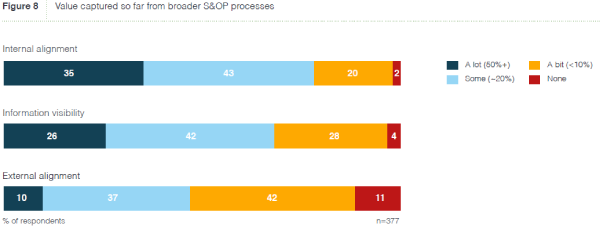
What’s really sad about this situation is not just money being wasted but also learning that is lost for all parties concerned. Early last year we ran a separate field research project on inter-enterprise collaboration, which showed decisively that truly collaborative trading partner relationships not only save money but also reduce risk, improve innovation and solve problems dramatically faster. The data from that survey suggests that learning curves (defined as rate of improvement in any target metric) are on average 50% steeper in collaborative trading partner relationships that traditional relationships. Trust may be hard to quantify in financial terms, but in terms of learning it’s worth an extra 50 cents on the dollar.
S&OP processes, metrics and tools certainly seem to be earning their keep, but until they are working on a platform of collaboration the results will feel a lot like two steps forward, one step back.
Gotcha.
Kevin O’Marah
Chief Content Officer
SCM World
Please contact me directly with any comments, questions or suggestions. I welcome your feedback.
Beyond Supply Chain
Subscribe on LinkedIn to receive the biweekly Beyond Supply Chain newsletter.