By Kevin O'Marah | August 16, 2013
CSCO Outlook for 2027: Cloudy With a Chance of Moderate Growth
October 09 2026


By Kevin O'Marah | August 16, 2013
There is only one thing that really rattles cages down here in Key West, the famously laid back tropical island at the southernmost end of US Route 1 – hurricanes. They threaten every year between midsummer and late autumn, but usually veer off into someone else’s backyard or peter out to little more than a bad rainstorm. In 2005, however, they came in force and left a mess.
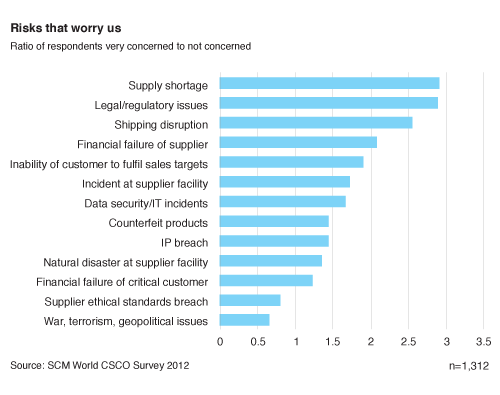
This got me thinking about supply chain risk and how we manage it. Hurricanes in Key West represent cataclysmic threat. The same can be said of earthquakes in Tokyo or floods along the Mississippi. In truth, though, such natural disasters do not usually top the list of supply chain risks we worry about. Our annual CSCO research reflects the longstanding reality that “supply shortage” is our top concern: a third of respondents in 2012 said they were very concerned about this.
Common sense and experience tilts our focus to those high-likelihood, low-impact events that often cause disruptions such as logistics failures, regulatory snags and suppliers going out of business. Prudent supply chain risk management strategies address these kinds of problems with dual or multi-sourcing, often based on risk mapping of the supply network. Best practice also includes a systematic crisis management protocol that can be measured by, for instance, time to recovery of full operational status.
Coherent, process and data-driven risk management strategies do offer security in the face of supply chain disruption, but what about the proverbial “Big One”?
At the very bottom of our list of worries is “war, terrorism or other geopolitical issues”. Is this because we see geopolitics as beyond our scope? Perhaps, but only just ahead of geopolitics is “supplier ethical standards breach”. There’s no question who owns the problem of supplier ethics, and yet we don’t seem to grasp the hazard inherent in leaving these two highly combustible ingredients unattended.
Revolutionary movements from Castro’s Cuba to the recent Arab Spring tend to start with a sense of economic injustice and/or futility. Poor pay for dangerous work breeds people with little to lose in challenging the powers that be.
Garment workers in Bangladesh provide a recent and egregious example of how bad it can be, but this is by no means the only case of a supplier breaching ethical standards to save money. It is also symptomatic of a global supply chain too attuned to cost cutting and not enough to creating value. The result is too few winners, too many losers and an unstable political environment.
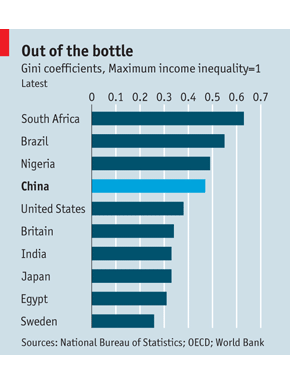
China, for instance, continues to struggle with widening income disparity as are big, critical growth markets like Nigeria and Brazil (as the chart below from The Economist illustrates). If angry protests over rising bus fares in Brazil boil over into something bigger, or if Nigeria loses a decade of reform through an explosion of anger among millions of frustrated urban poor, then we could all have trouble.
Supply chains that depend on these countries – and many do – could see a lot more disruption from shifting political winds than even the biggest hurricane.
Supply chain leaders can only do so much. From a risk management standpoint, there are specialists in assessing geopolitical risk and information service subscriptions, such as Stratfor, that do a good job of keeping us up to date. In terms of reducing sources of political strain, however, many global supply chain leaders are already taking actions that could help.
Hewlett-Packard, for instance, has invested heavily in western China, creating wealth where poverty had been the norm. Walt Disney pulled out of Bangladesh months before the factory collapse, sending a message about ethical sourcing to its supply base without waiting for disaster to force its hand.
Nike has spent nearly two decades pushing standards for ethical sourcing without ever really taking public credit for its efforts. These companies may not be consciously working to avert geopolitical disaster in their supply chains, but their actions are reducing risk for all of us.
There is a possible hurricane brewing out there that could be too big to manage. Its energy builds with economic injustice. By insisting on ethical standards in our supply base, we might get lucky and just end up with a bad rainstorm.
Kevin O’Marah
Chief Content Officer
SCM World
Please contact me directly with any comments, questions or suggestions. I welcome your feedback.
Beyond Supply Chain
Subscribe on LinkedIn to receive the biweekly Beyond Supply Chain newsletter.