By Pierfrancesco Manenti | February 08, 2019
CSCO Outlook for 2027: Cloudy With a Chance of Moderate Growth
October 09 2026


By Pierfrancesco Manenti | February 08, 2019
Perhaps I’m a technology geek, but I buy everything online. I hate “physical” shopping and I travel too much to do it. I’m used to placing online grocery orders late at night, on Sundays. The last time I reordered my dog’s food I was boarding a flight. Lately, I’ve been chatting with Alexa a lot!
I love that delivery is fast and generally on time. Having worked in supply chain for almost 30 years, I know what it takes to offer such an amazing customer experience. Demand planning, supply planning, manufacturing, and logistics and distribution all equally contribute to make clients happy. The Theory of Constraints teaches us that a chain is no stronger than its weakest link. So, in supply chain this means that all the four building blocks (Figure 1) need to work together like clockwork.
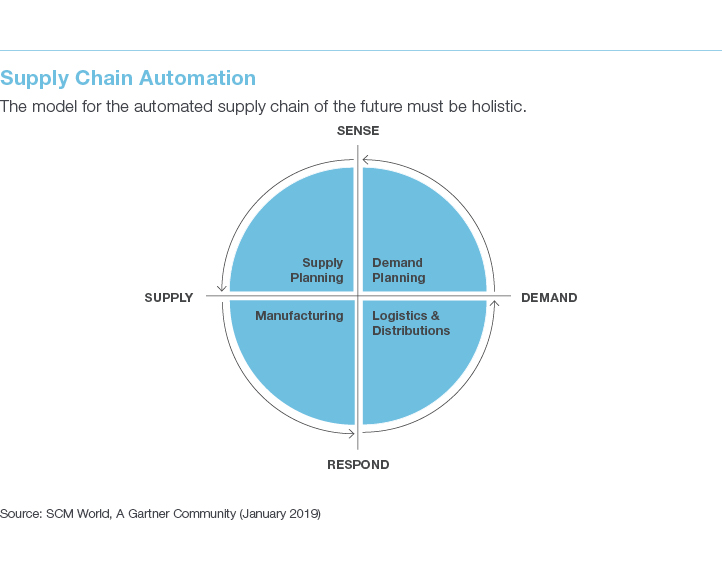
Digitalization and automation can be of great help here. In our 2018 Future of Supply Chain Survey, we found that 73% of supply chain organizations are already investing in artificial intelligence (AI) to support supply chain strategies, along with investments in many other technologies including advanced robotics and robotic process automation (RPA). However, chief supply chain officers (CSCOs) shouldn’t forget the Theory of Constraints: the value of digital is multiplied when it is applied holistically rather than by individual functions.
Unfortunately, as discussed in Gartner’s report, “Designing the Supply Chain Organization in a Digital World,” the practice of individual supply chain functions developing their own digital roadmap in isolation is still very common. Launching separate automation investments that are uncoordinated and unbalanced always leads to pockets of local business improvements, which, in most cases, is not reflected in end-to-end improvement.
Using AI-enabled planning technology, for example, supports companies to sense demand and supply signals and then plan their supply chain in a much more frequent, granular and predictive way than in the past. However, the speed of change imparted by improved planning capability would be meaningless, if not counterproductive, unless companies are also able to rapidly respond with greater operational agility, in both manufacturing, and logistics and distribution.
Learning from Leaders
The outlook is positive, though. Results from the 2018 Future of Supply Chain Survey confirm that most CSCOs are working on a holistic digital roadmap aimed at investing to substantially automate several areas of their supply chain altogether.
A bunch of leading supply chain organizations are already undertaking such a holistic approach to supply chain automation:
These and many more case examples are discussed in Gartner’s report, “The Path to the Lights-Off Supply Chain.” This report is an indispensable guide for CSCOs and their teams to get ready for the AI-enabled technologies that will drive supply chains to the next operating model.
Beyond Supply Chain
Subscribe on LinkedIn to receive the biweekly Beyond Supply Chain newsletter.