By Kevin O'Marah | August 02, 2013
CSCO Outlook for 2027: Cloudy With a Chance of Moderate Growth
October 09 2026


By Kevin O'Marah | August 02, 2013
Early in June, The Wall Street Journal published an article declaring that supply chain management is now the “Hot New MBA”. The article included tasty factoids like Arizona State’s supply chain undergraduate major average starting salary, which at $56,410 was a solid 10% higher than undergraduate business majors overall. ASU’s supply chain MBAs get a $4,925 premium over their fellow classmates. This is obviously great news for students but could be a red flag for employers.
As an MBA student myself from 1990-92, I had by far the most fun and best grades in two, apparently distant, subjects: operations and strategy. For me the link was, and still is, that winning in business depends heavily on actually doing something physical. No matter how clever the financing, how compelling the marketing or how well motivated the people, success in physical product businesses boils down to strategically handling operations. This is what I understand as supply chain.
We didn’t use the term much back then, and even today one man’s “supply chain” is another man’s back office, cost centre or errand boy. Now, after two decades of debate and evolution, I’d sponsor a definition of supply chain as “the process of adding value to materials”.
Academically, it’s a hybrid of systems engineering, operations research and pure business strategy. With today’s massive connectivity and the rapid de-commoditisation of so many kinds of product, few can really get the job done on a simple diet of plan, source, make and deliver.
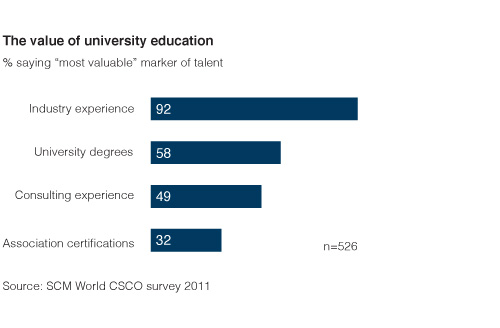
In our extensive 2011 CSCO survey of talent management in supply chain, several findings stand out. First is the high value supply chain executives place on a good university education when looking for people. As a marker of talent, university degrees rate higher than association certifications like ISM or consulting experience, although of course we’d still rather poach from the competition.
(Our 2013 CSCO survey launched this week and we’re asking similar questions again – if you’d like to take part, click here.)
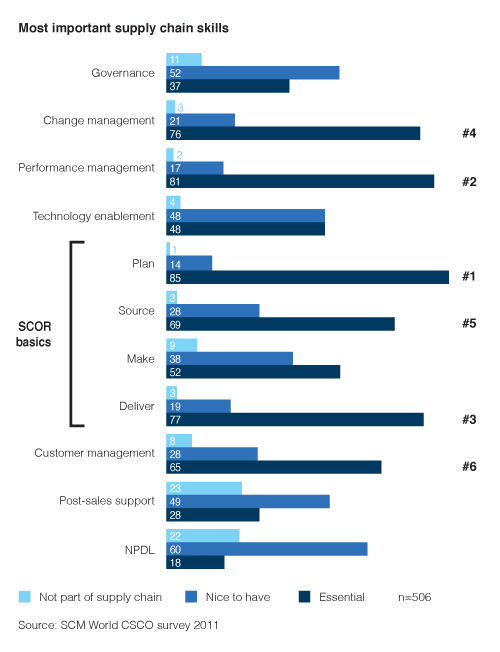
The same 2011 survey also dug into what specific skills matter most to leaders trying to build a great supply chain team. As the data makes very clear, three of the top six most “essential” skills are not part of the traditional SCOR model. What employers want, it seems, is business people who can not only build a forecast or plan a delivery but also think and act strategically. Universities are being asked to help.
The WSJ article hung much of its story on the newness of supply chain management from an academic perspective. It profiled nine schools with new programmes on offer. One of these, interestingly, is Arizona State, which many in supply chain already think of as a top school. The catch is that ASU has apparently just started offering master’s degrees in supply chain management, despite many years of recognised leadership in purchasing. Breaking down silos is apparently happening in academia, as well as business.
Other schools thought of as strong in the discipline are also often specialised, as in the case of the University of Tennessee, which excels at logistics but isn’t really teaching supply chain the way I think of it. Even obvious, big names like MIT or Penn State tend to Balkanise around disciplines with too little cross-functional thinking. This is perhaps understandable given a publishing paradigm that favours specialisation, but it certainly works against what business leaders want.
Our 2011 survey collected some unscientific data on which schools executives preferred from a hiring perspective. The 176 people who completed this question named their top three universities in order of preference. They collectively identified 75 separate universities in the top rank slot alone. Clearly, the market for university trained talent has a long way to go before any kind of consensus is likely to emerge. The list, as we published it back then, reads less like a ranking of the best in supply chain and more like a list of top business schools.
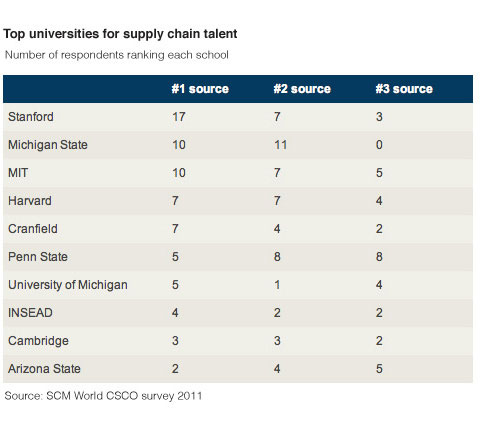
For those who can’t resist a ranking, how satisfying it is to see Michigan State ranked ahead of Harvard or Cranfield ranked ahead of Cambridge. The discipline is new and the playing field is wide open. For those looking to hire top talent, however, there’s far too little clarity on where to spend your recruiting budget. Universities need to step it up a notch, and quickly.
Kevin O’Marah
Chief Content Officer
SCM World
Please contact me directly with any comments, questions or suggestions. I welcome your feedback.
Beyond Supply Chain
Subscribe on LinkedIn to receive the biweekly Beyond Supply Chain newsletter.