Do some companies have “shiny object syndrome” when it comes to new supply chain technologies? I used to see this phenomenon everywhere but, lately, have shifted to a more nuanced view that the most leading companies also have innovation cultures that naturally lead to more technological experimentation.

Part of my support for Gartner’s global CSCO community is to provide insight on members’ strategies. One method is based on comparing how their teams respond to our annual Future of Supply Chain survey, relative to the broader supply chain population (n=1,346 for our late-2020 study).
Having completed more than 20 of these analyses, I noticed a trend. Some of the most advanced organizations — those that tend to land at the high end of Gartner’s Supply Chain Top 25 list — have cultures that lean heavily into innovation. More specific to the survey question, they consistently rate most technologies (AI/ML, 3D printing, AR/VR, etc.) as more “important and disruptive” than the average company.
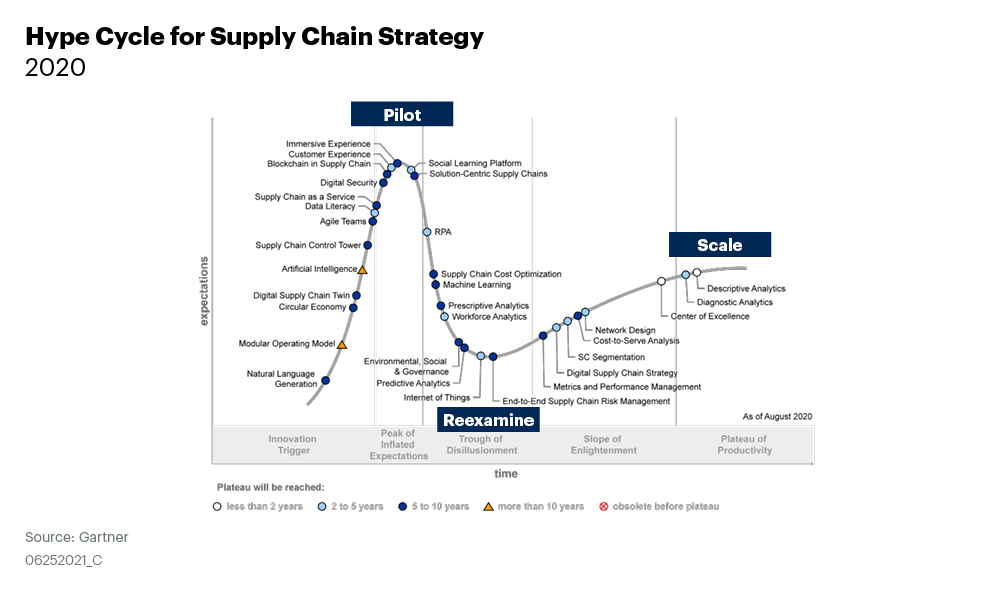
Putting this in the context of Gartner’s Hype Cycle, these companies are more likely to pilot technologies and techniques that are newer and less tested in the marketplace.
So what?
Perhaps these companies simply attract more supply chain employees who are tech enthusiasts. Digging deeper, it’s clear that the relationship between corporate culture and employee profile is bidirectional.
Here are three things that innovation leaders do that allow them to continually run ahead of the pack:
Take a venture capital approach to innovation
- I asked my colleague, Noha Tohamy, who publishes our annual Hype Cycle for Supply Chain Strategy, for her take on my theory. She replied, “When these leading companies say technologies are ‘important and disruptive,’ I always think that the rest of this choice is to pursue in limited scope, while minimizing our risk, until we prove that it’s worth pursuing at a large scale.”
- Outside of advanced analytics, we are not seeing companies run headlong toward investing in new technologies, except for those where they also see commercial opportunities. Examples of this are blockchain solutions and 3D printing technologies.
- That said, they are more prolific “dabblers” and tend to place more small bets than the average company, with a willingness to see a significant number not pay out.
- Some companies have a percentage of their annual transformation budget set aside (e.g., 1-2%) for pure R&D investment and use idea crowdsourcing and expert panel techniques to vet proposals with an executive board, a la Shark Tank or Dragons’ Den.
Push the envelope through partnership with the innovation ecosystem
- Many of the more prolific innovators have developed deep, long-standing relationships with academia and technology service providers. Their networks are broader and richer than most, and the brand owner gets to “rent” the leading-edge minds working at these partners.
- They also form collaborative development relationships with suppliers. Sometimes suppliers bring supply chain technologies to bear that are a significant win-win for both sides of the relationship. For instance, PepsiCo’s innovative use of on-shelf availability technologies helps drive smarter replenishment (read: sales) and even insight on promotion effectiveness for both itself and its retail customers.
- In some cases, we have seen advanced companies spanning disparate industries, pool resources such as data scientists to co-develop solutions (e.g., cognitive demand planning) that can be used by all of them. Back to Noha’s observation, this is about containing investment risk and maximizing the return on innovation.
Drive innovation by design
- A big part of the innovation culture mentioned above is the tone set by the organization’s leaders. They reward experimentation and do not punish learning experiences (AKA, failures). During innovation project reviews they ask open-ended, exploratory questions and don’t govern using the same success metrics as more traditional transformation and continuous improvement initiatives.
- Agile methodology techniques are taught and applied: launching minimum viable products, rapid prototyping with customers through sprints, “testing and learning” in the marketplace, and so on.
- Innovation leaders also have clear governance that enables them to scale new, disruptive capabilities, where it makes sense. In the middle of the Hype Cycle, they seek opportunities to pick up and explore new lateral applications of technologies that may not have passed the test during initial evaluation.
In summary, these are the companies that like to push boundaries versus simply executing established processes and capabilities with excellence. After all the analysis, one thing is clear: supply chain leaders do believe the hype.
Stan Aronow
VP Distinguished Advisor
Gartner Supply Chain
Stan.Aronow@gartner.com