By Kevin O'Marah | July 22, 2016
Navigating the Supply Chain AI Fog
September 18 2026


By Kevin O'Marah | July 22, 2016
The pace of change in supply chain management today is exponential. Digitisation bleeds into every element of sourcing, manufacturing, logistics and planning, all driven by super-steep learning curves underpinning advances in analytics, robotics and compute power.
The challenge for senior supply chain executives is cranking up the speed at which people learn how to apply these exponentially advancing technologies. Just as important is how well they can communicate and influence to manage change in the business.
Continuous improvement is no longer enough – today’s supply chain professionals must master continuous acceleration, and often in the face of resistance to change. A new approach to learning is needed.
Fast mastery
I spent a few hours with Colgate-Palmolive’s supply chain leadership team in Piscataway, New Jersey this week and saw first-hand the powerful impact of applying a new type of learning to the profession. The session opened with ‘Future of Work Teams’ reporting back on their talent development programme in a series of presentations summarising lessons learned against a discrete set of top-down strategic goals.
The content was impressive enough, but maybe more critically, messages were tight, confident and convincing. Unlike many an internal supply chain strategy session, bogged down in spreadsheets and lingo, these were closer to TED Talks in style: quick, punchy and loaded with external validation and familiar iconic company examples.
Chief Supply Chain Officer Mike Corbo offered me a quote as we sat listening: “You can’t create a ‘high-speed’ supply chain by being connected to a ‘slow speed’ company”. In other words, clock speeds in supply chain must be matched by clock speeds elsewhere in the organisation. What this requires is persuasion, objection handling and the ability to make a compelling case for change.
Supply chain management is a field science
Everyone understands the need for talent development in supply chain. What too few realise is that the course content is incredibly dynamic and not readily available from books, universities or consultants.
Traditional academic and technical subjects lend themselves to a student-teacher system of education. Masters of the topic start with fundamental principles, often grounded in pure science or engineering, and impart their accumulated decades of wisdom on apprentices. There is a right answer and learning is mainly about internalising it. This is true for accounting, chemistry and even golf. Most learning is essentially a long lecture class with tests and grades along the way to confirm acquired knowledge.
Supply chain is different. First of all, it only became a genuine function and academic subject within the past 20 years. Crystallising out of established functions like purchasing, production and distribution, it’s not really any of these so much as the thread that connects them. Today, as we see new technologies upsetting not only the work within these functions, but across them, we find a discipline that’s being invented as we study it.
In many subjects, innovation happens in the laboratory where serious experts tinker and find new truths. Not so with supply chain. True innovation happens in the field where practitioners, faced with customer driven challenges or investor pressure to cut costs, invent new processes by using the technologies increasingly at their fingertips.
The learning process is more like a self-propelling engine where teachers and students take turns sharing what they’ve figured out with peers, only to realise through Q&A how much they still don’t know. At SCM World, we’ve intentionally built a system around this reality with an Executive Advisory Board and Chairman governing content architecture, and a community of C-level, VP-level and core team practitioners systematically sharing what they’ve learned in the real world.
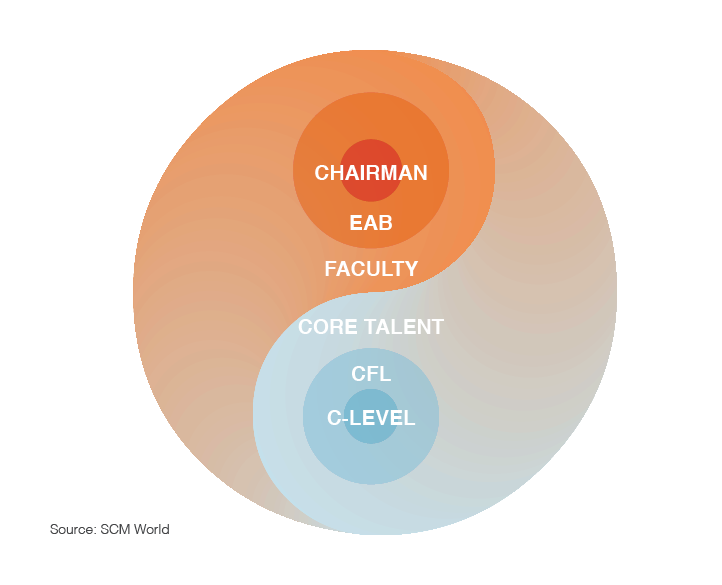
The great thing about this system is its dependence on practitioners doing both the teaching and the learning. This means lessons learned in one company help others to accelerate improvements in their own companies. It also forces supply chain people to sharpen their soft skills, which, according to SCM World survey results, are by far the biggest problem in the development of emerging leaders.
The yin-yang symbol conveys the idea that at the very peak of mastery it is the most basic question that sparks renewed learning.
The supply chain learning engine never stops.
Beyond Supply Chain
Subscribe on LinkedIn to receive the biweekly Beyond Supply Chain newsletter.