By Kevin O'Marah | July 15, 2016
CSCO Outlook for 2027: Cloudy With a Chance of Moderate Growth
October 09 2026


By Kevin O'Marah | July 15, 2016
This week, SCM World hosted 100 top supply chain executives at our sixth annual Leaders Forum in Dublin. The key takeaway for me was that operations and supply chain have become the most critical competitive playing field for companies across industries. Winning in the marketplace today is all about winning operationally.
Working smarter and harder
Strategy is a word derived from ancient Greek meaning ‘a plan of action designed to achieve a long term or overall aim’. Its historic use has been about how the deployment of resources with a calculated understanding of opponents’ tendencies can turn weakness into strength leading to victory. It explains how Genghis Khan conquered most of Eurasia, how Vince Lombardi’s Green Bay Packers transformed American football and how 300 Spartans nearly held off a million-strong army of invading Persians at Thermopylae.
In supply chain terms, it also explains how Jeff Bezos’ legendary flywheel model, scribbled on a cocktail napkin years ago, enabled a little bookselling e-commerce start-up to revolutionise the worlds of retail, logistics and consumer products. The true genius of this strategy was not just harnessing the power of happy customers but realising precisely where a maniacal focus on continuous improvement would pay off most handsomely.
For Amazon, this was in fulfilment.
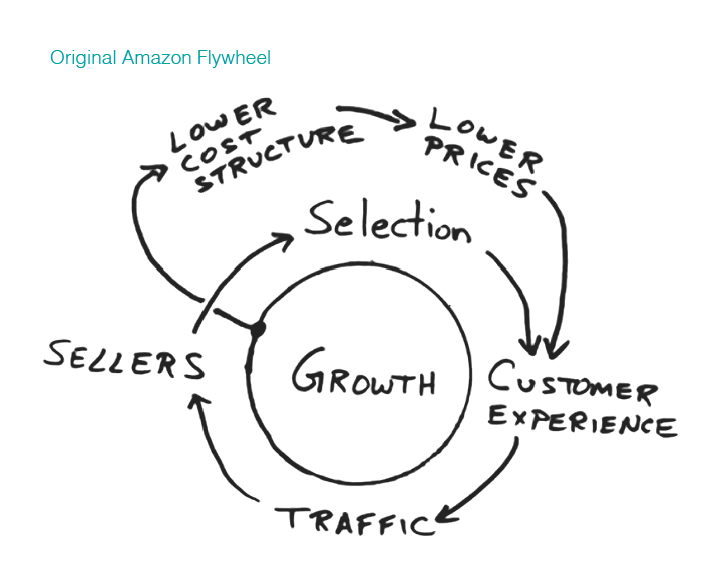
Amazon has clearly been working smarter than everyone else. But it is also working harder, attacking minute details in materials handling, order promising and last mile logistics at the frontier of both technology and the organisation of work. For those lucky enough to be in the room for Dave Clark’s presentation, it was obvious that this flywheel is still churning.
Weapons of war
Another big takeaway from this year’s Leaders Forum is the way that digital technology is changing the game. Data analytics, additive manufacturing, spatial awareness and Uberisation are not merely making supply chains more efficient. Rather they are changing what is possible, which means localised manufacturing, crowd-sourced logistics and predictive fulfilment are quickly moving from science fiction to structural fact.
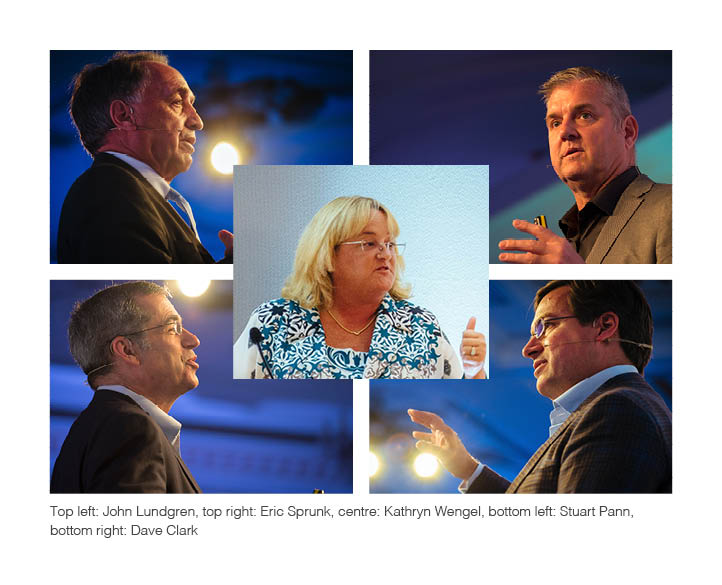
Amazing new ways to make and use shoes, medical devices and industrial equipment are now out of prototype phase and into production. The pace of learning is accelerating and knock-on effects in logistics network design, supplier collaboration and post-sale consumer engagement have already started to manifest in business. Those who saw the presentations of Kathy Wengel from Johnson & Johnson, Stuart Pann from HP and Eric Sprunk from Nike will attest that this new phase in supply chain innovation has definitely started.
We also heard TED-style talks from Mike Phillips of McLaren Applied Technologies, Rick Smith from Fast Radius and Mark Gordon of Wachtell, Lipton, Rosen & Katz, each of which offered a look over the horizon at how lateral thinking can impact supply chain strategy. Whether the angle is massive data simulation techniques drawn from Formula One racing, materials science and 3D printing advances or legal strategies for activist investor engagement, we are clearly no longer just trying to tune our S&OP process.
And yet, S&OP is still at the centre of it all.
A grand plan
Our opening keynote was delivered by John Lundgren, the CEO of Stanley Black & Decker, a company that has applied supply chain strategy beautifully to deliver fantastic financial results. John’s presentation laid out the workings of SFS 2.0, which builds on an earlier incarnation, known simply as ‘Stanley Fulfillment System’.
The elements of the original included:
In concert, these principles applied diligently under the leadership of a CEO who gets it, have driven excellent business results.
Now updated to exploit the digital revolution, SFS 2.0 extends core SFS but applies an integrated strategic logic to drive cost effectiveness, asset efficiency and outsized organic growth. For me, the most impressive thing was not just seeing a CEO comfortably talking supply chain, but that three of the five elements of his operational edge are growth rather than cost-oriented.
The operational edge today is about winning with offence, not just defence.
Beyond Supply Chain
Subscribe on LinkedIn to receive the biweekly Beyond Supply Chain newsletter.