By Kevin O'Marah | May 22, 2015
CSCO Outlook for 2027: Cloudy With a Chance of Moderate Growth
October 09 2026


By Kevin O'Marah | May 22, 2015
I wrote last year that the Supply Chain Top 25 was getting boring, and although I wouldn’t exactly call the 2015 edition a shocker, congratulations are in order for a return to relevance. Most important, we have a new number one with Apple retired alongside perennial leader Procter & Gamble. The list this year creates some fresh debates and stirs the pot just enough to revive interest.
It also shows the value of investing in talent, as 7 of the top 10 are SCM World members, including the new champion.
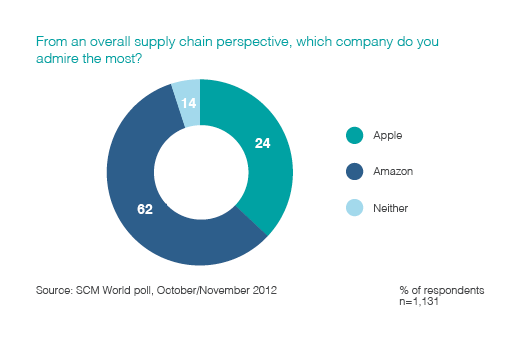
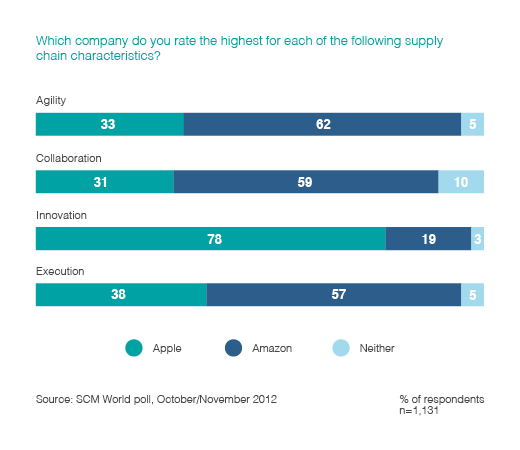
Amazon now sits atop the list, and justifiably so given its nearly single-handed role in blowing up retail and consumer supply chains. We ran a survey a couple of years back, in fact, and found that Amazon was more admired even than Apple, especially for its agility, execution and collaboration.
As an example to emulate, however, few can follow this leader. Its three-year return on assets is a generally unacceptable 0.0%. My guess is that the ultimate payback will never involve real margins on shipping physical product, but instead a digital supply chain tapping reflexive consumer buying habits to sell massive margin content products. This is why Amazon is producing original television, publishing books and generally stomping around the entertainment industry.
McDonald’s comes right behind Amazon with an aggregate score only fractionally lower despite negative three-year growth. It is true that McDonald’s innovations in supply chain management are astounding. Unfortunately, they are about 30 years old and not helping the company to do what it really must, which is to innovate. Menu shake-ups add SKU complexity and hurt service levels without giving customers any reason to visit in the first place.
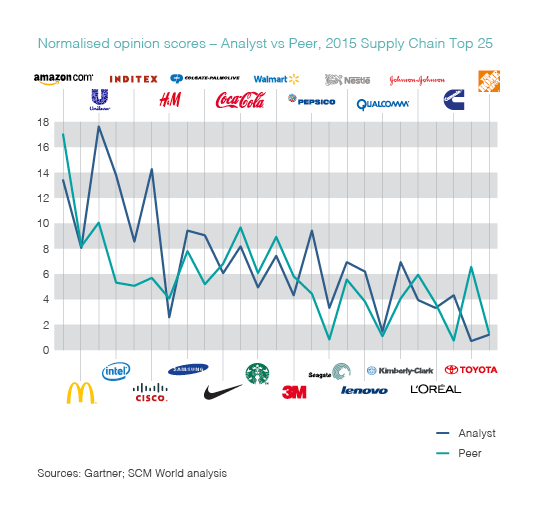
The next four on the list include three companies that are important contributors to the SCM World community learning engine. Normalised opinion scores show a clear “thank you” from analyst voters to Unilever, Intel and Cisco for this active public leadership. These three companies have been consistent and generous in sharing what they’ve learned with everyone else, and in my opinion well deserve the bump they get from the analysts.
In fairness, I still see too little respect shown to less glamorous, but clearly excellent supply chain organisations at companies like General Mills, Schneider Electric and Delphi, all of whom not only run great organisations, but also step up to the challenge of public leadership. These three were among the winners in SCM World’s Power of the Profession Awards (aka, the “Supply Chain Oscars”) this past February, which was based on a rigorous three-tier screening system involving hundreds of executives reviewing dozens of case studies submitted as nominations.
The retirement of Apple and Procter & Gamble was a good move – I said as much last year in this column when I proposed a hall of fame. But IBM should be in there too. Back in 2004 when the first Top 25 was released, IBM ranked fourth. The next three years saw the tech legend come third, fourth and fifth respectively. It has since faded into the background as its hardware business has shrunk.
This is no way to treat a legend. Not only is IBM the place where Tim Cook learned much of what made Apple great, but it is also the birthplace of this year’s 18th ranked Lenovo. It was among the first to extensively exploit high-velocity inventory management techniques in PC plants in Mexico in the mid-1990s. It was also one of the first large-scale efforts to use integrated product and process design for better new product development, which involved building a full-footprint product lifecycle management system from scratch.
IBM gave us too many good people and good ideas to be forgotten by the Supply Chain Top 25.
I left Gartner myself for SCM World a few years back because I saw so much potential for faster learning in the community-driven model. The Top 25 is back on track, but real expertise sits with the practitioner community, not the analysts.
Beyond Supply Chain
Subscribe on LinkedIn to receive the biweekly Beyond Supply Chain newsletter.